
 thecryptobasic.com
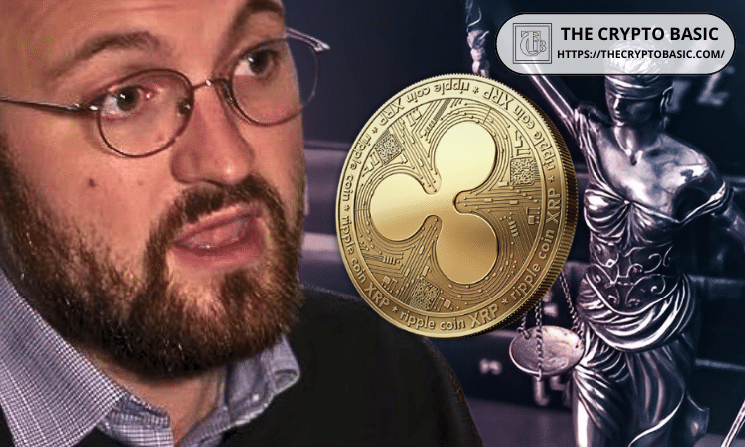
Cardano founder Charles Hoskinson contrasts Midnight ($NIGHT) with Ripple and $XRP, arguing that the two models differ fundamentally in how value is created and distributed.
Hoskinson made this known during a recent interview with Wendy O on “The O Show.” His commentary centers on ownership, token utility, and whether network growth directly benefits token holders.
Key Points
- Cardano founder Charles Hoskinson argues that Midnight ($NIGHT) and $XRP differ fundamentally in value creation and distribution.
- He argues Ripple uses $XRP sales to generate capital for external investments and acquisitions, but $XRP holders never benefit from this model.
- Hoskinson compares Ripple’s model to Tether’s, where value accrues mainly to a central entity.
- His comments have reignited tensions with the $XRP community, raising the prospect of renewed disputes with figures like Brad Garlinghouse.
$XRP Holders Don’t Benefit From Ripple’s Value Creation Model
Speaking in response to questions about $XRP’s recent momentum, Hoskinson acknowledged the token’s visibility but challenged the underlying structure supporting its growth.
He claimed that Ripple retains significant control over $XRP supply and uses the token as a mechanism to generate capital, which it then deploys into external ventures such as acquisitions and new business lines.
According to him, this model creates a disconnect between $XRP holders and Ripple’s broader financial success. While the company expands its footprint through moves like acquiring firms such as Hidden Road or launching new products, he argues that $XRP holders do not gain ownership rights or direct financial exposure to those developments.
He further pointed to the absence of staking or yield mechanisms as evidence that $XRP’s value proposition is not designed to redistribute returns to holders. Instead, he likened the structure to Tether, in which a centralized entity captures most of the economic upside while users primarily benefit from access to the network.
WATCH: Charles Hoskinson explains how Midnight and $NIGHT are "radically different" from Ripple and $XRP pic.twitter.com/i5H1Z8xDbF
— Wendy O (@CryptoWendyO) April 17, 2026
Midnight Is Radically Different
In contrast, Hoskinson described Midnight and its $NIGHT token as “radically different,” suggesting a model where tokenomics are more closely aligned with user participation.
For context, the Midnight Foundation allocated the total supply to users across eight blockchains, including Cardano and $XRP. However, only a few of these tokens were claimed by eligible beneficiaries who held at least $100 of the supported tokens on the snapshot date.
This differs from $XRP, where around 80% of the pre-mined 100 billion supply was distributed to Ripple.
Fresh Hostility Between Hoskinson and $XRP Community Looms
His recent commentary has reignited criticisms from some $XRP proponents who suggest that Hoskinson is merely obsessed with Ripple and $XRP. Both have been at loggerheads for several years, particularly during the peak of the Ripple lawsuit, but only resolved the differences after Donald Trump’s re-election.
Following the reconciliation, Hoskinson suggested several initiatives to mend fences, including supporting $XRP on the Lace wallet and $XRP DeFi.
However, the relationship between him and $XRP proponents began to deteriorate again after he accused Ripple CEO Brad Garlinghouse of supporting the Clarity bill that makes $XRP and other established tokens winners, while newer projects are automatically classed as securities.
His recent commentary about how $NIGHT differs from $XRP has reignited discussions that another lengthy dispute might be around the corner.