
How to Earn Interest on USDT in 2026: 5 Methods Compared
Quick answer
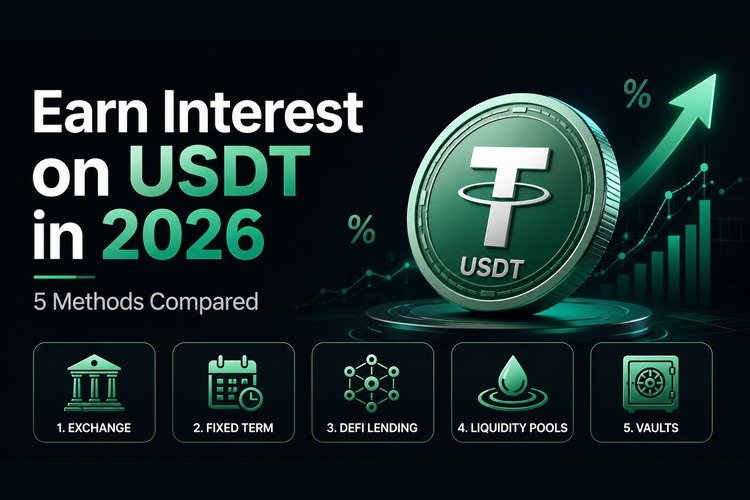
Yes, you can earn interest on USDT in 2026 through flexible exchange Earn products, fixed-term products, DeFi lending, stablecoin liquidity pools, and automated yield vaults. USDT generates no yield on its own; every method below puts USDT into a yield-generating product or strategy. The right choice depends on liquidity, yield source, custody, fees, and risk — not simply which platform advertises the highest annualized rate.
Key Takeaways
- USDT pays no native yield; returns come from a separate product or strategy.
- Headline rates may be variable, promotional, tiered, or limited to a specific balance.
- APR and APY are not interchangeable: compare like-for-like metrics or use annualized yield/rate when discussing products collectively.
- Aave and Compound publish variable USDT lending rates that respond to market conditions and utilization.
- Liquidity pools and vaults may offer higher yields, but can add smart-contract, depeg, liquidity, incentive-token, and strategy risk.
- Always verify current rates, limits, fees, withdrawal rules, and local tax treatment before depositing.
What Are the Best Ways to Earn Interest on USDT in 2026?
There is no universally best method. A flexible exchange product prioritizes convenience, while DeFi lending provides greater on-chain transparency. Liquidity pools and vaults add more yield sources but also more complexity.

Know when your
coins move
Alerts, real-time prices, and market news — all in one app
 Point your phone camera to install
 4.8 based on 40K reviews in the App Store and Google Play


| Method | How Yield Is Generated | Typical Liquidity | Return Potential | Main Risks | Best For |
|---|---|---|---|---|---|
| Flexible CEX Earn | Platform lending, treasury strategies and/or incentives | High | Low–medium | Exchange/counterparty risk | Beginners, active traders |
| Fixed-term CEX Earn | Platform lending/treasury strategies and/or promotional incentives | Low–medium | Medium | Exchange + lockup risk | Holders with predictable liquidity needs |
| DeFi lending | Interest paid by on-chain borrowers | High | Low–medium | Smart-contract, utilization, network risk | DeFi users prioritizing transparency |
| Stablecoin liquidity pools | Trading fees + token incentives | Medium–high | Medium | Depeg, liquidity, smart-contract risk | Experienced DeFi users |
| Yield vaults | Automated lending, LP, or farming strategies | Varies | Medium–high | Strategy + protocol-stack risk | Advanced yield seekers |
Read more: 5 Best Crypto & Bitcoin Loan Platforms: Security, Fast Verification & Funding
1. Flexible Exchange Earn — Simple Access to USDT Yield
Flexible exchange Earn products are among the simplest ways to put idle USDT to work. Users deposit or hold USDT on a centralized platform, while the platform handles the underlying yield mechanism. Depending on the product, returns may come from lending, treasury strategies, promotional incentives, or other platform activities.
MEXC is one example. Users looking to earn interest on USDT can compare its flexible Earn options with alternatives based on current estimated rates, balance limits, liquidity, and eligibility. As of August 2026, the campaign brief for MEXC Earn Plus lists a 7% base Est. APR. This should be treated as a current estimate rather than a fixed long-term return: MEXC's official Earn materials state that APRs and applicable limits may be adjusted dynamically according to market conditions and platform rules.
The main benefit is convenience and flexible access, without having to manage DeFi wallets or gas fees. The trade-off is custody: funds held on an exchange are exposed to platform and counterparty risk. Users should also distinguish base rates from boosted or promotional rates before comparing offers.
2. Fixed-Term Earn — More Yield in Exchange for Less Liquidity
Fixed-term products require users to commit USDT for a defined period, such as 30, 60, or 90 days, for which those terms are offered. The annualized rate may be fixed or specified when the user subscribes, although terms vary between platforms.
The decision comes down to whether the additional return compensates for reduced access to the funds.
For example, is an extra 1–2 percentage points of annualized yield worth losing access to $10,000 in USDT for 90 days? If you may need the funds early, the additional yield may not compensate for the loss of liquidity.
Fixed-term products can therefore suit users with predictable holding periods, but they still carry centralized exchange risk in addition to lockup or early-redemption restrictions.
3. DeFi Lending — Transparent Rates Without Centralized Exchange Custody
DeFi lending lets users supply USDT to smart-contract money markets where borrowers pay interest to suppliers. Rates generally move with market utilization: higher borrowing demand can raise supplier returns, while lower utilization can reduce them.
Aave and Compound are two established examples. Instead of using a static figure that may become outdated quickly, readers should check each protocol's live interface before depositing. Aave reports its return as Supply APY, while Compound reports Net Earn APR, so their displayed percentages should not be compared as though APR and APY were identical. Their current interfaces illustrate how these USDT rates can differ and change over time.
DeFi lending lets users interact through their own wallet without handing custody to a centralized exchange. However, supplied assets are placed into protocol smart contracts, introducing smart-contract, governance, liquidity, network, and wallet-management risks. Gas and bridging costs can also reduce net returns.
4. Stablecoin Liquidity Pools — Trading Fees With Additional Risks
Stablecoin liquidity pools generate returns primarily from swap fees and, in some cases, additional token incentives. A USDT/USDC-style pool on a DEX such as Curve illustrates the model: liquidity providers supply assets that traders use for swaps and receive a share of the resulting fees.
Price divergence is generally smaller while both stablecoins maintain their pegs, but losses can become significant if one asset depegs. A pool may become increasingly exposed to the weaker stablecoin as traders exchange out of it.
Returns also vary substantially with trading volume, fee levels, incentives, chain, and market conditions, so historical pool yields should not be presented as a reliable future range.
The benefit is access to multiple yield sources. The trade-off is additional complexity: even when price divergence is limited under normal conditions, smart-contract, liquidity, incentive-token, and depeg risks remain.
5. USDT Yield Vaults — Automated Strategies With Layered Risk
Yield vaults automate strategies that would otherwise require several manual transactions. A vault may deposit funds into lending markets, liquidity pools, or farms, harvest rewards, and automatically compound the proceeds.
Platforms such as Yearn and Beefy illustrate this approach. Automation can reduce operational effort, but it does not make the strategy inherently safer. Beefy's documentation, for example, describes vaults and strategy contracts that route deposits into underlying DeFi protocols and explicitly recognizes risks associated with smart contracts and the platforms used by a strategy.
A vault can therefore create several dependencies:
USDT → vault → strategy → underlying protocol → liquidity pool or other assets
The advantage is automated strategy execution and compounding. The downside is that users must evaluate not only the vault itself but also every underlying protocol and asset on which the strategy depends.
Which USDT Yield Method Fits Your Situation?
Rather than choosing based on the highest displayed rate, start with how and when you expect to use your USDT.
- Need access to funds regularly: A flexible CEX Earn product or liquid DeFi lending market may be more suitable because withdrawals are generally easier.
- Know you will hold for several months: Compare fixed-term and flexible annualized rates, then determine whether the extra return compensates for reduced liquidity.
- Prefer on-chain transparency: Aave, Compound, or another established lending protocol allows users to interact through their own wallet, but adds smart-contract and network risk.
- Understand advanced DeFi: Stablecoin pools or vaults may provide additional yield sources, but users should identify exactly where those returns come from before depositing.
The key principle is simple: additional yield should be evaluated alongside the additional risk, restrictions, and complexity required to earn it.
How to Choose a USDT Yield Option
Before putting USDT into any product, ask six questions:
- Where does the yield come from? Borrowers, trading fees, incentives, treasury strategies, or platform subsidies?
- What metric is being advertised? APR, APY, Est. APR, or an “up to” promotional rate?
- Can the USDT be withdrawn immediately?
- Which fees reduce the net return? Consider withdrawal, network, trading, bridging, management, or performance fees.
- Where are the assets held? On a centralized exchange or inside one or more smart contracts?
- What could cause principal loss? Platform failure, smart-contract exploits, stablecoin depegs, liquidity problems, or strategy failures?
Remember that holding USDT already involves issuer and stablecoin depeg risk. A yield product adds another layer of risk rather than removing the underlying USDT exposure.
Bottom Line: The Highest USDT Yield Isn't Necessarily the Best Option
Flexible exchange Earn products prioritize simplicity. Fixed-term products trade liquidity for potentially better rates. DeFi lending offers transparent on-chain markets, while liquidity pools add trading-fee opportunities. Vaults automate more sophisticated strategies but introduce additional dependencies.
Compare net yield, yield source, liquidity, fees, custody, and downside risk rather than headline APR or APY alone. Because rates and product terms can change quickly, verify the current figures immediately before depositing.
FAQ
Can you earn interest on USDT?
Yes, through Earn products, lending, liquidity pools, or DeFi — not by simply holding USDT.
What’s a realistic USDT return in 2026?
Rates vary by platform, product, market conditions, and incentives. Compare current APR/APY and terms rather than relying on one benchmark.
Is USDT yield safe?
No yield is risk-free. Risks include platform/counterparty, smart-contract, liquidity, and stablecoin depeg risks. Higher yields usually mean higher risk.
DeFi or centralized exchange?
Neither is universally better. Centralized Earn is simpler but requires custody trust; DeFi offers on-chain transparency but adds smart-contract and operational risks.
Do I pay tax on USDT yield?
It depends on your jurisdiction and the product. Check local tax rules or consult a tax professional.