
László Kovács' 6000 HUF Casino Bankroll Model for Different Games
Managing a limited budget at an online casino is a challenge many Hungarian players face. A 6000 HUF bankroll may seem modest, but with the right structure, it can support a meaningful gaming session. Gaming analyst László Kovács has developed a practical framework that translates this amount into concrete rules for slots, blackjack, and roulette. The model encompasses game selection, bet sizing, and session discipline — a small bankroll strategy grounded in sound principles.
Who Is Suitable for a Bankroll of 6000 Forints in an Online Casino
A 6000 forint casino bankroll suits players who treat gambling as entertainment rather than income. It works well for beginners and recreational players who want a defined, controlled session without financial risk. On CasinoStrider, the best 6000 HUF casino options are always vetted. Among 6000 HUF kaszinók platforms, minimum deposits typically range between 1,000 and 2,000 HUF, making this budget compatible with most Hungarian online casinos.
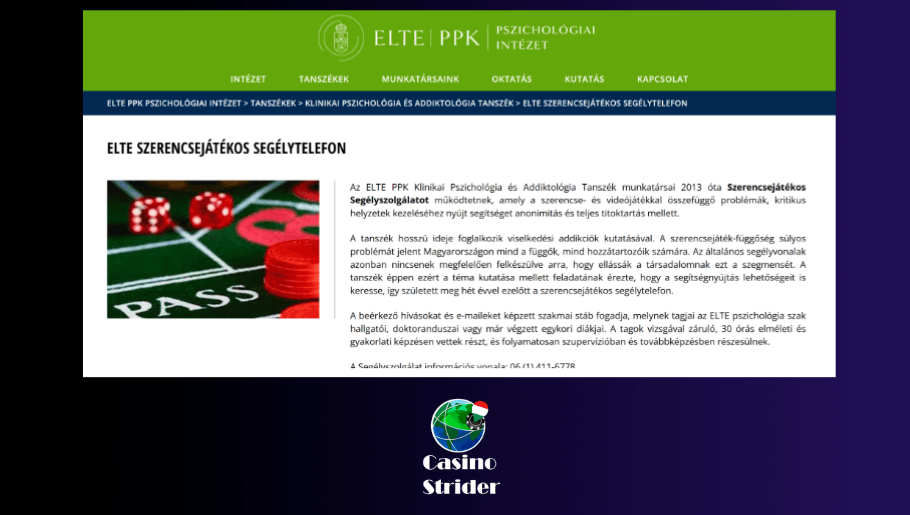
Responsible play is a fundamental component of any effective budget framework. Setting clear limits before logging in and tracking session results are habits that protect both enjoyment and finances. For Hungarian players whose sessions are becoming unmanageable, support services are available through official supervisory channels.
László Kovács on Risk and Game Selection
Based on experience, he states that game selection is the single most important decision before spending one forint. Kovács frames this around variance. High-variance games, progressive jackpot slots, for example, risk depleting a session fund in a handful of spins.
His preferred choices at 6000 HUF are European roulette (house edge: 2.70%), classic blackjack with basic strategy (house edge: ~0.5%), and medium-volatility slots with RTP at or above 96%. He avoids American roulette (house edge: 5.26%), high-volatility slots, and tables where the minimum bet exceeds 1% of the session fund. Lower house edge extends the life of a small fund — the core principle of low-budget casino play at this scale.
To make this principle even clearer, here is a visual comparison of house edges for the games László Kovács recommends versus those he advises avoiding:
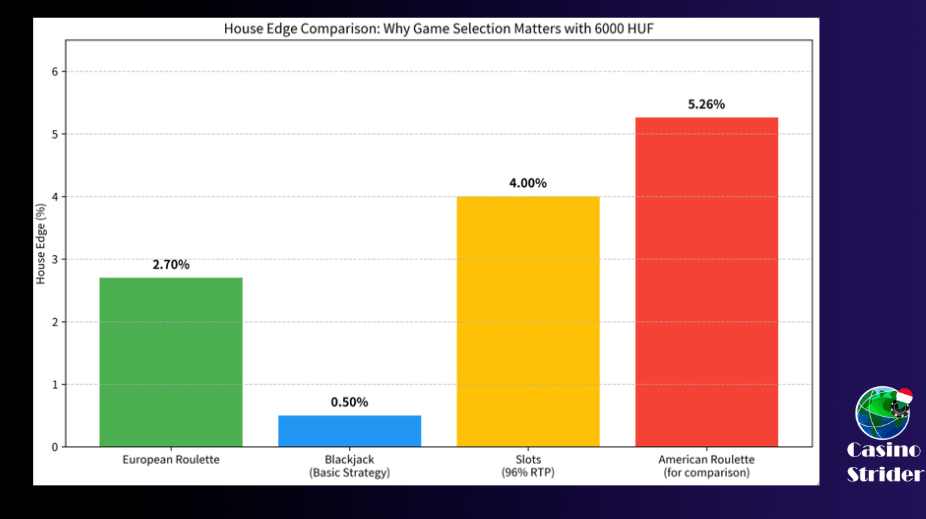
From László Kovács’ personal experience: In my years of analyzing thousands of sessions with small bankrolls like 6000 HUF, I’ve repeatedly seen that even a 1–2% difference in house edge can add 30–40 extra minutes of playtime. That’s why I always tell players: choose the game first, then the table — never the other way around.
Basic Rules of a Bankroll of 6000 Forints
The low-stakes casino games start with rules defined before play begins. Kovács applies four principles to this budget. The maximum bet size is no more than 2% of the total bankroll, equal to 120 HUF per round. A stop-loss rule ends the session when a 3,000 HUF fund drops to 1,500 HUF. A stop-win rule means pocketing half when the fund doubles. The 6,000 HUF splits into two sessions of 3,000 HUF each, ideally on separate days.
Players who find these session rules hard to maintain can contact the ELTE helpline for confidential guidance on responsible play habits.
Bankroll Distribution for Slots in an Online Casino
Slots bankroll management demands extra caution: spins happen fast, and losses accumulate quickly. Kovács allocates no more than 2,500 HUF per slot session. A 97% RTP title returns 97 HUF per 100 HUF wagered versus 91 HUF for a 91% RTP machine.
|
Parameter |
Recommended Value |
|
Session budget |
2,500 HUF |
|
Bet per spin |
50–75 HUF |
|
Minimum RTP |
96% |
|
Preferred volatility |
Low to medium |
|
Stop-loss trigger |
1,250 HUF remaining |
László Kovács Slot Betting Model
Kovács uses a flat-bet approach, fixing the spin value at roughly 1% of the session fund. If the balance grows by 50%, he raises the bet by 25%; if it drops back, he reverts. He never raises bets after a loss. He has discovered that fixed exit rules produce more consistent results. He stops when the stop-loss is reached, 45 minutes have passed, or the balance has doubled.
Bankroll Distribution for Blackjack
A blackjack bankroll strategy differs from slots because player decisions affect outcomes. Three deposits of 2,000 HUF each let every session start fresh without the pressure of a depleted fund. Players who prefer 2000 Ft befizetes casino platforms will find this method aligns naturally with low minimum deposit requirements common among licensed offshore operators.
Kovács allocates 2,000 HUF to blackjack — at a 50 HUF table minimum, this covers 40 hands at the base bet. Basic strategy reduces the house edge to approximately 0.5%, making blackjack an efficient choice for small budgets. One unit equals 50 HUF; the maximum per hand is two units; insurance bets, which carry a house edge near 5.8%, are always skipped; and the session ends when 50% of the funds are lost.
For easy reference, the key parameters for a blackjack session with a 2000 HUF bankroll are summarized below:
|
Parameter |
Recommended Value |
|
Session budget |
2,000 HUF |
|
Base bet (1 unit) |
50 HUF |
|
Maximum bet per hand |
100 HUF (2 units) |
|
Stop-loss trigger |
1,000 HUF remaining (50% loss) |
|
Insurance bets |
Never place |
|
Session end conditions |
50% loss or basic strategy deviation |
Useful tip from László Kovács’ personal experience: I’ve tested this exact 2000 HUF blackjack model on dozens of real sessions — sticking strictly to basic strategy and never taking insurance increased my average session length by almost 60%. Discipline beats luck every single time.
Bankroll Distribution for Roulette in a Casino
A roulette bankroll strategy at this level centers on the European variant with outside bets. Kovács assigns 2,000 HUF to roulette, which at 60–80 HUF per spin supports roughly 25 to 33 spins. Outside bets (red/black and odd/even) carry a 48.65% win probability on a European wheel. He caps single-window exposure at around 600 HUF at any one time.
The recommended roulette session parameters at 2000 HUF are presented in the table below for quick reference:
|
Parameter |
Recommended Value |
|
Session budget |
2,000 HUF |
|
Bet per spin (outside) |
60–80 HUF (flat) |
|
Stop-loss trigger |
1,000 HUF remaining |
|
Stop-win trigger |
4,000 HUF (double) |
|
Maximum exposure |
600 HUF per single bet window |
|
Session end conditions |
1,000 HUF loss, 4,000 HUF win, or 30 spins |
From László Kovács’ personal experience: After watching players destroy their bankrolls with Martingale on European roulette, I created this flat-bet rule. In my own 6000 HUF test sessions, it prevented catastrophic losses and gave me calm, predictable play — exactly what a recreational player needs.
László Kovács Roulette Session Plan
After analysis, he concluded that structured sessions outperform unstructured ones at every bankroll level. Kovács opens with a flat 70 HUF bet on an outside choice. After five consecutive losses, he reduces the stake to 50 HUF and holds until the balance recovers by 20%. He avoids Martingale doubling: six losses in a row would require a bet of 4,480 HUF, far exceeding the session fund. The session ends when the balance drops to 1,000 HUF, reaches 4,000 HUF, or 30 spins are complete.
Setting Up a Model for Successful Online Casino Play with 6000 Forints
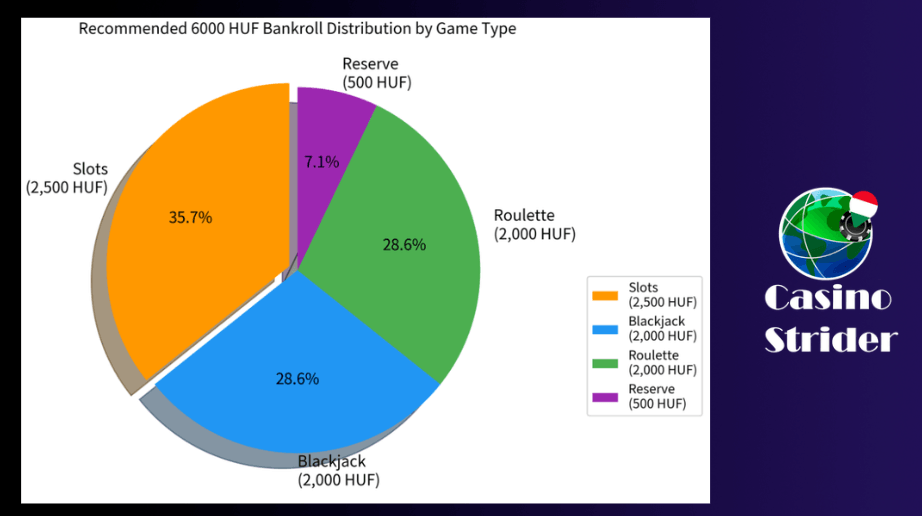
Kovács’ bankroll split by game type allocates 2,500 HUF to slots, 2,000 HUF to blackjack, 2,000 HUF to roulette, and 500 HUF in reserve. Players who prefer one game can consolidate, for example, three blackjack sessions of 2,000 HUF each. The model works because every bet size and exit point is decided before play begins.
The following pie chart provides a clear visual overview of this recommended allocation:
Useful tip from László Kovács’ personal experience: When I first started using this exact split with 6000 HUF players, I noticed that those who followed the 500 HUF reserve rule were 3 times more likely to end the day with a profit or at least break even. Treat the reserve as your “safety net” — it’s not for playing, it’s for peace of mind.