
 coindesk.com
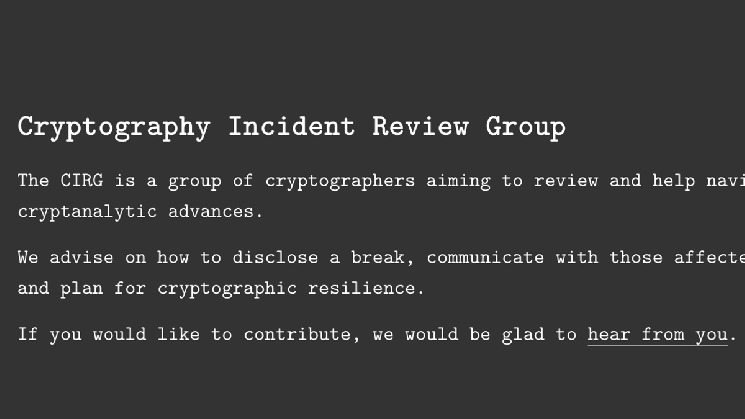
A group of 21 prominent cryptographers has formed an organization to review advances in code-breaking research and advise on how to disclose security weaknesses, as speculation grows that artificial intelligence labs may have made breakthroughs capable of undermining widely used encryption.
The Cryptography Incident Review Group, or CIRG, includes Stanford University's Dan Boneh, Johns Hopkins University's Matthew Green and MIT researchers Yael Tauman Kalai and Vinod Vaikuntanathan.
"We advise on how to disclose a break, communicate with those affected, and plan for cryptographic resilience," the group said on its website.
Vaikuntanathan, in a Sunday post on X, cautioned against accepting unverified claims about AI's ability to break cryptographic systems.
"There's lately been a steady stream of speculation on social media about AI labs breaking cryptography. Some are blown up, others flat out wrong," he wrote.
He called for researchers to use advanced AI models to test existing cryptographic systems before attackers discover vulnerabilities. He also urged investment in new cryptographic methods and backup systems that could be deployed if current defenses fail.
"Have Plan B and Plan C ready before Plan A breaks," he wrote.
CIRG's website lists a forthcoming statement but provides no details about its contents or publication date. It does not identify any compromised encryption system or connect its formation to a particular discovery by an AI laboratory.
Rumor mill
The group's formation comes after days of online speculation that AI researchers have discovered new methods of breaking cryptographic systems.
The initiative attracted widespread attention Sunday after Steve Weis, an Anthropic software engineer who works on cryptography and security, shared the group's website on X.
Weis later clarified in a separate post that the review group is independent of Anthropic and that his original post was not intended as an announcement.
"To be clear, this is an independent review group for cryptography work, not an Anthropic group. My post should not be taken as any sort of announcement or intentional vague post. I like the group's goal and shared it. I should have added this context," he said.
The speculation has centered on whether AI researchers have found more efficient ways to solve the mathematical problems underlying widely used encryption systems, including RSA, as well as the digital signatures that protect cryptocurrency transactions.
No such practical breakthrough has been publicly established. However, the rumors have gained traction amid a series of AI-assisted mathematical breakthroughs, including a claimed solution to the 167-year-old Riemann hypothesis, one of the most famous problems in mathematics. On Nov. 20, Anthropic mathematician Levent Alpöge announced that he and Claude had developed a proof of the hypothesis, which concerns the distribution of prime numbers.



