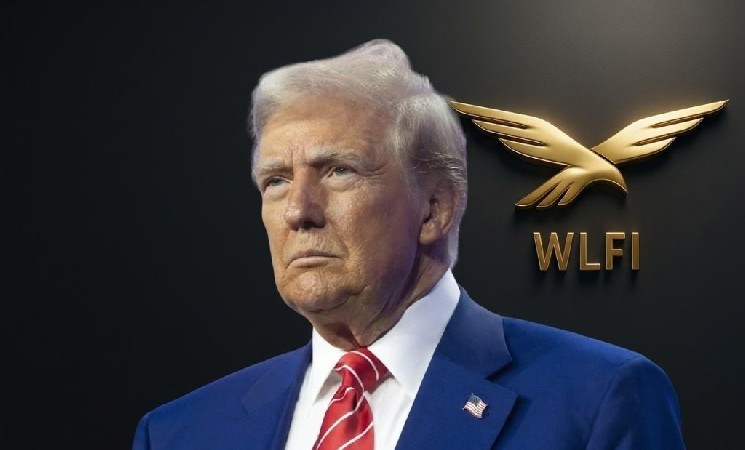
Potential Conflict of Interest Discussed at World Liberty Financial
In April, World Liberty Financial borrowed various assets, including its own stablecoin $USD1, using its governance token $WLFI as collateral on the decentralized finance platform Dolomite.
On Saturday, a cryptocurrency wallet withdrew $24.6 million $USD1 via Dolomite, significantly depleting the liquidity available for other investors to withdraw.
Some market observers attributed the loss of $USD1’s dollar peg to investors withdrawing funds from the platform due to concerns about uncollectible debt. It was also alleged that a separate $60 million cyclical borrowing position existed on the platform, where $USD1 was used as collateral to borrow more $USD1.
The fact that Corey Caplan, World Liberty Financial’s director of technology, is also one of Dolomite’s co-founders has raised potential conflicts of interest.
These developments have raised questions about how World Liberty Financial managed this relationship and whether BitGo, the issuer of $USD1, had adequate risk management mechanisms in place.
Could US Regulators Intervene?
BitGo is the current authorized issuer of $USD1, while World Liberty Financial and its affiliates generate revenue from the stablecoin, control the $USD1 brand, and provide various services to the project.
World Liberty Financial plans to take over the issuance of $USD1 from BitGo, provided it receives final approval from the US Office of the Comptroller of the Currency (OCC).
The final regulation prepared by the OCC under the GENIUS Act, which is stated to come into effect on January 18, 2027, will require authorized stablecoin issuers to ensure that transactions with related parties do not pose a significant risk of financial loss.
Whether World Liberty Financial can be considered an affiliate of BitGo is a separate legal debate. Controlling the $USD1 brand or sharing in stablecoin revenues alone is not sufficient to establish such a relationship.
On the other hand, the regulation will also require stablecoin issuers to oversee the service providers they work with. The fact that World Liberty Financial has not publicly disclosed in detail which services it provides for $USD1 creates uncertainty regarding the parties’ responsibilities in risk management.
Jump Turned the Crypto Crisis into an Opportunity
According to data from the onchain analytics platform Lookonchain, Jump Crypto purchased $USD1 tokens, which had lost their dollar peg, at discounted prices from cryptocurrency exchanges and redeemed them for $1 via BitGo. The company reportedly withdrew approximately 43.26 million $USD1 tokens in about an hour.
On the other hand, TRON founder Justin Sun accused World Liberty Financial of investor fraud and called on cryptocurrency exchanges to delist $WLFI and $USD1. A legal dispute is already ongoing between Sun and World Liberty Financial.
World Liberty Financial announced that it sold a portion of its Ethereum holdings to reduce debt, that it did not conduct any $WLFI sales, and that its $USD1 reserves were not at risk.
The company also announced that Binance automatically closed both long and short positions in the $WLFI futures market. Binance stated that it is reviewing the transactions.
According to the data, over $15 million worth of leveraged $WLFI positions were liquidated in the last 24 hours. The majority of these liquidations were from investors who had taken positions expecting the price to rise.
It was also noted that World Liberty Financial’s website no longer lists members of the project team. However, the names of members of the Trump family, the Witkoff family, Zak Folkman, and Chase Herro continue to appear in the project’s technical document, known as the Gold Paper.
According to reports, BitGo, regulators, and members of the Trump family have yet to make a public statement regarding the latest developments. It also remains unclear exactly what triggered the sudden sell-off on Binance.
*This is not investment advice.

 en.bitcoinsistemi.com