
 news.bitcoin.com

Bolivia’s anti-drug czar, Ernesto Justiniano, and the director of the Bolivian Special Anti-Narcotics Force (FELCN), Frans William Cabrera Quispe, met with DEA officials to organize collaboration efforts. The focus of this action would be to probe the cryptocurrency money laundering networks of Sebastian Marset.
-
Key Takeaways:
- Bolivian officials met with the U.S. DEA to probe Sebastian Marset, captured March 13, for crypto money laundering.
- Chainalysis reports that global crypto money laundering surged 8x since 2020, reaching a massive $82B in 2025.
- The DEA and Bolivian Police will investigate companies receiving illicit crypto to track Marset’s crime network.
Bolivian Officials Meet With US DEA to Tackle Drug-Linked Crypto Money Laundering
World regulators are strengthening their integration and collaboration to tackle the use of cryptocurrency for illicit purposes, such as drug-related money laundering.
On Tuesday, Bolivia’s anti-drug czar, Ernesto Justiniano, and the director of the Bolivian Special Anti-Narcotics Force (FELCN), Frans William Cabrera Quispe, traveled to Washington and met with the U.S. Drug Enforcement Administration (DEA) to strengthen the cooperation of both countries in the fight against drug trafficking and criminal organizations involved with these groups.
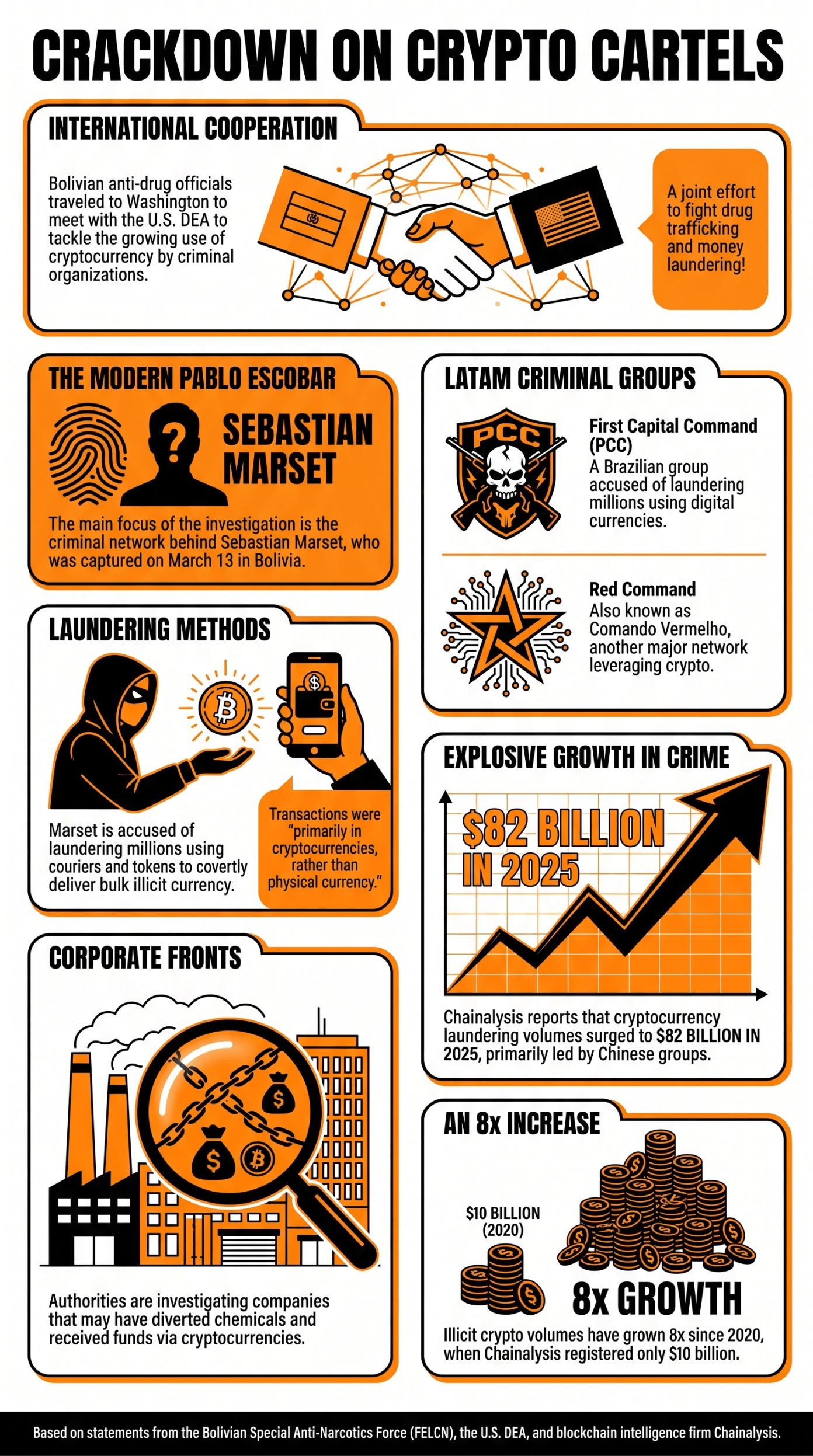
The main focus of this travel would be to coordinate an investigation into the criminal networks behind Sebastian Marset, called the modern Pablo Escobar, who was captured on March 13 in Bolivia, in addition to other criminal drug groups that operate in Latam. Among these are the First Capital Command (PCC) and the Red Command (Comando Vermelho), two Brazilian groups that have been accused of laundering millions using digital currencies.
Marset, currently under U.S. custody, is being accused of laundering millions using “couriers and tokens to covertly deliver bulk illicit currency, typically in euros,” according to an unsealed indictment.
Talking to local media, Justiniano stated that, in addition to the funds coming from the sale of these narcotics, they were “also looking into the matter of companies that may have been diverting chemicals” and “money laundering—specifically, companies that have received funds via cryptocurrencies.”
Mirko Sokol, General Commander of the Bolivian Police, stressed that intelligence indicated that Marset carried out transactions “primarily in cryptocurrencies, rather than in physical currency,” and the investigations are following this lead.
Cryptocurrency money laundering has been on the rise, with investigators sounding the alarm about the rising use of crypto assets for these illicit activities. Chainalysis, a blockchain intelligence firm, stated that cryptocurrency laundering volumes rose to $82 billion in 2025, with Chinese groups at the helm.
Volumes have grown 8x since 2020, when Chainalysis registered only $10 billion.