
 coindesk.com

By the end of this quarter, ether.fi will have cut the last structural link between its staking tokens and restaking protocol EigenLayer. Protocol documentation put under 1% of assets still restaked as of August with EigenPod withdrawal credentials due to be removed by the end of the year.
When ether.fi launched in 2024, deposits were restaked on EigenLayer automatically. In August the company stripped restaking out of weETH, the version of its token that circulates and is accepted as collateral across DeFi, leaving it as a plain liquid staking token. Anyone who still wants restaking has to opt into a separate token built on Symbiotic, a rival platform.
Mike Silagadze, ether.fi's chief executive, said the decision came down to risk. "There were no meaningful yield opportunities in restaking and there was some perceived risk from stakers, so we decided it made sense to exit," he told CoinDesk.
What restaking was meant to be
Staking means locking up $ETH to help secure Ethereum, in return for a yield. Restaking was the idea that the same locked $ETH could do a second job: EigenLayer would rent that security out to other services, such as oracles and data availability layers, which would pay for the protection. Depositors would earn twice on one pot of money. Liquid restaking tokens sat on top of that, giving depositors a tradable receipt that they could sell or use as collateral elsewhere rather than locking their $ETH away and waiting. weETH was the largest of them.
EigenLayer held $19.7 billion at its peak and liquid restaking tokens grew more than 1,000% in the first six weeks of 2024. But the services buying security never paid enough to cover both the base staking yield and a premium on top, so the second yield restaking promised never materialized.
On Sept. 8, DefiLlama's restaking category held $10.02 billion and generated $99,977 in fees over the prior week. The liquid staking category, on $51.87 billion, generated $27.35 million. Per dollar secured, ordinary staking earns roughly 53 times more.
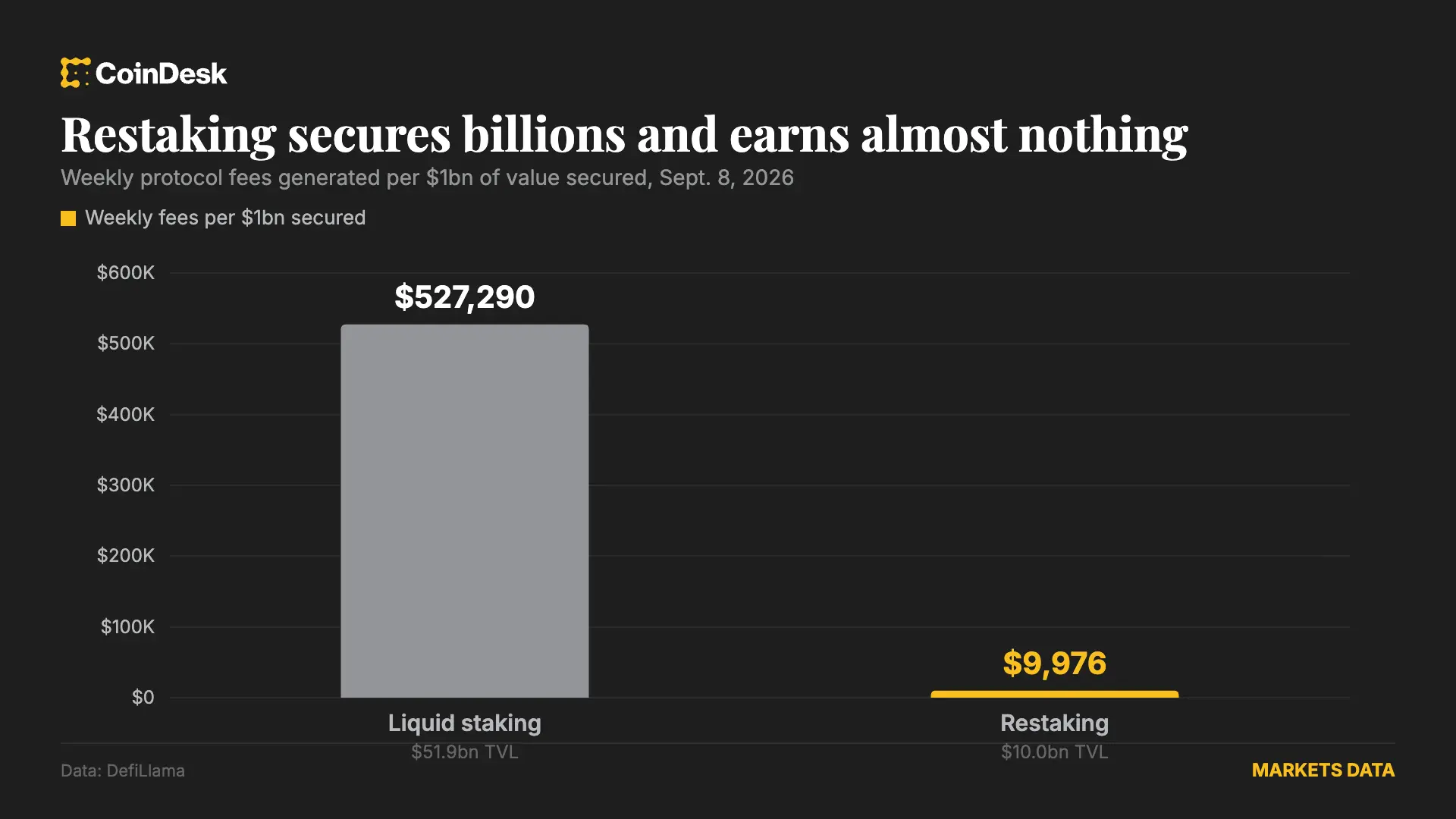
Two developments then removed what was left of the incentive to restake. Points programs subsidizing deposits wound down through 2025, and slashing went live in April 2025. Slashing is the penalty that confiscates part of an operator's staked $ETH when it misbehaves, by going offline or signing conflicting messages, for example. So restaking suddenly carried a real, priced downside where before the risk had been theoretical. There was no extra yield to compensate.
Set ether.fi aside and the rest of the sector is small. Renzo, Kelp, Swell, Puffer Finance and Bedrock, the five largest remaining liquid restaking tokens, made $953,350 in combined gross profit in the second quarter of 2026. Three quarters earlier the same five made $2.18 million. Puffer, which raised $23 million, recorded $21,590 for the quarter. Swell recorded $22,370.
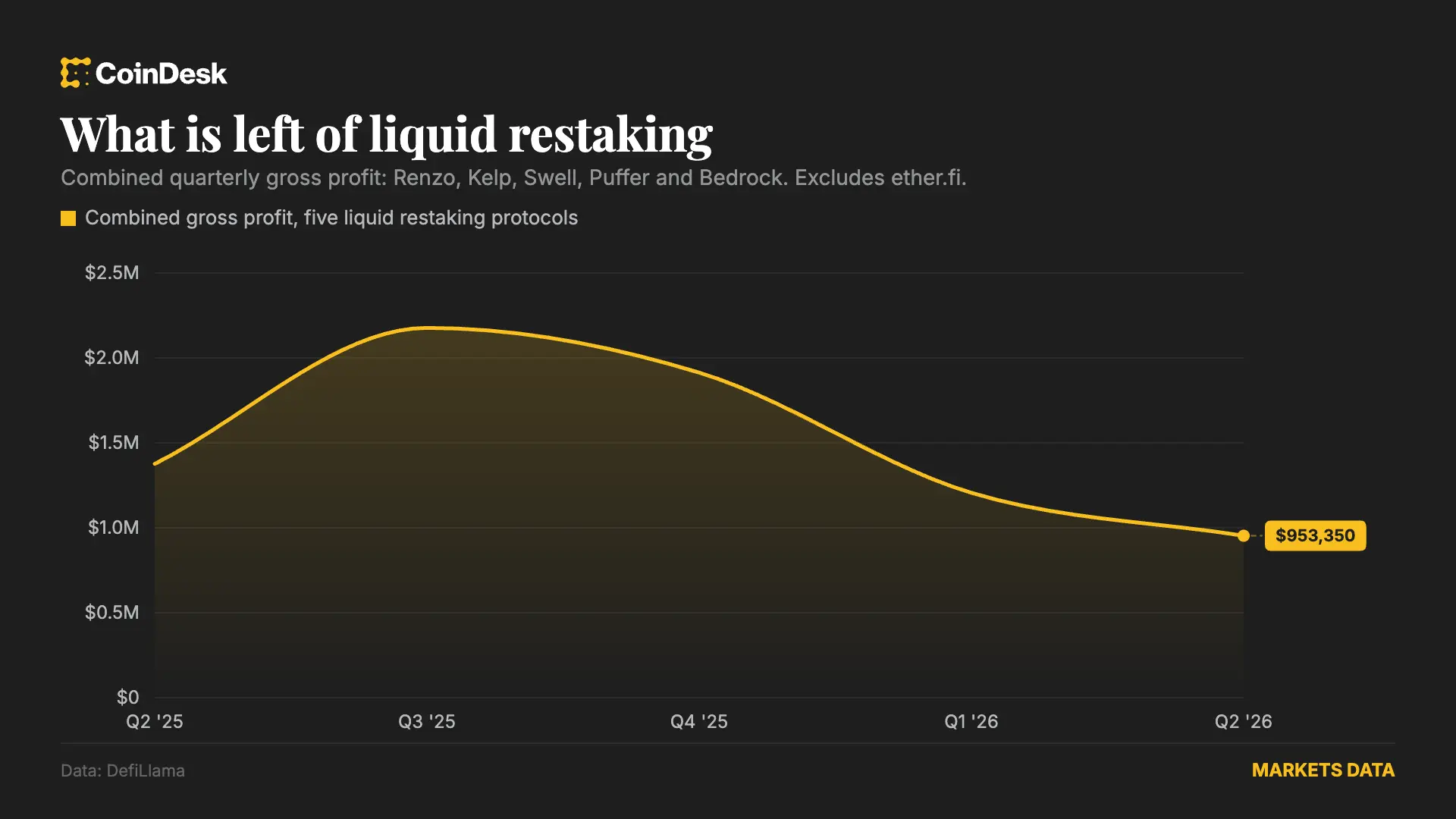
The income statements also show which part of these businesses was ever profitable, and it was not the restaking. On Kelp's books, EIGEN token rewards appear at $460,600 in gross revenue and $460,600 in cost of revenue: they arrive and pass straight to depositors, leaving nothing with the protocol. Puffer and Swell book staking rewards the same way. Whatever profit these companies made came from the orinary staking fees charged underneath the restaking layer.



