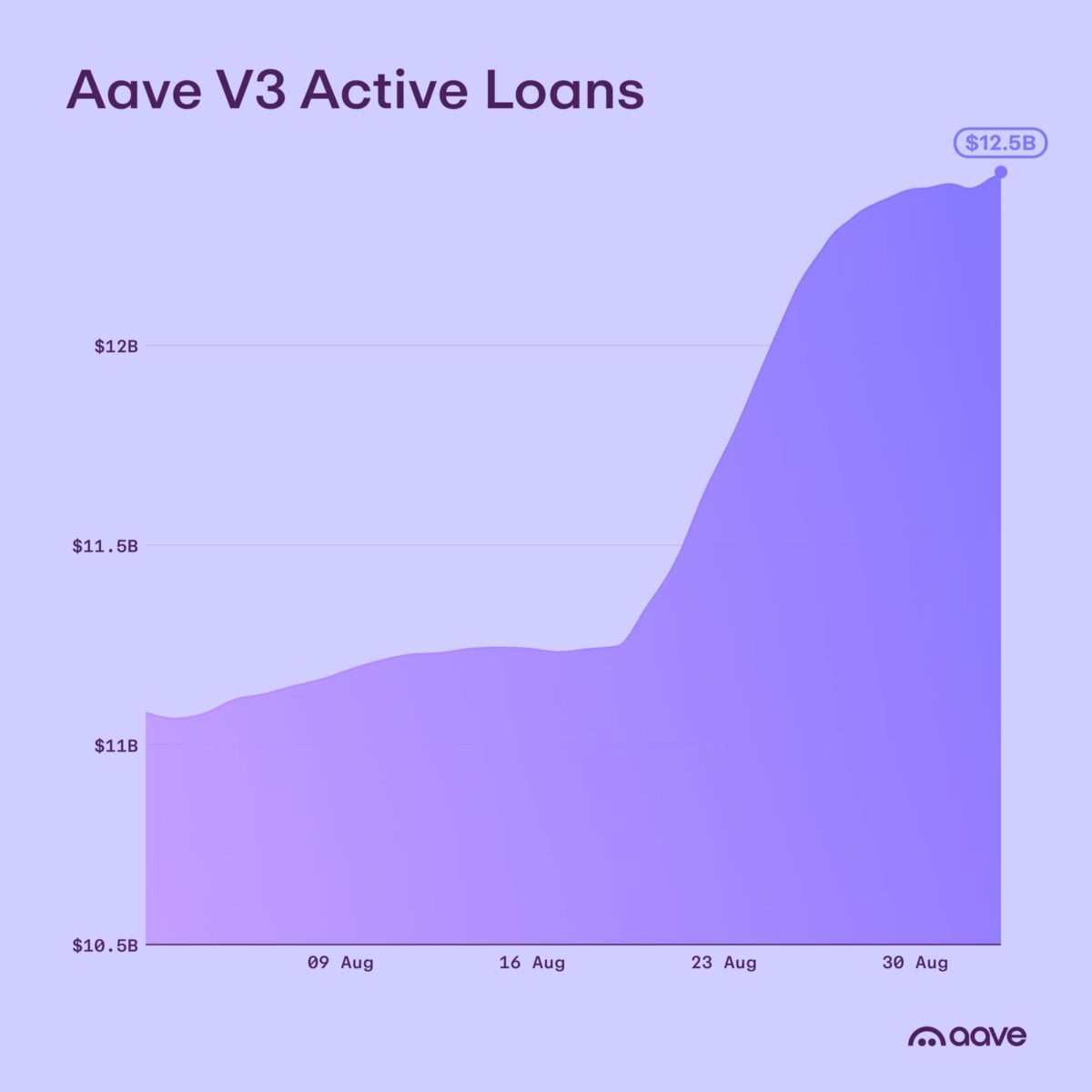
Aave’s August surge suggested that DeFi borrowers were returning at scale, rather than rotating between smaller lenders.
Its active loans rose from about $11.1 billion to $12.5 billion. This surge added more than $1.5 billion in the last 30 days.
Of this surge, the sharpest expansion occurred after the 20th of August. This was after the borrowing pace accelerated past the $12 billion mark, extending the move to the end of that month. That growth mattered because larger loan balances usually reflect stronger demand for leverage and on-chain liquidity.
Know when your coins move
Alerts, real-time prices, and market news — all in one app
Point your phone camera to install
4.8 based on 40K reviews in the App Store and Google Play
Source: X
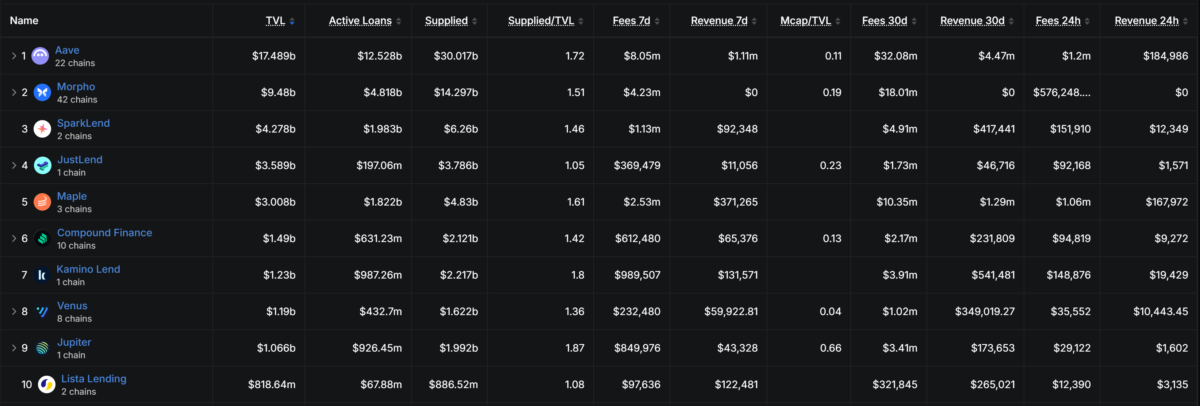
Notably, Aave [$AAVE] controlled roughly 42–48% of top-ten Active Loans. That share gives it unusual influence over on-chain credit conditions.
Still, it’s worth noting that if this borrowing trend holds, it could enter V4 with stronger utilization, deeper liquidity, and greater pricing power than its closest rivals.
Aave’s lending lead dwarfs rivals
Aave’s scale provided an advantage extending beyond its position atop the lending rankings.
Its loan book reached approximately $12.7 billion. That almost matched the combined $13–14 billion held across nine competing protocols.
According to DeFiLlama, Morpho held $4.81 billion in Active Loans, while most competitors remained below $2 billion. Borrowing demand was therefore heavily concentrated within Aave rather than distributed evenly across the sector.
Source: DeFiLlama
Yet roughly $30 billion supplied against $12.7 billion borrowed means Aave still has liquidity waiting for future borrowers.
This matters simply because growth can continue without deposits needing to rise equally fast. As a result, this helps the protocol accommodate demand more easily.
Meanwhile, despite that edge, rivals are still expanding, but they must close a wide-scale gap. All in all, if borrowing keeps rising, Aave can defend its lead while putting existing liquidity to work.
Will V4 unlock Aave’s idle capital?
Looking ahead, Aave’s next challenge is no longer finding liquidity but making the capital it already has become more resourceful.
Meanwhile, V3 fragments deposits across markets, so one pool can face heavy borrowing while another leaves capital underused.
On the other hand, V4 tackles that mismatch by connecting liquidity through shared hubs. In turn, this lets the available funds support more lending opportunities.
Ultimately, that could turn Aave’s existing scale into higher utilization and potentially more revenue without matching every new loan with fresh deposits.
Horizon then extends that opportunity beyond crypto by bringing tokenized Treasuries and credit funds into lending.
Its deposits remain in the hundreds of millions, but the direction matters. If both channels grow, Aave could expand borrowing while diversifying where demand originates.
Final Summary
Aave [$AAVE] commands nearly half of top-ten active loans, with borrowing growth reinforcing its DeFi lending dominance.
V4 could unlock underused liquidity, while Horizon gives Aave another growth path through tokenized assets.

 ambcrypto.com