The price of MKL spiked 11.5% in the past 24 hours, though the token is down 90% from its all-time high in December 2024.
Launched in late 2023, Merkle Trade offered non-custodial derivatives trading alongside features such as trading missions and loot boxes, leaning heavily into game-like mechanics.
That approach helped Merkle raise $2.1 million in a seed round in April 2024 led by Hashed and Arrington Capital, with participation from Aptos Labs, Morningstar Ventures, Amber Group and others.
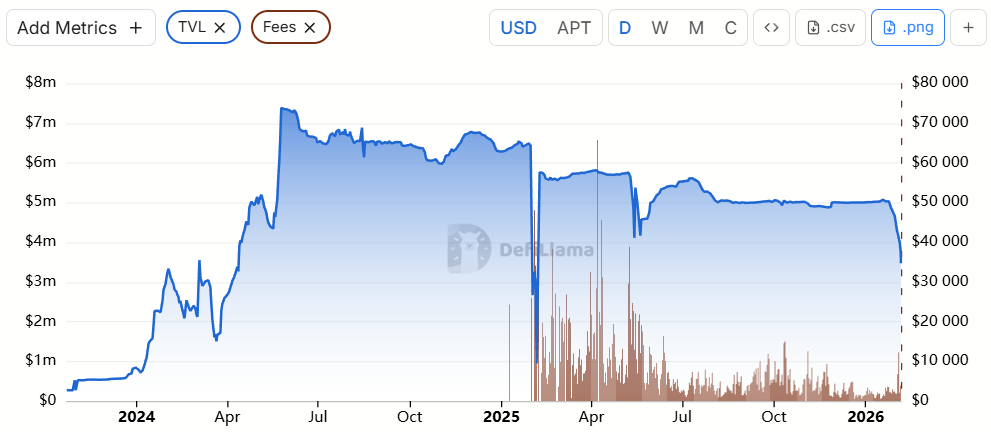
Merkle Trade’s TVL and fees. Source: DefiLlama
By May 2024, total value locked (TVL) on the platform peaked at more than $7.4 million, according to DefiLlama data. Since then, TVL has fallen by more than half to about $3.47 million, making Merkle Trade the 17th-largest protocol by TVL on Aptos at press time.
Among the four Aptos-based perp DEXs listed on DefiLlama, however, Merkle is the leader by far, accounting for $12.4 million of the total $13.68 million in perp volume on the chain in the past 24 hours.
Aptos Struggles
Merkle’s slide in TVL since 2024 reflects weakness across the broader Aptos ecosystem, where total value locked is currently around $332.6 million, making it the 16th-largest chain by DeFi TVL.
Current TVL across the ecosystem is down more than 70% from December 2024 where it was over $1.2 billion, and back to levels last seen in the summer of 2024.
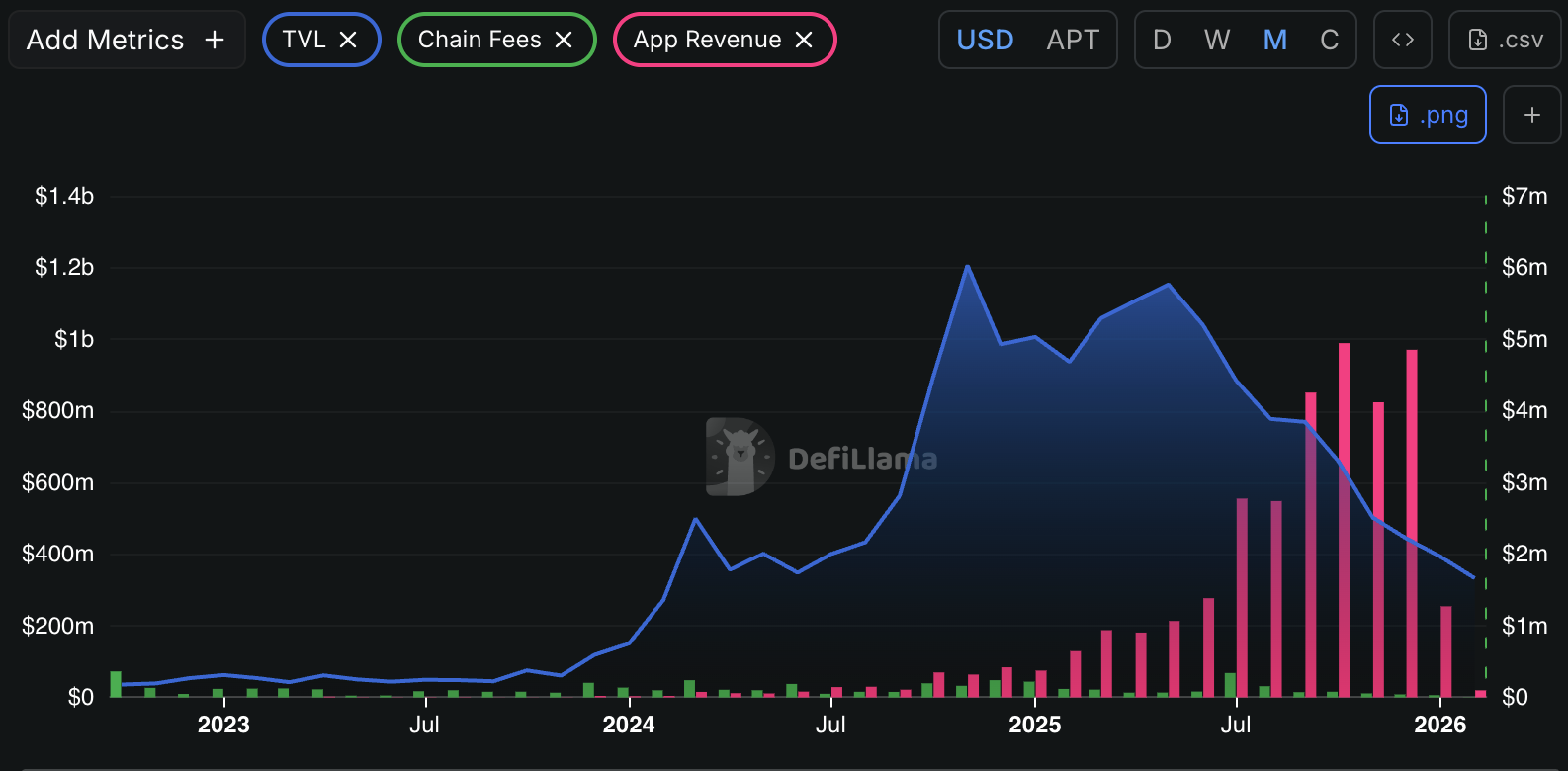
Aptos TVL vs. Chain Fees vs. App Revenue. Source: DefiLlama
App revenue on the network, however, increased in 2025, though it remains relatively low. Weekly revenue from decentralized applications (DApps) on Aptos is led by DEX PancakeSwap, with $44,396 followed by Merkle Trade with $29,575.
By comparison, the top-four chains by app revenue today — Solana, Hyperliquid L1, Ethereum and EdgeX — have all recorded over $1 million in the past 24 hours.
The broader perp DEX sector exploded in 2025, with 24-hour volumes now outpacing most centralized exchanges. Hyperliquid has led the sector by trading volume, with rivals Lighter and Aster sometimes taking the lead.

 thedefiant.io