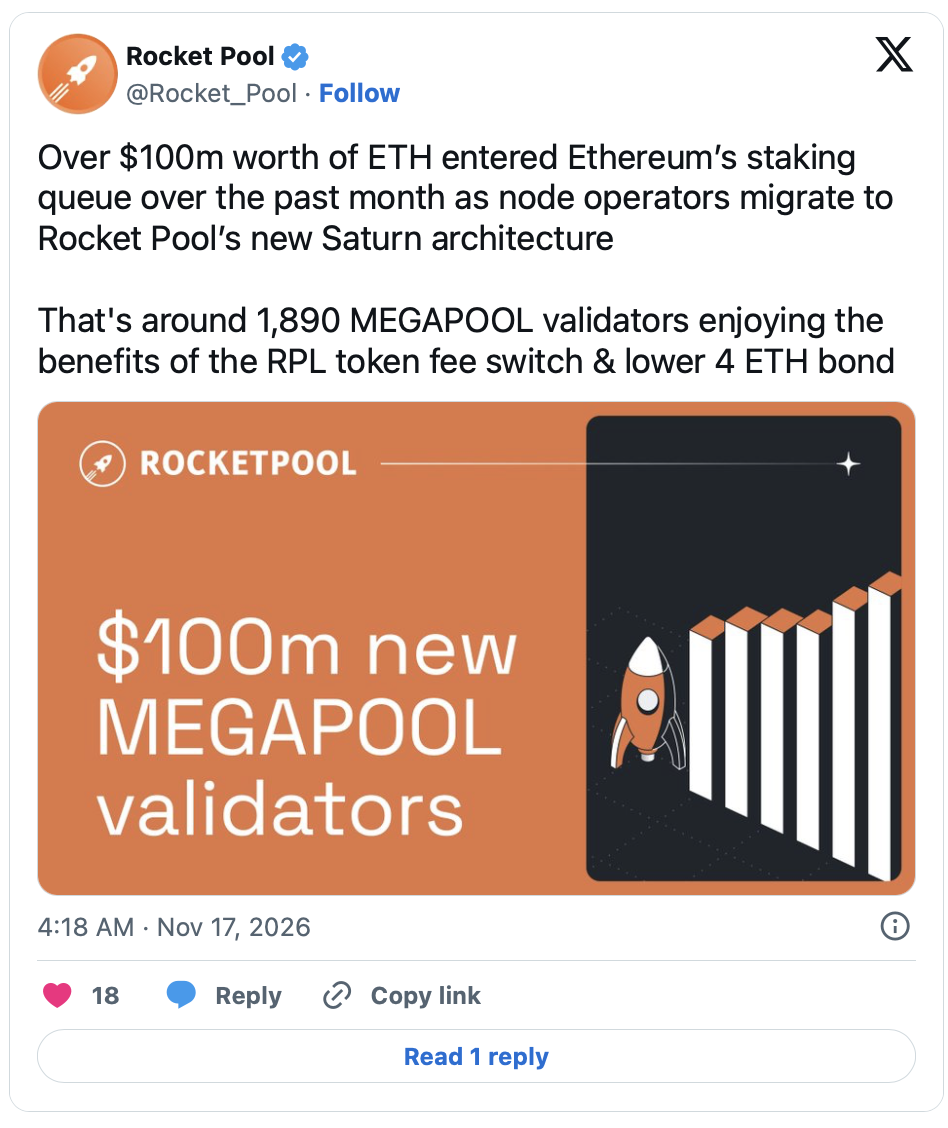
View post on X
Less Operator Capital, More $ETH Matched
Under Saturn, an operator supplies a 4 $ETH bond and Rocket Pool matches it with 28 $ETH from liquid stakers to fund a 32 $ETH validator, according to the protocol’s operator documentation. Liquid stakers receive rETH, Rocket Pool’s liquid-staking token, rather than running the infrastructure themselves.
The previous 8 $ETH bond supported one validator. The same operator capital can now support two, with more $ETH supplied by rETH holders. A megapool also groups an operator’s validators under one smart contract, instead of requiring a separate contract for each legacy minipool, as Rocket Pool explained in its Saturn overview.
The $RPL ‘fee switch’ is a distribution of $ETH staking rewards, not a payout to everyone holding the token. Under the documented default split, rewards on the liquid stakers’ portion of a megapool validator are divided between rETH holders, with 86%; the operator, with 5%; and eligible megapool-staked $RPL, with 9%. Operators retain the rewards on their own bonded $ETH.
Rocket Pool’s rewards guide says the $RPL allocation is distributed proportionally through 28-day reward periods. $RPL staking is optional, but simply holding $RPL in a wallet does not qualify. Governance can adjust the revenue split, so these percentages are not fixed yields.
Queued Is Not Yet Earning
Moving an existing stake is not an automatic conversion. Rocket Pool’s migration guide instructs operators to exit old minipools and create new megapool validators. New validators must first obtain matching $ETH from Rocket Pool and then clear Ethereum’s deposit-processing queue.
The Ethereum process itself has two stages: an initial 1 $ETH deposit, followed by the remaining 31 $ETH after withdrawal credentials are verified. The guide warns that operators stop earning $ETH rewards on exited validators until their replacements become active.
Rocket Pool remains much smaller than Lido by locked assets. DefiLlama listed about $877 million in Rocket Pool on Nov. 16, compared with Lido’s $17.9 billion. Those are asset-value snapshots, not measures of monthly deposits.
Nor does a 4 $ETH bond make Rocket Pool the lowest-capital route for operators. Lido’s current documentation lists a 2.4 $ETH bond for the first validator in its standard 32 $ETH Community Staking Module profile and 1.3 $ETH for subsequent validators. Saturn lowers Rocket Pool’s own barrier to entry; operators still have to weigh its reward structure and activation delays against competing models.

 thedefiant.io