What Hyperliquid’s Growth Says About the Future of On-Chain Markets
techgaged.com
16 May 2026 11:19, UTC
Hyperliquid is growing. A protocol that didn’t exist two years ago is now collecting more fees than Ethereum. That is not a marketing claim. That is what the data shows.
The question worth asking is not whether Hyperliquid is growing — it clearly is. The question is what that growth reveals about where on-chain markets are heading.
Is This What Winning Actually Looks Like?
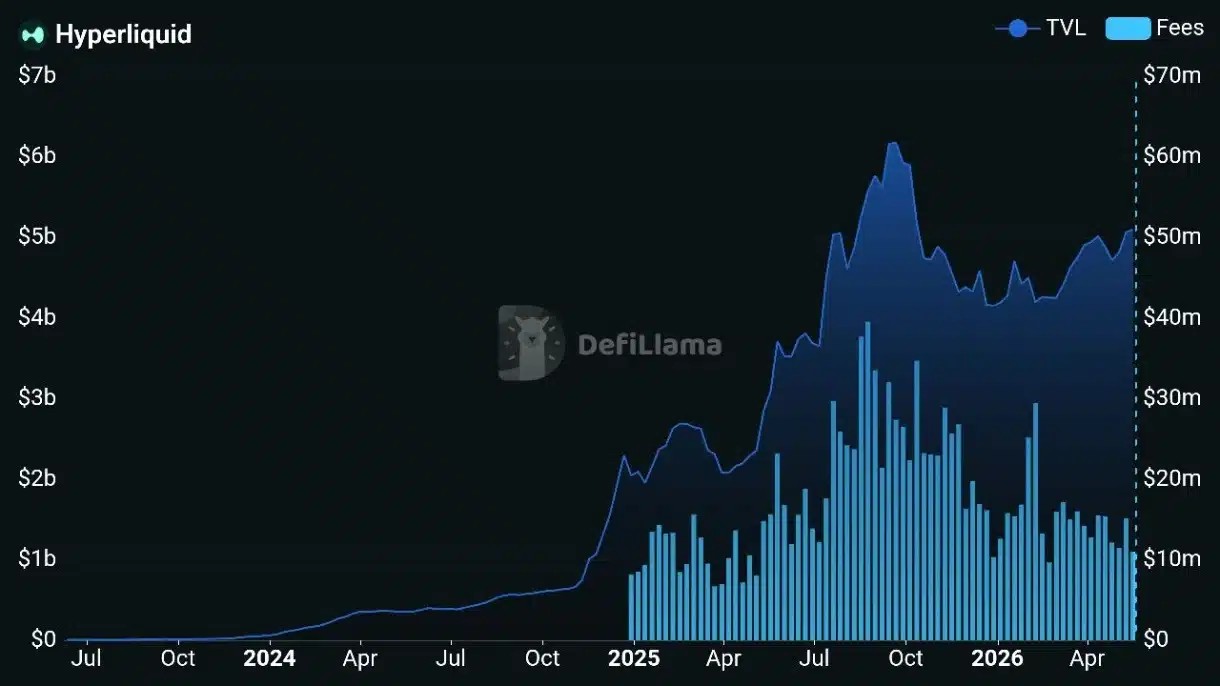
The DefiLlama chart tells the story in two lines. TVL climbed from zero in mid-2024 to a $6 billion peak.
Know when your coins move
Alerts, real-time prices, and market news — all in one app
4.8 based on 40K reviews in the App Store and Google Play
Fee bars grew alongside it — consistently, month after month. Hyperliquid now leads all blockchains with approximately 43% of weekly blockchain fee market share — generating around $11 million last week alone.
All-time fees have crossed $1.24 billion. Annualized revenue is running at $800 million–$1 billion. Monthly fees exceed $56 million.
Hyperliquid’s TVL Chart. Source: DefiLlama
More than 95% of those fees go to daily $HYPE buybacks. 21Shares launched the first U.S. spot Hyperliquid ETF on May 12, 2026.
Circle is now the technical deployment partner for USDC on Hyperliquid — making it the canonical quote asset. The shift is expected to generate greater reserve yield for the protocol.
Price Speaking Louder Than the Narrative — Reading the Tape
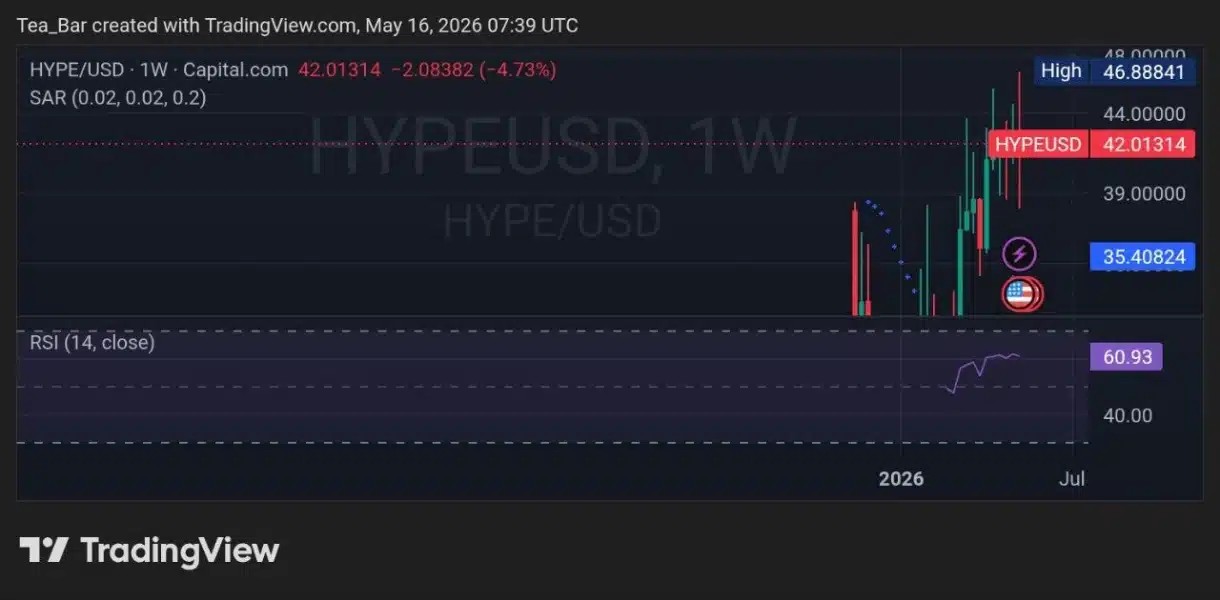
HYPEUSD (Weekly): As of May 16, 2026 (07:39 UTC), $HYPE trades at $42.01, down -4.73% on the week. It is pulling back from its cycle high of $46.89. The Parabolic SAR at $35.41 sits below price.
HYPEUSD Weekly Chart. Source: TradingView.
The weekly trend remains bullish. The RSI at 60.93 is mid-range. It is not overbought. It is rising steadily from the launch lows.
Price is consolidating just below the cycle high. The $39–$40 area is the first support zone to watch on any further pullback.
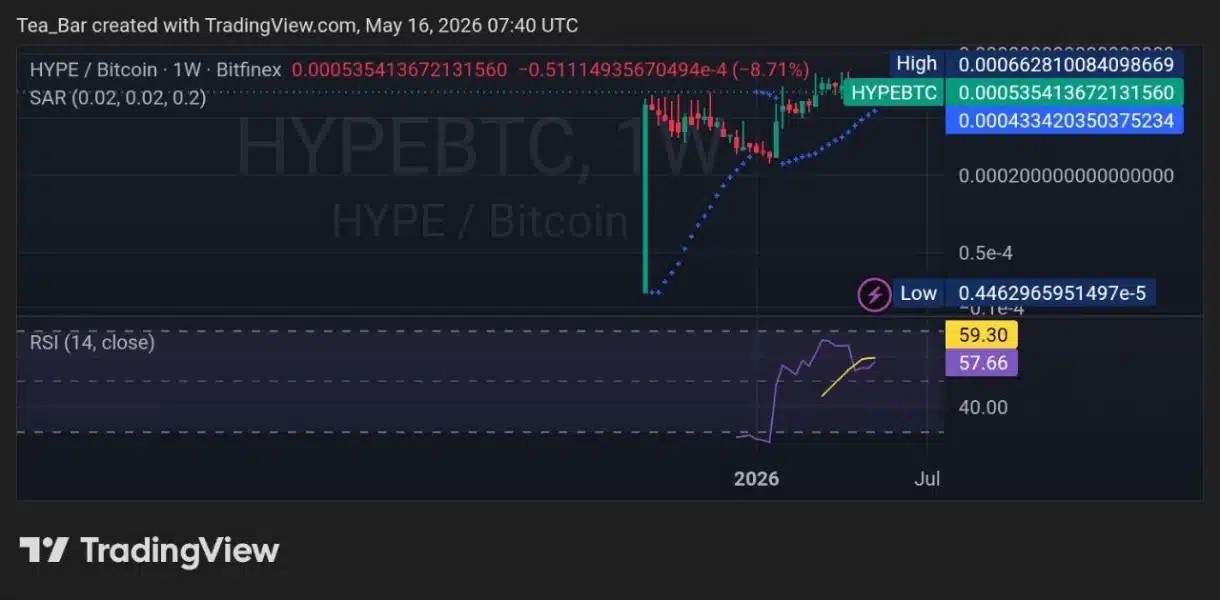
HYPEBTC (Weekly): Against Bitcoin in similar date and time, $HYPE sits at 0.00053541. The cycle high is 0.00066281.
The Parabolic SAR at 0.00043342 sits below price. The BTC-relative trend is bullish. The RSI at 59.30 is rising. The signal at 57.66 is tracking alongside.
HYPEBTC Weekly Chart: Source: TradingView.
Both readings are mid-range and not stretched. $HYPE has built a sequence of higher lows since early 2026.
That structure holds as long as the SAR stays below price. The next test is a weekly close above 0.00060000 — the level that would put the all-time high in range.
How Long Can One Chain Hold 43% of Blockchain Fees?
Fee dominance at this scale is historically difficult to maintain. Competitors are moving.
Rivals backed by major players are gaining traction with aggressive incentives. Hyperliquid also blocks U.S. users due to regulatory restrictions — ceding a significant portion of the total addressable market.
HIP-4 introduces permissionless prediction markets — a move designed to expand fee generation beyond crypto perpetuals. Whether that is enough to sustain the lead is the real question.
The fee chart says it is working. The competitive landscape says the pressure is building. Which one matters more in the next twelve months?
Disclaimer: This article is for informational purposes only and does not constitute financial, investment, or trading advice. The views expressed are based on publicly available data, market observations, and the author’s interpretation at the time of writing. Cryptocurrency markets are highly volatile and unpredictable, and past performance or current technical setups do not guarantee future results. Readers should conduct their own research and consult with a qualified financial advisor before making any investment decisions. TechGaged does not accept liability for any losses incurred based on the information presented.

 techgaged.com