
 thecryptobasic.com
Cardano continued building institutional-grade infrastructure in Q1 2026, even as $ADA fell 27.4% quarter-over-quarter to $0.24, according to a new report from Messari.
The report highlighted progress across stablecoins, tokenization, compliance, governance, and privacy-focused infrastructure. These developments support Cardano’s long-term goal of attracting institutional users and regulated financial activity.
USDCx Milestone
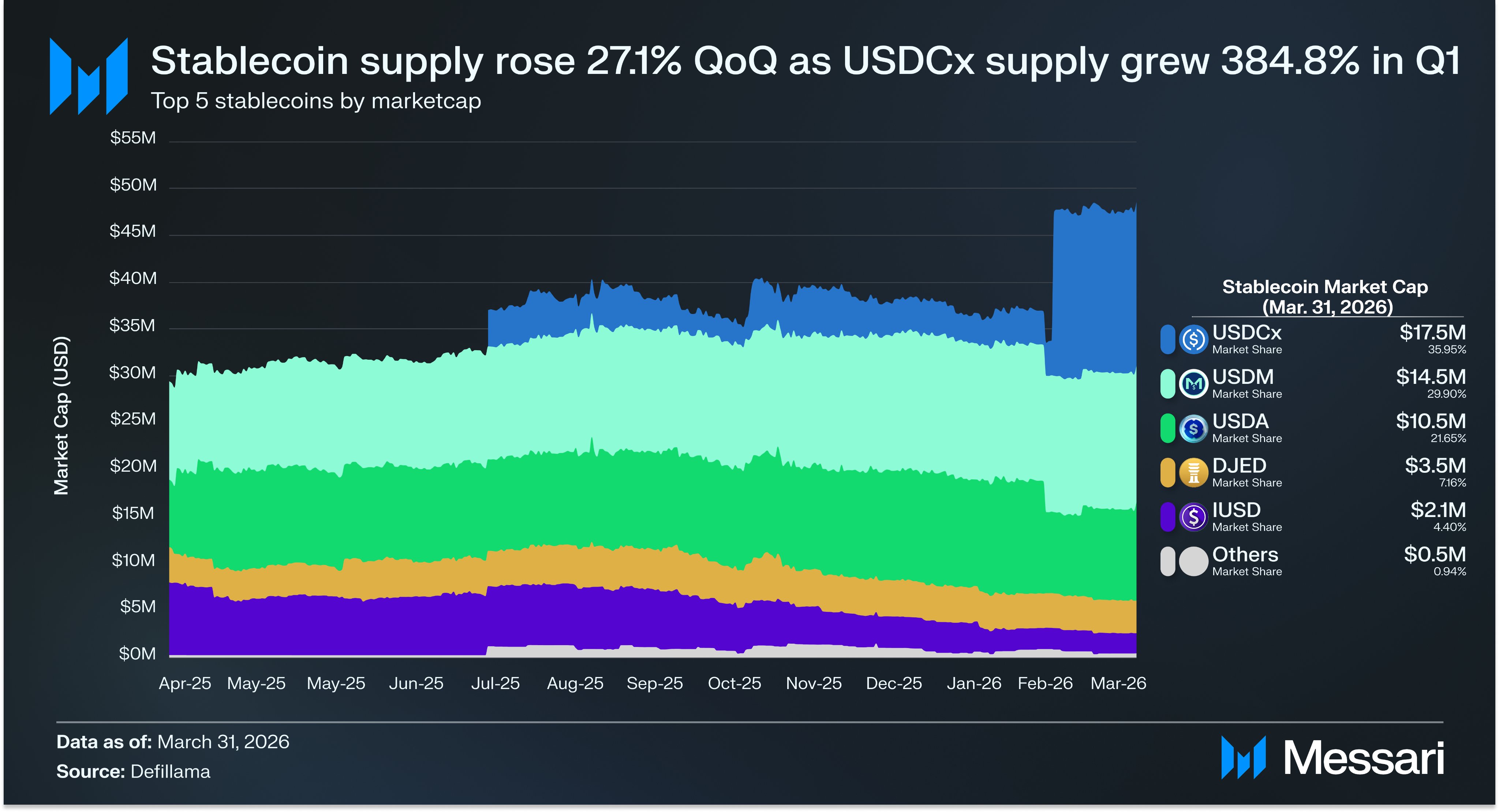
One of the quarter’s biggest milestones was the launch of USDCx, Circle’s regulated stablecoin on Cardano, on Feb. 27. Within weeks, USDCx became the network’s largest stablecoin. It ended the quarter with a supply of $17.5 million and captured 36% of Cardano’s stablecoin market.
As a result, Cardano’s total stablecoin market capitalization grew 27.1% to $48.6 million. USDCx overtook USDM as the network’s dominant stablecoin, while supplies of other major stablecoins declined.
Messari also noted that Cardano advanced its regulated payments strategy through integrations such as the EMURGO-Wirex Cardano Card and Stablecoin Push-to-Card functionality powered by Visa Direct.
Midnight Launch Boosts Tokenization Strategy
Another milestone came on March 30 with the launch of Midnight, a privacy Layer-1 blockchain and Cardano’s first partner chain under its Partner Chains framework.
Midnight launched with nine institutional validators and a dual-token model. $NIGHT is for governance and rewards, while DUST serves as a shielded resource for transaction fees.
Messari researcher Jonnytoshi described Midnight as a key part of Cardano’s plan to become a regulated tokenization platform by combining privacy features with institutional oversight.
Cardano also secured several strategic infrastructure partnerships during the quarter. LayerZero integrated with the network on March 17, providing access to cross-chain connectivity and more than $80 billion in omnichain liquidity. Additional partnerships included Pyth Network and Dune Analytics.
Meanwhile, Grant Thornton Switzerland completed what Messari described as the world’s first on-chain financial audit using the Cardano Foundation’s Reeve framework. The system supports regulated blockchain financial reporting.
Governance and Treasury Activity Accelerate
Meanwhile, Cardano’s decentralized representatives (DReps) approved a 350 million $ADA Net Change Limit covering February 2026 through July 2027. The measure established a multi-year capital allocation framework for the ecosystem.
During the quarter, 80.1 million $ADA was deployed through governance-approved treasury withdrawals. The Critical Integrations Budget became the first major initiative funded under the new structure and supports Cardano’s institutional adoption plans.
Staking metrics remained strong despite market weakness. Total staked $ADA rose 1.5% to 21.7 billion $ADA, pushing participation to 58.3%.
However, $ADA’s price decline reduced the dollar value of staked assets by 26.4% to $5.2 billion.
DeFi Activity Mixed
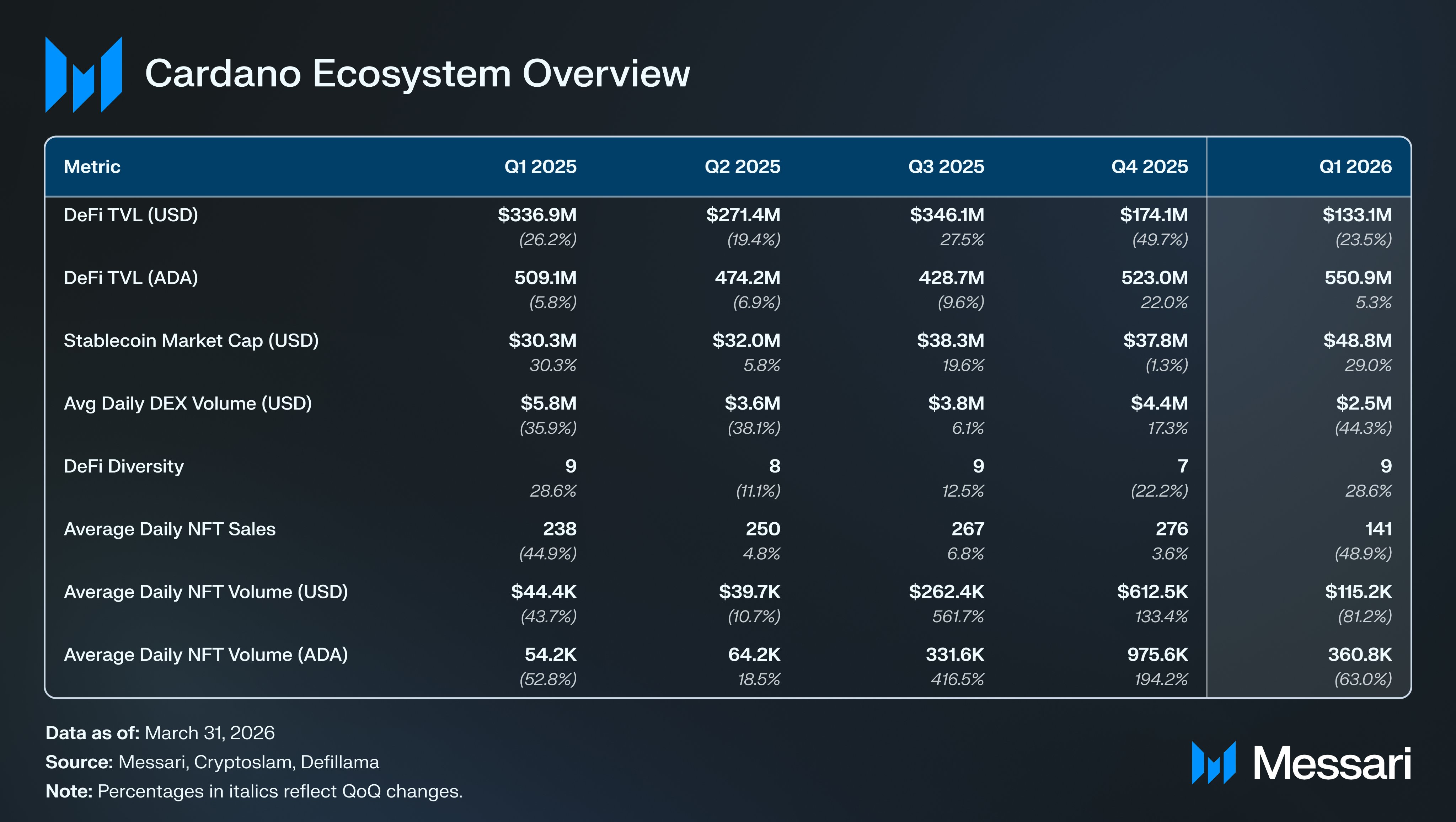
Cardano’s DeFi ecosystem delivered mixed results during the quarter. Total value locked (TVL) fell 23.5% to $133.1 million, slightly worse than the industry’s 18.9% decline. Average daily DEX volume also dropped 44.3% to $2.5 million.
Despite the slowdown, several protocols posted strong growth. SundaeSwap’s TVL increased 45%, while DanoFinance grew 31.7% to $15.6 million, making it one of Cardano’s three largest DeFi protocols.
DanoFinance was also the only top-five Cardano DEX to record positive trading volume growth. Average daily volume climbed 48.6% quarter-over-quarter to $242,700, helped by the launch of a USDCx lending pool in March.
Although average daily active addresses declined 28.1% to 13,400, transaction activity remained resilient. Average daily transactions rose 2.2% to 26,550, driven partly by activity surrounding USDCx and the $NIGHT token launch.
Messari noted that transactions per address increased 16.5% to 1.98, suggesting existing users became more active even as the active user base shrank.
Focus Shifts to Upcoming Upgrades
Looking ahead, Cardano is preparing for the Van Rossem hard fork, also known as Protocol V11, which is scheduled to launch in June 2026.
The network also continued work on several scaling initiatives. Leios consensus reached its first working prototypes, while the LSM Tree update reduced stake pool operator hardware requirements from 24GB to 8GB of RAM. Hydra v1.3.0 and Amaru also moved closer to production readiness.
Messari noted that CME’s launch of $ADA futures on Feb. 9 started a six-month countdown toward spot exchange-traded product (ETP) eligibility on Aug. 9, 2026.
According to the report, Q1 saw Cardano’s market performance and infrastructure development move in opposite directions.
While $ADA declined, the network delivered a series of institutional upgrades, partnerships, governance initiatives, and compliance tools that could strengthen its position in the quarters ahead.