
Stake Plinko Explained: Risk Levels, Rows, and How to Check a Drop
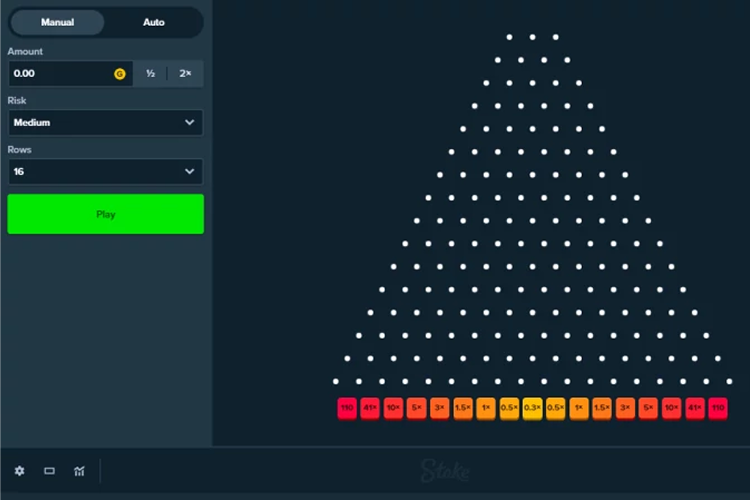
The ball heads toward the edge. One more bounce and it could reach that big multiplier. Then it turns back, drops into a small payout pocket, and you’re reaching for the button again. That little journey is Plinko’s whole appeal. You can follow the whole round without learning card values, betting markets, or a screen full of symbols. Drop a ball and see where it lands.
However, before you do that, take a look at the payout numbers along the bottom. Switching the risk level changes the payouts beneath it. Adding rows changes the possible paths. And the “provably fair” label gives you a way to check how a result was generated.
Same Bouncing Ball, Different Stakes
Plinko is based on the old TV show, polished to fit online casinos. The goal stayed the same: a ball falls through a pyramid of pegs and finishes in one of the pockets at the bottom.

Know when your
coins move
Alerts, real-time prices, and market news — all in one app
 Point your phone camera to install
 4.8 based on 40K reviews in the App Store and Google Play


On Stake Plinko, those pockets carry different multipliers. You choose your bet and board settings before dropping the ball, and its final position determines how much you win. Smaller multipliers are near the middle, with larger ones towards the edges.
First, understand that a payout doesn’t always mean a profit. A pocket marked 0.5x returns half your bet. Put in $1, and you get $0.50 back. The ball completed its journey, the game paid something, and you still lost $0.50.
What the Risk Settings Actually Change
Older Stake Plinko guides use Low, Medium, and High. Stake now lists them as Easy, Medium, and Hard, with Expert added as a fourth option. With 16 rows selected, the maximum payouts are 16x on Easy, 110x on Medium, 1,000x on Hard, and 10,000x on Expert. Choose fewer rows, and those maximums change.
The main difference is how much each finishing pocket pays. To see what a risk setting means for your balance, look at both the smaller returns and the biggest multiplier.
Low Risk Means Smaller Wins
Low risk, labeled Easy, has a smaller gap between its lowest and highest returns than the more aggressive settings. At eight rows, Stake’s payouts range from 0.5x to 5.6x. With a $1 bet, that means returns from $0.50 to $5.60.
This can suit someone who prefers a steady balance. There’s less emphasis on the huge edge payouts you see in high-risk settings.
Still, “low risk” can sound more reassuring. Losing half a stake is a loss, even if the dollar amount is small. Repeated small losses can add up just as quickly as a few larger ones.
Medium Risk Makes the Edges More Tempting
Medium risk widens the gap between small returns and larger payouts. At eight rows, the range at Stake is 0.4x to 13x.
With the same $1 stake, the smallest return is now $0.40 and the largest is $13. You’ve traded some protection on the smaller results for a bigger possible payout. That trade can be easy to miss when you focus on 13x. The lower end changed too.
Medium also isn’t a promise of balanced rounds. You could get several disappointing results, hit a larger payout early, or finish somewhere in between. The label tells you where the setting falls among the choices, not how your next few bets will go.
High Risk Makes Small Returns More Costly
High risk, labeled Hard, puts much more emphasis on rare, larger payouts. Stake lists a 0.2x minimum across the high-risk row settings and a 1,000x maximum at 16 rows.
A $1 drop at 0.2x returns $0.20. That’s a $0.80 loss.
Imagine ten drops all returning that amount. You would wager $10 and receive $2 altogether, leaving you $8 down. This is only an example, but it shows why the small numbers deserve as much attention as the large ones.
Also, a bigger payout can turn that around. If nine $1 drops return 0.2x and the tenth lands at 29x, you’d receive $30.80 from $10 in bets, which is a $20.80 profit.
Choose a bet size that lets you enjoy the chance of a bigger payout while keeping smaller returns manageable. Giving yourself room for a few losing drops can help you play at a comfortable pace without feeling pressured to win the money back.
Expert Adds an Even Bigger Top Number
Stake lists a maximum of 10,000x for Expert with 16 rows. The maximum is the upper limit the board can pay. It gives you no timetable for reaching it.
It’s easy to picture what a large multiplier would do to your balance. But answer the less exciting question: how much are you comfortable spending while waiting for that result?
Eight Rows or 16? Look at the Whole Board
Stake Plinko lets you choose between eight and 16 rows. Each row adds another left-or-right decision to the ball’s path. The game has an eight-row board with nine finishing positions, while a 16-row board has 17.
More rows also bring a different payout layout. You can’t judge the change just by watching the ball travel farther.
For example, ten rows have an 8.9x maximum, while 11 rows have an 8.4x maximum. So, adding a row actually lowers the top payout.
Take a moment when changing rows. Check what happened to the middle pockets, the lowest return, and the outer multipliers. Change one setting at a time if you want to understand the difference. Changing the risk level, row count, and stake at once makes it harder to tell which change affected your results.
How Much 5x Actually Put in Your Pocket?
The multiplier includes your original wager. If you bet $1 and land 5x, you get $5 back. Your profit is $4. With a $2 bet, 5x pays $10 altogether, leaving an $8 profit.
The same math works below 1x. A $2 drop at 0.5x returns $1, so you lose $1. At 1x, your $2 comes back, and you break even.
This is a small detail that clears up a lot of confusion. When you read a multiplier, ask what returns to your balance after the stake has already been deducted. For a whole session, compare all payouts with all wagers. One attractive result doesn’t necessarily put you ahead if earlier drops cost more than they returned.
Why the Middle Gets So Many Balls
Watching several balls land near the center can make the edges feel almost unreachable. There’s a simple reason: far more paths lead towards the middle.
Stake’s Plinko generates a left or right direction for each row.
Imagine a tiny board with only two rows. The ball could go in four directions: left then left, left then right, right then left, or right then right. Two of those four paths finish in the middle. Only one reaches each extreme edge.
The same idea applies to the bigger board. Many combinations of left and right moves can end near the center. To reach the far left, every decision must go left. To reach the far right, every decision must go right.
Using that equal-chance path model, either extreme edge on an eight-row board has a combined probability of one in 128. At 16 rows, the combined probability is one in 32,768.
That doesn’t mean an edge result is due after 32,768 drops. There’s no scheduled arrival, so anyone could win on their first drop.
Turning Up the Risk Doesn’t Steer the Ball
Choosing a higher risk level changes the payout. The path still uses left or right decisions at each row.
The bigger edge multiplier can make you watch that side of the board more closely. It doesn’t make the ball head there more often. The same goes for a close miss. A ball might spend much of its journey near the edge before turning back towards a smaller payout. It can feel like you almost had a bigger result.
For your balance, though, only the final pocket counts. The next drop starts without a reward for how close the previous one looked.
What You Can Expect From the 99% RTP
Stake lists Plinko at 99% RTP, with a 1% house edge. RTP means return to player. It describes the game’s theoretical average return over a very large amount of play. It doesn’t mean a $100 deposit will leave you with $99. You could finish ahead, lose the deposit, or stop somewhere in between.
The calculation uses total wagers. Suppose you deposit $20 and keep playing with money returned by earlier drops until you’ve wagered $200 altogether. A 1% house edge means you’d expect to lose $2 on those wagers.
That $2 is an average, not a forecast for your account. Your actual result can be far away from it.
What “Provably Fair” Lets You Check
A losing run can leave you wondering whether the game followed its own rules. Provably fair verification gives you something more concrete to examine than the run itself.
Stake publishes its method and provides tools for checking completed results. The casino commits to a hidden value before play, then reveals it later so you can repeat the calculation. Players compare their generated seed with the operator’s and verify the results.
A verified losing drop remains a losing drop. The result can follow the published process perfectly and still return only part of your stake. The payout board already allows that.
The server seed is a hidden value the casino generates. Before betting, you’re shown its hash, which acts like a digital fingerprint. The client seed is your input. You can change it yourself. The nonce is a counter that advances with each bet, so the same seed pair can produce different results.
Save the client seed, nonce, row count, risk setting, wager, and completed result. Keep the server seed hash shown before the seed is revealed. The row count and risk setting help you connect the generated path with the correct payout board. A finishing position alone doesn’t tell you the return without those settings. The best way is to try this with a small bet.
Also, don’t get attached to one seed. A seed that once produced a large payout isn’t a lucky password. Reusing a word or number won’t make the game repeat your favorite result.
A provably fair system only helps double-check outcomes after the game ends; it can’t change the house edge, RTP, or risk.
Keep Crypto Amounts Simple
When betting in crypto, a small-looking decimal can skew your view of your spending. Convert the stake to a cash amount before deciding whether you’re comfortable with it.
For example, a 0.00001 BTC bet at 5x returns 0.00005 BTC altogether. The profit is 0.00004 BTC, and its cash value depends on the exchange rate. Today, that would be a bit over $3.
The multiplier calculation stays straightforward. The extra job is tracking what the currency amount represents for your budget.
Cryptocurrencies are extremely volatile, so it’s always a good idea to check markets before cashing in. Value swings are common, which is why many players wait for a favorable exchange rate.
Check the ending balance in the same way. A session is easier to understand when you can clearly see what you started with, what you wagered, and what remains.
Enjoy the Drop Without Rushing the Next One
Decide on your budget and stopping point before the first ball. If needed, Stake has a feature that would automatically stop further wagers once you reach a preset limit.
Choose an amount you can afford to lose without needing a later win to make it bearable.
Then give yourself enough time to follow the balance. Plinko’s quick rounds make “just one more” an easy habit, especially after a close miss.
There’s plenty to enjoy in the simple format: choosing a board, watching the path, and seeing the result. Understanding the numbers behind it means fewer surprises. Keep the bets affordable, take breaks, and let the game stay entertainment.