“The private keys controlling user funds never left the device,” the company said.
Fluidkey describes itself as self-custodial: users control funds with their private keys and can access them without Fluidkey. Its privacy feature gives each incoming payment a new receiving address. According to the company’s account of this attack, the failure was in getting unauthorized transfers signed, not in taking the keys off users’ devices.
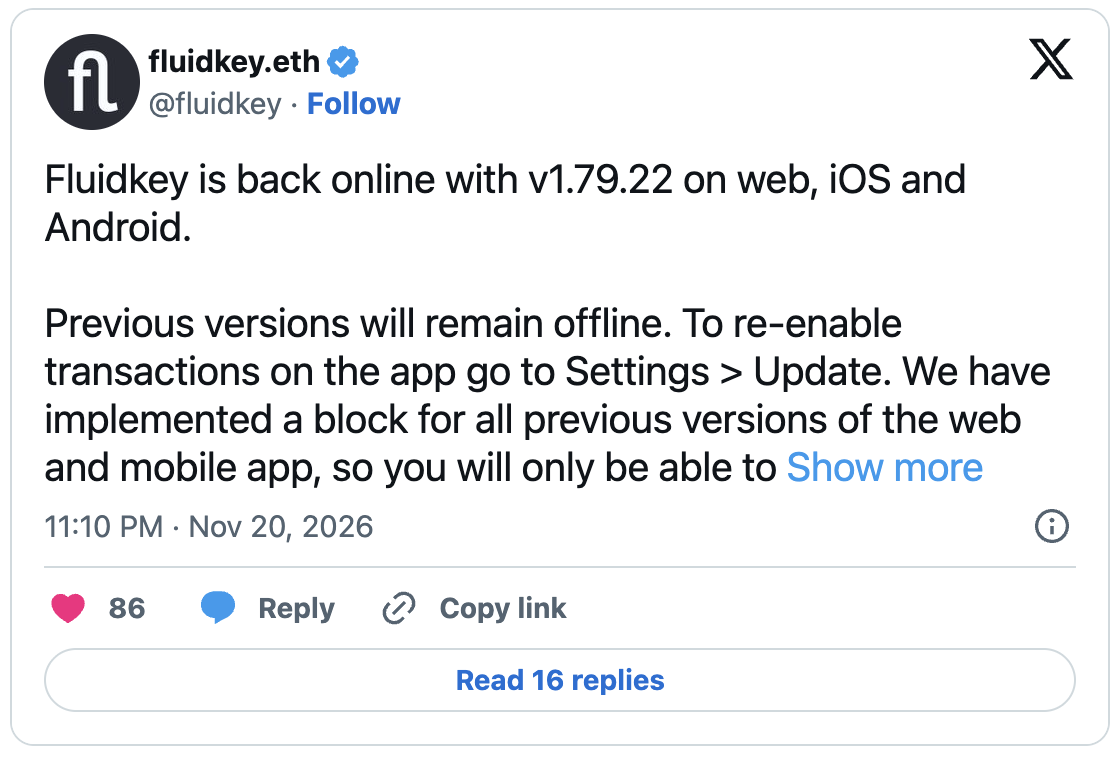
View post on X
Separating Theft From Withdrawals
Bitquery counted a payout as attacker-linked when its recipient sent funds to a collector wallet or Tornado Cash, or received transaction-fee funding from the attacker. Most of the money was in dollar stablecoins, the firm said.
Not every outgoing payment met that test. About $349,000 went to addresses with an established history during Bitquery’s hour-long scan, which also included ordinary payments before the drain began. Within that group, roughly $277,000 moved across Ethereum and Base to a wallet in use since 2024 — a pattern Bitquery interpreted as one user moving their own funds. Those ownership classifications rest on wallet histories and exchange-address labels.
Another $65,000 went to destinations Bitquery could not classify and was excluded from its lower-bound estimate. Some of those payouts could also be theft, the firm said, but legitimate users of a privacy wallet may withdraw to fresh addresses too.
Bitquery also traced 881.6 ETH deposited into Tornado Cash from six wallets after the drain. That records deposits into the mixer, not where the funds emerged afterward.
Fluidkey said it restored its web, iOS and Android apps on Nov. 20 with version 1.79.22, which prevents transfers from being prepared in the way used in the attack. Older versions remain blocked, and users must select Settings > Update to re-enable transactions, it said. The company said it would contact affected users individually and publish a full post-mortem.

 thedefiant.io