
 cointelegraph.com

Criticisms and limitations of quantitative easing
Although quantitative easing can be a useful tool in times of economic crisis, it is often criticized for its potential drawbacks, which include escalating inequality, distorting markets and possibly laying the groundwork for future financial instability.
Benefits from QE frequently accrue to asset owners, especially the wealthy who own financial assets such as stocks and bonds. Due to the fact that it may not always result in fair economic growth or be advantageous to a larger population, this can worsen income disparity.
Additionally, the increase in liquidity brought on by QE has the potential to fuel excessive speculation and asset bubbles in the financial markets, potentially driving up prices for stocks, homes and other assets to unsustainable levels. Furthermore, higher volatility in the cryptocurrency markets could result from increased liquidity from QE, making them less appealing to traditional investors.
The effects of QE on inflation and real economic growth may be modest. In times of uncertainty or when interest rates are already very low, it may fail to significantly increase consumer spending or business investment.
Moreover, QE can impair the proper operation of financial markets by artificially lowering interest rates and distorting the yield curve, making it more difficult for investors to appropriately assess risk and allocate resources effectively.
When central banks rely too heavily on unorthodox monetary measures like QE, their effectiveness may eventually decline, leaving fewer tools available to address future economic challenges. Last but not least, QE may result in a weaker currency, which could raise issues with global trade imbalances and competitive currency devaluation.
Quantitative easing (QE) and quantitative tightening (QT)
The opposite of QE, known as QT, involves central banks selling assets to reduce the money supply and possibly raise interest rates. QT may result in less liquidity on financial markets, which may impact the value of cryptocurrencies.
Some key differences between QE and QT are stated in the table below:
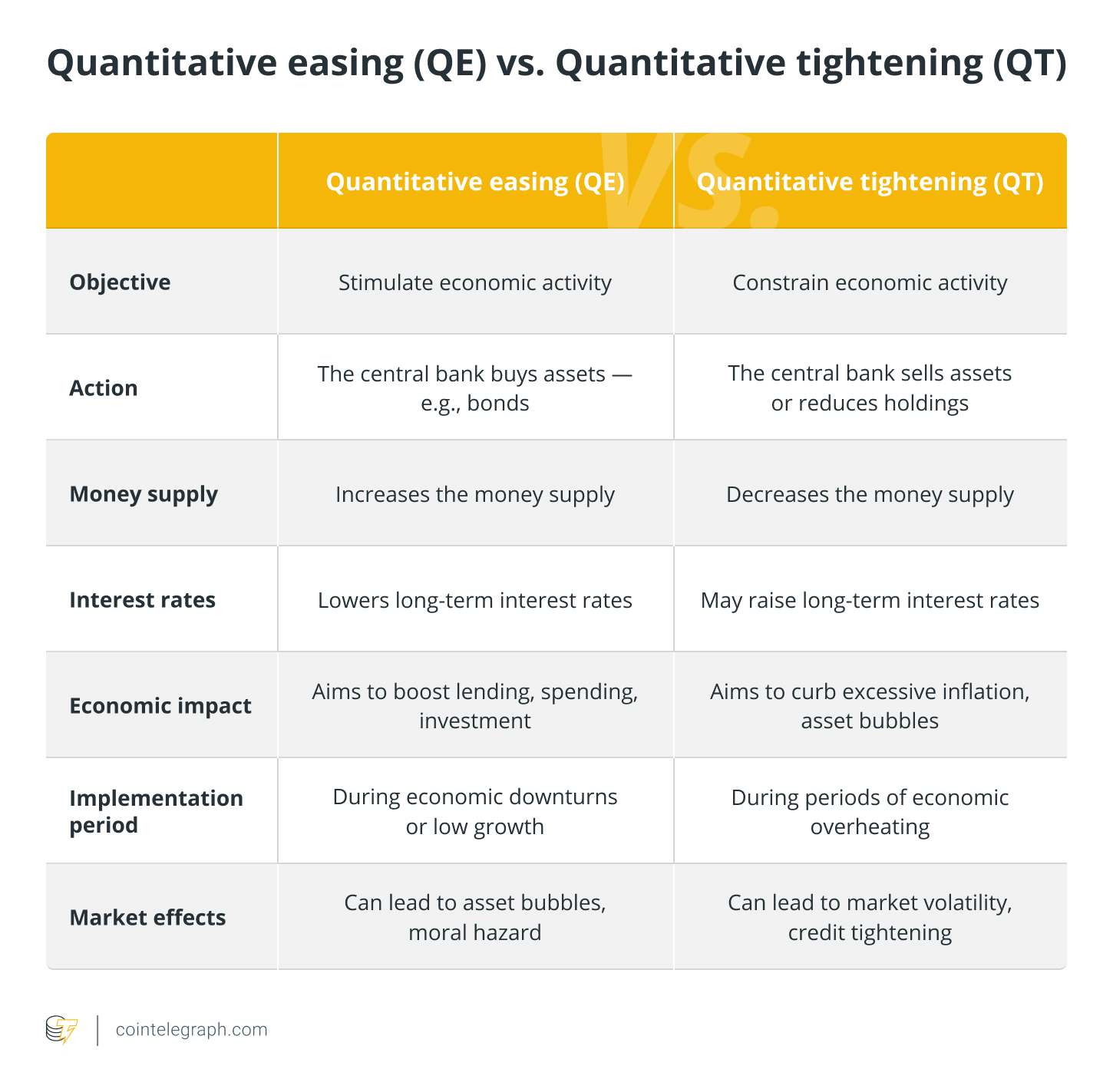
It’s important to emphasize that the effects of policies such as QE and QT are not fixed; they can fluctuate depending on unique economic circumstances and the timing of their execution.
Impact of quantitative easing on cryptocurrencies
Through broader market dynamics, quantitative easing may have an indirect impact on cryptocurrencies.
Traditional banking systems’ quantitative easing may have unintended consequences for cryptocurrencies. When central banks participate in quantitative easing, they may lower interest rates and devalue fiat currencies by injecting money into the economy.
Some investors may turn to alternative stores of value, such as cryptocurrencies, in light of greater liquidity and diminished purchasing power for traditional assets. As a result, the demand for cryptocurrencies like Bitcoin would rise, potentially pushing up their values. However, such a scenario doesn’t directly result from QE’s mechanisms but rather from investors’ reactions to the economic conditions influenced by quantitative easing.
However, as mentioned, cryptocurrencies function in a unique ecosystem that is influenced by forces other than conventional monetary policy. Other factors that affect their worth include market sentiment, regulatory changes, technological improvements and adoption patterns.
The interaction between conventional financial markets and the distinctive features of digital assets makes QE’s effect on cryptocurrencies complex and multifaceted.



