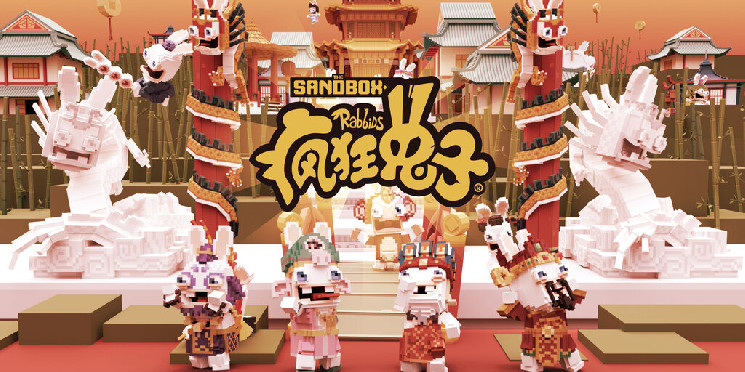
We're counting down to the @RabbidsOfficial Avatars public launch! 🐰 It's almost time to shake things up in the metaverse...
Get ready for Feb 22 @ 2pm UTC
Find out all you need to know 👇https://t.co/JISwtmVf6r pic.twitter.com/TtLyrLU6y2
— The Sandbox (@TheSandboxGame) February 21, 2023
On February 28, then, The Sandbox will launch a Rabbids game world in the current open alpha test, which houses a limited number of playable experiences. The avatars are billed as a “key to future utility” in The Sandbox, including access to potential future drops.
The Sandbox previously added Rabbids characters to its museum-like $NFT Institute experience last September, and released Rabbids-themed $NFT items and accessories. Today’s mint marks the first time that players can purchase Rabbids avatars for use in the game, however.
Ubisoft, the studio behind the Assassin’s Creed and Just Dance franchises, was one of the first major video game publishers to take note of Web3 and begin making moves around NFTs. The firm made a Minecraft-inspired $NFT game prototype called HashCraft in 2018, but the project was ultimately shelved. Still, Ubisoft expanded further into the crypto industry.
HashCraft: Ubisoft’s blockchain experiment is the future of gaming
In 2020, Ubisoft released a Rabbids-themed $NFT experiment to benefit the charity UNICEF, letting users collect Rabbids and even steal them from other owners. The following year, Ubisoft and Web3 fantasy sports startup Sorare collaborated on One Shot League, a Sorare spinoff that utilized its existing Ethereum $NFT soccer player cards.
Ubisoft has also supported $NFT game projects like Axie Infinity and Nine Chronicles and invested in firms like metaverse investment firm Animoca Brands and game maker Horizon.
The firm’s launch of Tezos-based NFTs for the PC version of Ghost Recon Breakpoint was a turning point for the company’s Web3 push, tying the assets into an existing, traditional video game that did not have $NFT functionality at launch. The “Quartz” NFTs, as Ubisoft branded them, let users collect and trade unique weapons and gear for the squad-based shooter.
The launch proved controversial among gamers, however, many of whom have been vocally opposed to NFTs due to scams in the crypto space, exorbitant prices for some assets, and what some see as another way for game publishers to extract money from players.
The Ghost Recon implementation was relatively superficial, however, and Ubisoft gave away the NFTs for free—but they failed to create much secondary market demand. In April 2022, Ubisoft ended its broader post-launch support for the game, but said that it would use the Quartz platform for future games. It has yet to announce any further Quartz $NFT projects.
Last September, Ubisoft CEO Yves Guillemot said in an interview that the firm was “still in research mode” with Web3 implementation, and said that the gaming giant should’ve made it clearer to players that Quartz was an experiment and a work-in-progress.
‘Still in Research Mode’ With Web3, NFTs Says Ubisoft CEO Yves Guillemot
Some gamers who are opposed to NFTs took that as a sign that Ubisoft was pulling out of the space, but the publisher has continued to make moves since.
It invested in Horizon and joined the Mythos Foundation last fall, and recently collaborated with cloud storage startup Aleph.im to develop fully decentralized smart contracts—which hold the code that powers decentralized apps (dapps) and $NFT projects—on Tezos. Rabbids NFTs are only the latest step in Ubisoft’s continued Web3 expansion.

 decrypt.co