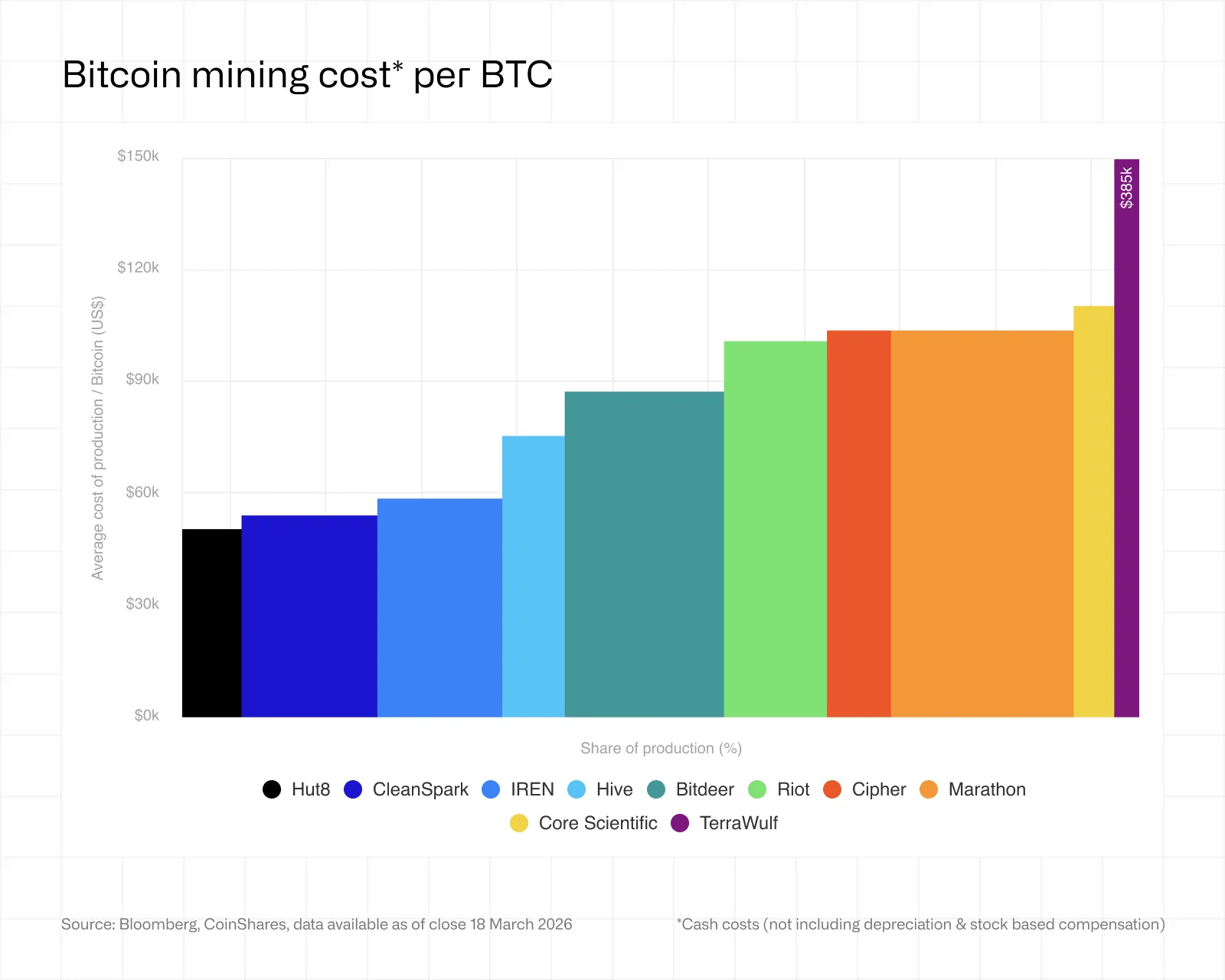
Source: Coinshares report on mining. “The weighted average cash cost to produce one bitcoin among publicly listed miners rose to approximately US$79,995 in Q4 2025,” Butterfill said in the report on Wednesday.
James Butterfill, head of research at Coinshares, stated the environment reflects “one of the most challenging periods” for miners since the last halving, driven by a combination of price pressure and rising network competition.
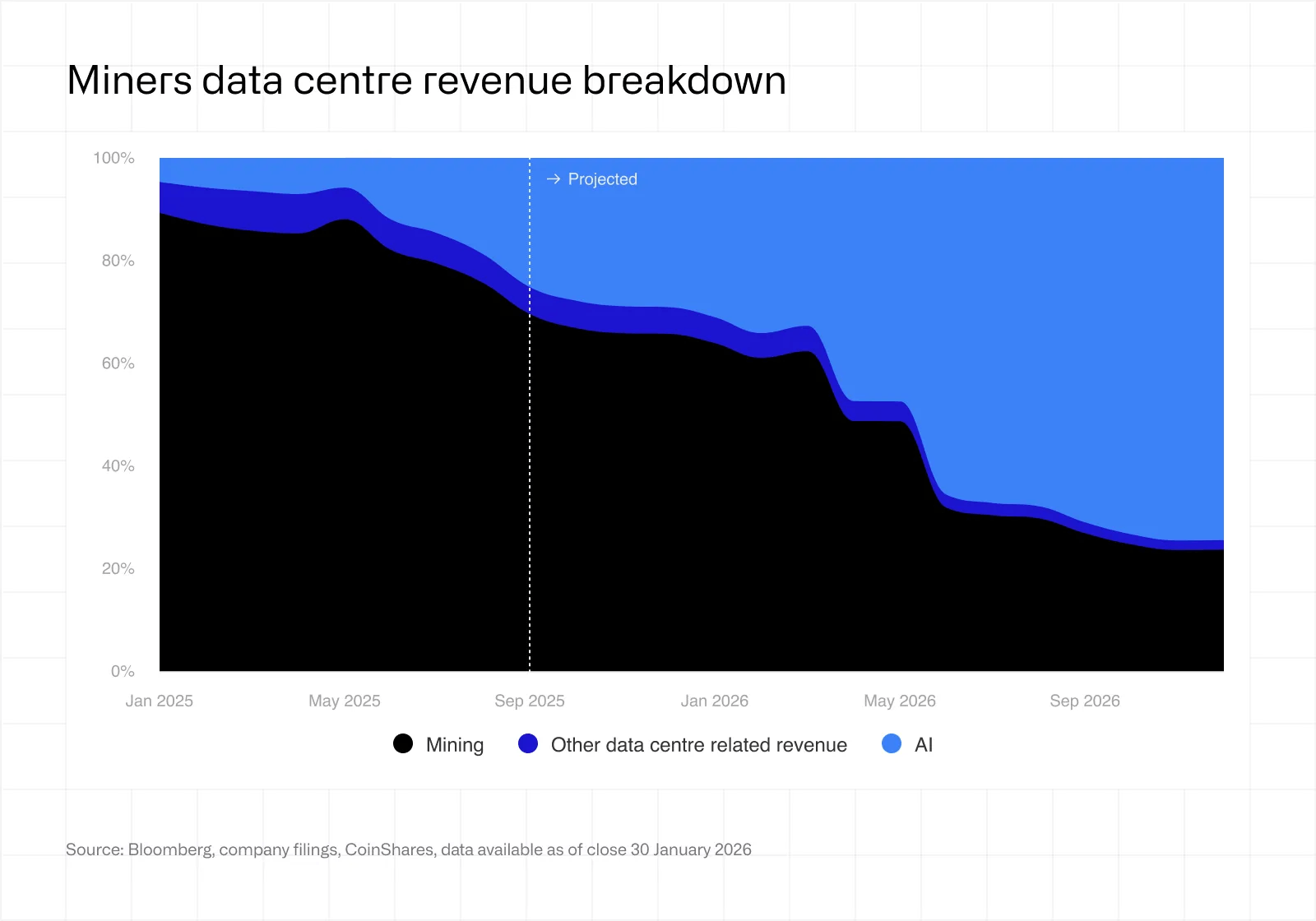
Against that backdrop, the industry is increasingly turning toward AI and high-performance computing (HPC) as an alternative revenue stream. Coinshares said publicly listed miners have announced more than $70 billion in AI and HPC-related contracts, with some firms expected to generate up to 70% of revenue from AI by the end of 2026.
The shift reflects a basic economic trade-off: AI infrastructure offers more stable returns than bitcoin mining under current conditions. Still, the transition is uneven. Some companies are aggressively repositioning as data center operators, while others continue prioritizing mining or adopting hybrid strategies.
Source: Coinshares report on mining.
Meanwhile, the Bitcoin network itself remains resilient despite recent volatility. Hashrate peaked above 1 zettahash per second in 2025 before pulling back and stabilizing near 1,020 exahash per second. Coinshares expects long-term growth to continue, projecting hashrate could reach 1.8 zettahash by the end of 2026 and 2 zettahash by early 2027.
Geographically, the United States, China and Russia still dominate global mining, accounting for about 68% of total hashrate, while countries like Paraguay and Ethiopia are gaining ground.
Despite the AI pivot, mining economics remain closely tied to bitcoin’s price. The report noted that a recovery toward $100,000 could lift hashprices and improve margins, while prolonged weakness may force more operators offline. For now, the sector appears to be splitting into two camps: traditional miners and hybrid infrastructure firms balancing bitcoin production with AI-driven workloads.

 news.bitcoin.com