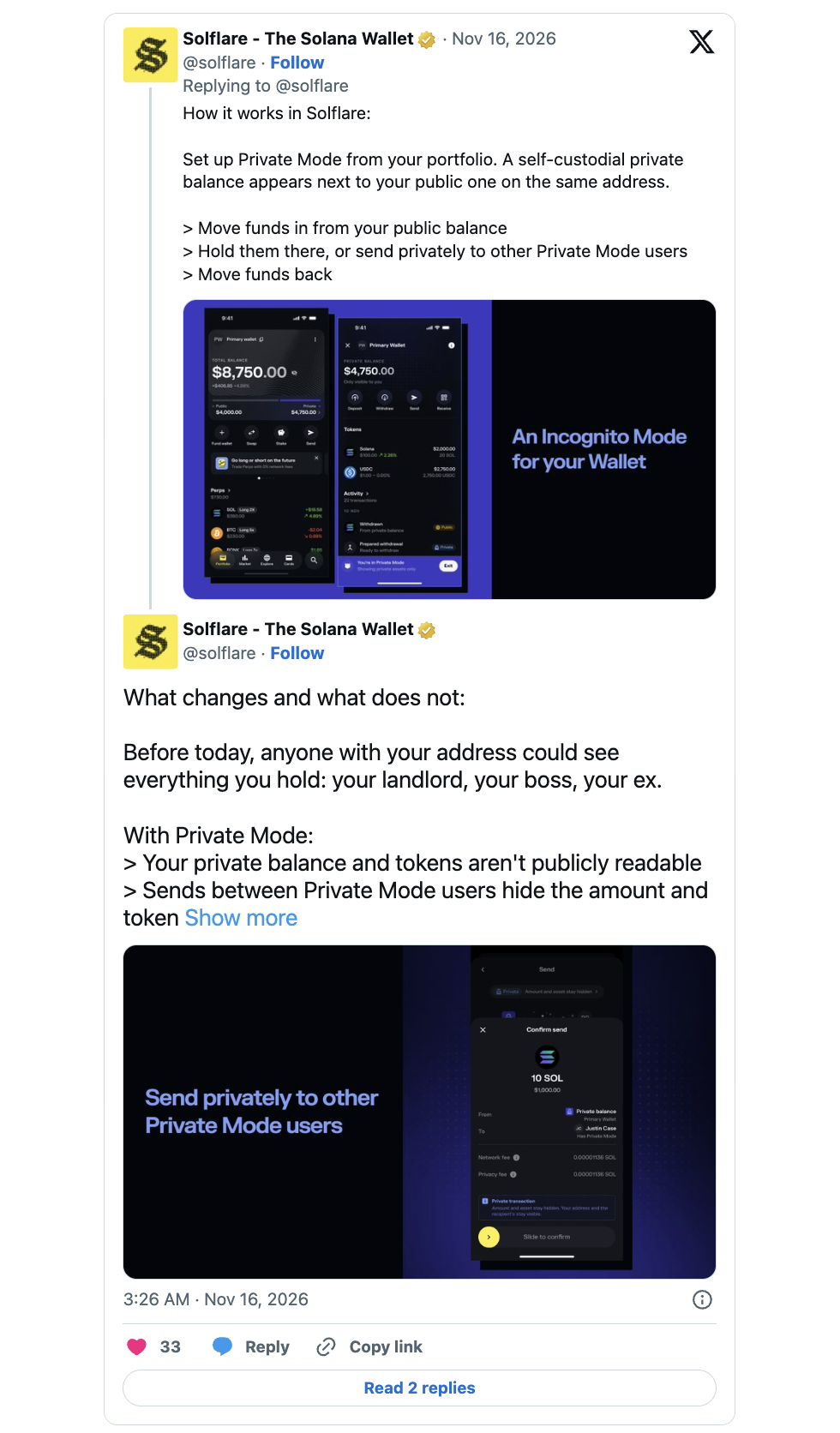
View post on X
For users, the change offers a way to pay someone without exposing their entire private balance. It does not erase public transaction history or hide financial relationships. Both parties must enable Private Mode: Solflare's product page says a payment to someone without it becomes a public transfer, with a warning before confirmation.
The feature is separate from Solflare's existing Private Send, which routes payments through a third-party provider to break the direct onchain link between wallets.
The initial release is limited to holding funds and payments. Swaps, staking, Earn and decentralized apps still use public balances, so users must withdraw from Private Mode to access them. Solflare lists a privacy fee plus a network fee, without specifying a rate on the product page.
Solflare told users to update to the latest app, but the launch thread and product page do not specify mobile-versus-extension availability or a token-by-token support list. Helius says the underlying framework supports SOL and tokens using Solana's SPL and Token-2022 standards; that is not a confirmed Solflare launch inventory.
Helius Supplies the Privacy Layer
The feature builds on Helius's Solana Privacy Rings, which the infrastructure company released on mainnet Nov. 10. Rings hold encrypted balances on Solana and use zero-knowledge proofs to verify payments without publishing their asset or amount. Private transfers still require the owner's signature.
Solflare says it computes private balances on the user's device from encrypted records. Helius supplies the protocol, proof-generation service and indexer, which retrieves those records. Neither company holds users' funds, according to Solflare.
Self-custody does not eliminate infrastructure trust. Helius's wallet-integration guide says remote proof generation requires unencrypted transaction inputs and nullifier keys, which help prevent double spending. Its default prover runs in an attested AWS Nitro enclave, and the guide describes local proof generation as forthcoming. Helius's architecture documentation says anyone can run an independent indexer as a fallback.
An October Certora audit reviewed the core pool program and proof circuits. Its scope excluded the wallet SDKs, user registry, indexer and Custom Ring programs.
For compliance, Helius's privacy documentation allows users to share viewing keys for read access, or disclose an individual transaction with a transaction-specific key. That access does not grant spending authority. The default Ring has no global auditor visibility; Helius's planned Custom Rings would add configurable compliance controls and auditor access.

 thedefiant.io