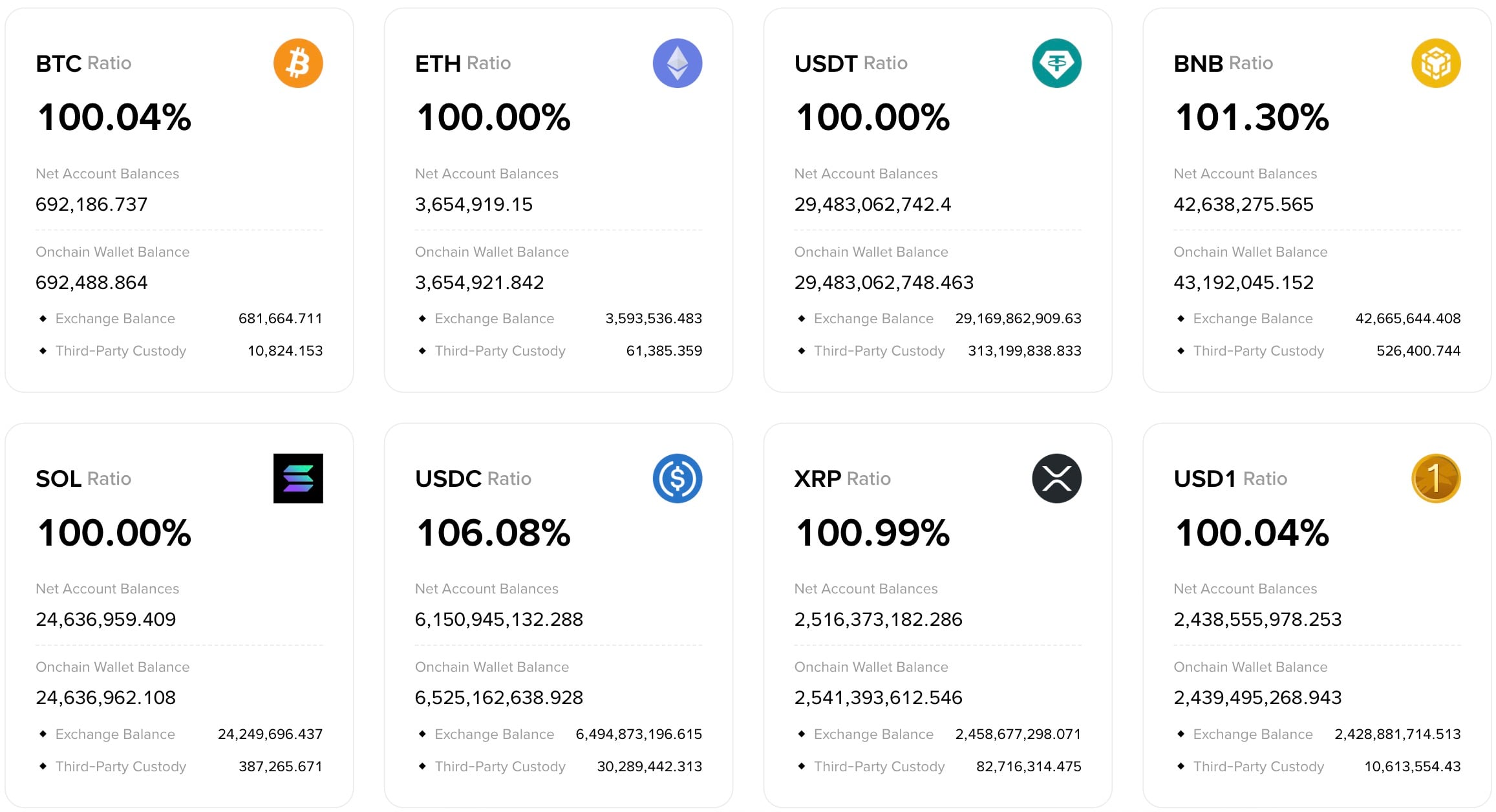
Binance has published its latest Proof of Reserves report as of October 31, 2026. Judging by it, client funds are still fully backed — despite the largest hack in crypto history at the end of the month. Coverage for $XRP is 100.99%, and for the Ripple USD ($RLUSD) stablecoin, 100.83%.
A comparison of balances as of October 1 and October 31 shows how the exchange's liabilities and reserves changed after the October 29 attack: hackers then withdrew about $6.3 billion from its wallets across ten blockchains.
Immediately after the attack, Binance suspended withdrawals and deposits, so the growth of balances in Ripple assets occurred before the hack. October results:
Know when your coins move
Alerts, real-time prices, and market news — all in one app
Point your phone camera to install
4.8 based on 40K reviews in the App Store and Google Play
$XRP: Liabilities to clients grew by 20.84 million coins over the month — from 2,495,533,677 to 2,516,373,182 $XRP. There are currently 2,541,393,612 $XRP on the exchange's wallets and with custodians.
$RLUSD: The most notable inflow is in the new stablecoin: user balances grew from 139.53 million to 201.89 million $RLUSD. Binance increased its reserves to 203.56 million $RLUSD.
How Binance plugged the hole
The main thing in the report is something else: Binance confirmed full coverage of the ten most traded assets, including $BTC, $ETH, $USDT, $BNB and $SOL — and did so just two days after the hack.
About $3 billion of the stolen funds was quickly frozen directly on the blockchains with the help of partners, including Tether, Circle and Ripple. To cover the losses and return reserves to 1:1, Binance allocated more than $6.34 billion of its own capital. This reserve included the SAFU fund, the Binance Futures insurance fund and retained earnings.
Binance Proof of Reserves dashboard showing 100%+ collateral ratios for $BTC, $ETH, $USDT, $BNB, $SOL, USDC, $XRP, and USD1, Source: Binance
The remaining 5% of losses are in low-liquidity tokens: they are being quietly bought back through over-the-counter (OTC) desks so as not to crash spot prices.
Each client can verify their own balance: the report is built on Merkle trees and zero-knowledge proofs (zk-SNARKs). For the market, this case sets a new bar: an exchange is no longer judged by whether it gets hacked, but by how quickly it stops an attack and whether it has enough of its own money to plug the hole.

 u.today