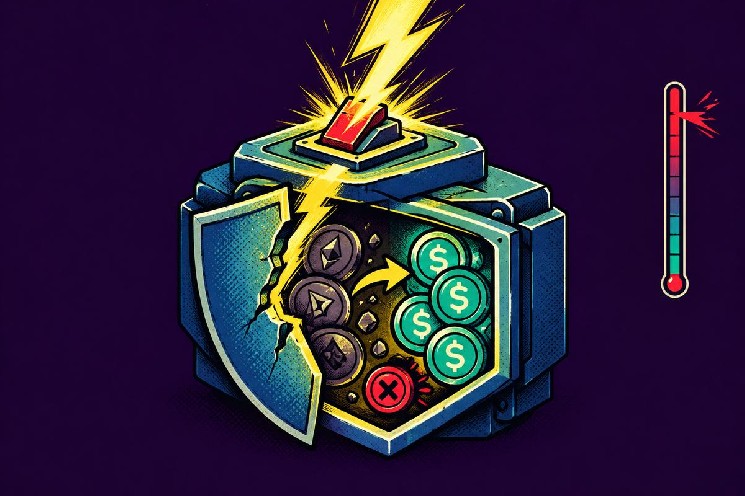
In just over twelve hours, Bitcoin’s price plunged from roughly $7,800 to $3,800. Market makers withdrew liquidity, while blockchain congestion obstructed arbitrage. BitMEX’s contract briefly traded $500 below Coinbase’s spot price, exposing how quickly pricing anchors weakened under stress.
Pricing anchors and liquidation buffers shaped crypto perpetual futures’ evolution
Perpetual contracts have no expiration date, so they use funding payments to pull their prices toward spot markets. BitMEX paired this mechanism with an external spot-price index and a smoothed mark price that determines liquidations rather than reacting directly to sudden order-book spikes.
Loss allocation changed too. On August 3, 2018, an approximately 50,000 $BTC position in OKEx’s quarterly futures market exposed the cost of socialized clawbacks: profitable traders surrendered part of their gains to cover another trader’s bankruptcy.
Huobi developed auto-deleveraging, or ADL, in 2014–2015; BitMEX adopted a modified version in 2016. Instead of spreading losses broadly, ADL forcibly closes highly leveraged, highly profitable counterparties. BitMEX acknowledged the borrowing in its 2025 blog post: “We copied the Huobi ADL mechanism but made a few tweaks.”
Insurance funds absorb liquidation shortfalls before ADL activates. Major-exchange funds range from hundreds of millions to more than $1 billion. Public balance data put Binance’s funds at $500 million–$800 million in early 2026 and Bybit’s $USDT perpetual fund above $400 million.
Stablecoin collateral
Stablecoin-margined contracts displaced inverse coin-margined products after 2020 because falling crypto collateral compounded trading losses during crashes. $USDT-backed contracts separated collateral from the underlying crypto asset.
Partial liquidation also replaced all-or-nothing closures, reducing positions in stages rather than automatically dumping an entire account’s holdings.
Article produced with the assistance of artificial intelligence and reviewed by the editorial team.

 en.cryptonomist.ch