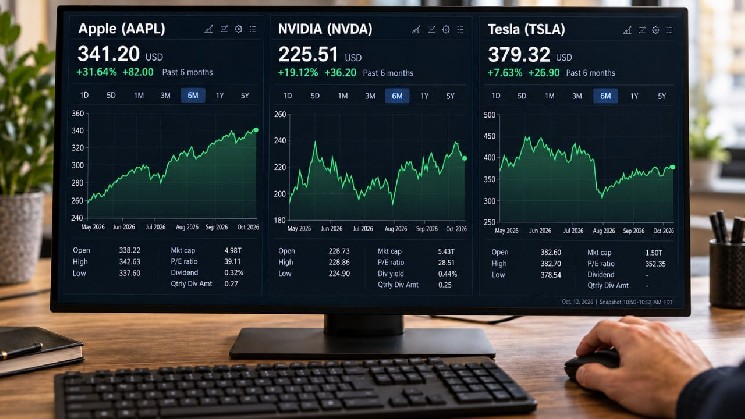
The initial lineup includes Apple Inc. (Nasdaq: AAPL), Nvidia Corp. (Nasdaq: NVDA), Tesla Inc. (Nasdaq: TSLA), and Micron Technology Inc. (Nasdaq: MU). The Invesco QQQ ETF (Nasdaq: QQQ) is also supported. Exchange-traded funds are investment funds whose shares trade on exchanges, and fractional purchases let eligible investors acquire less than one full share of supported securities.
Stock Dividends Return to Accounts as $USDC
Purchases provide an economic interest in underlying securities, with brokerage execution and custody handled separately from the exchange interface. Through its partnership with Alpaca, Bybit offers the service via Infra Capital Limited, an introducing broker regulated by Mauritius’ Financial Services Commission. Alpaca Securities LLC, a U.S. broker-dealer, executes orders and holds the assets.
$USDC funds purchases as a stablecoin designed to track the U.S. dollar, linking cryptocurrency balances with conventional investments. Such dollar-linked stablecoins target a relatively steady value. Eligible crypto and equity positions can be managed through Bybit’s Unified Trading Account, an account interface that brings these holdings together under one login.
Cash dividends are converted from U.S. dollars into $USDC and credited to the holder’s account, subject to applicable terms. Stock dividends appear directly in positions, while stock splits adjust holdings to reflect the corporate action. Eligible purchases and sales carry no trading commissions.
The announced service supports trading 24 hours a day, five days a week, commonly described as 24/5 trading. Availability depends on the product, with access across U.S. premarket, regular, and after-hours sessions. Voting rights are planned for a future phase.
Bybit Builds on Stock Derivatives as Rivals Expand
The launch builds on Bybit’s earlier move into traditional markets, where users already had access to stock derivatives. Its traditional-market integration brought stock contracts for difference, foreign exchange, and commodities into the app in 2025. Those contracts track price changes and are available through Metatrader 5 (MT5), software used to trade traditional-market instruments.
Conventional securities have also entered other cryptocurrency platforms, with exchanges extending their offerings beyond digital assets to include familiar investments. Kraken began commission-free trading in more than 11,000 U.S. stocks and ETFs in April 2025, initially covering selected U.S. jurisdictions. That rollout similarly included fractional purchases and the ability to manage several asset classes within one platform.
Crypto exchange Coinbase (Nasdaq: COIN) and Binance also offer conventional stock trading, with different eligibility rules and funding arrangements across their platforms. Coinbase provides U.S. stocks and ETFs to eligible U.S. residents through Coinbase Capital Markets. Binance launched access to more than 7,000 U.S. stocks and ETFs on June 1 for eligible users, with purchases primarily funded in $USDC and fractional shares starting at $5.
Crypto.com and Gemini have likewise incorporated brokerage services into their cryptocurrency platforms, while Robinhood combines both asset classes in its U.S. app. Crypto.com offers more than 12,000 stocks and ETFs to U.S. customers. Gemini’s securities service is available only to eligible U.S. residents in states where it has launched. Robinhood separately offers Classic Stock Tokens in Europe, structured as derivative contracts.
Tokenized equities use blockchain tokens backed by stocks or ETF shares held in custody; xStocks is a brand of these instruments. Kraken’s expanded Alpaca partnership for xStocks designated the broker as a source and custodian for equities backing those tokens. Bybit continues to offer tokenized equities, MT5-based products, and traditional-finance perpetual contracts alongside its new stock service.

 news.bitcoin.com