A cancel inside that window changes what the order may leave behind. Kraken converts the held placement to immediate-or-cancel, meaning it can trade when released but cannot leave an unfilled remainder on the book. The original hold expiry stays the same.
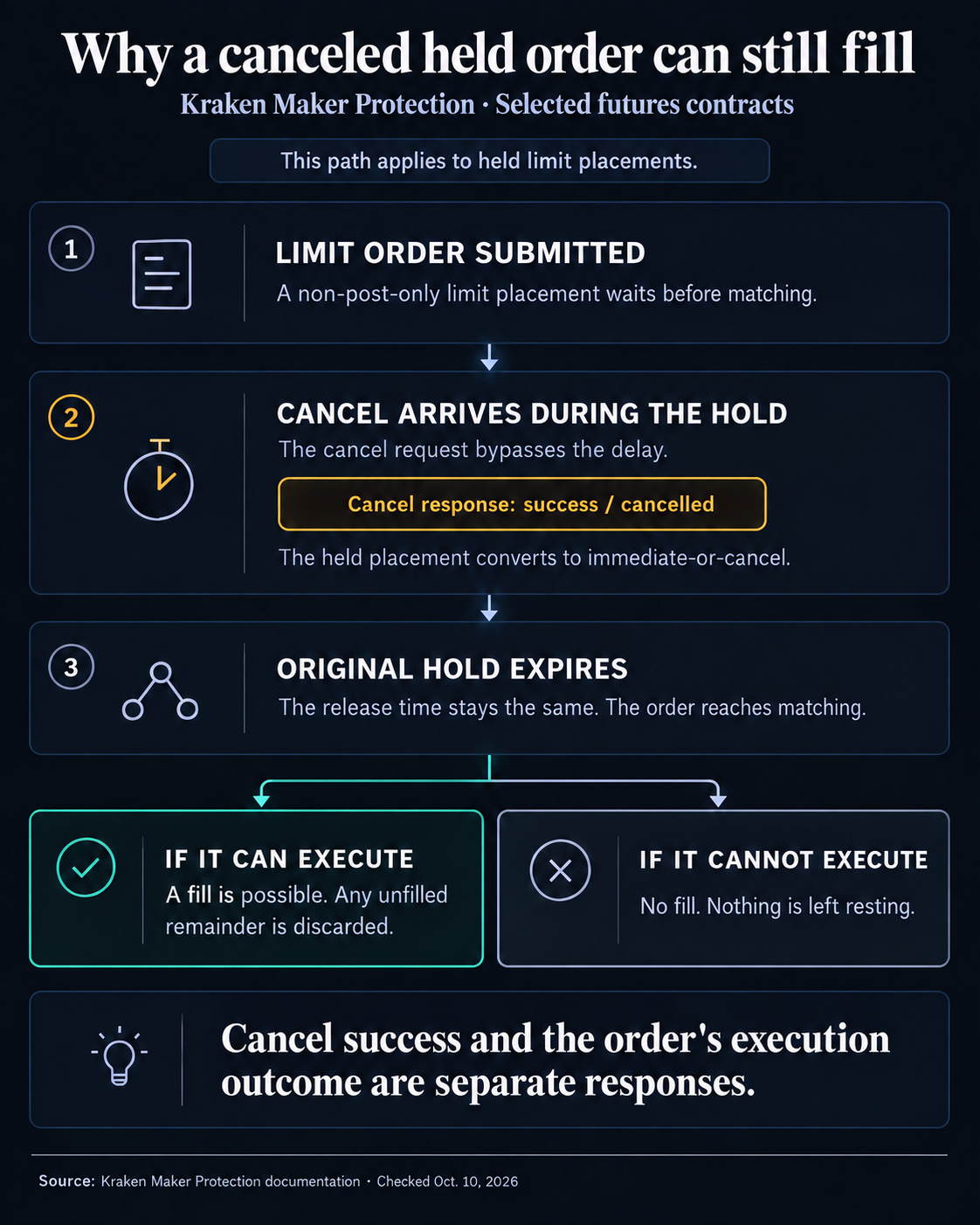
For example, a trader submits a non-post-only limit order and cancels before the hold expires. The cancel request bypasses the delay and converts the held placement to immediate-or-cancel. At the original release time it can still fill; any unfilled amount is discarded.
Kraken reports those instructions separately. The cancel receives success with order status “cancelled,” while the order later reports its own fills or failure to execute. For a converted limit that cannot trade, the REST v3 response is iocWouldNotExecute.
Kraken’s instruments feed identifies each market’s configured hold through makerProtectionMillis. Its documentation says an absent or zero value means no configured delay.
The distinction is contract-specific, so traders cannot infer coverage from the coin name alone. Kraken says its ten most liquid linear perpetual markets are excluded and spot trading is unaffected. Standalone post-only placements bypass the hold. Cancel requests also bypass it; a held limit placement still waits for its original release time.
Other held order types have different cancel responses. A cancel targeting a held immediate-or-cancel, fill-or-kill or market placement returns ORDER_NOT_FOUND; the original request still reaches matching when released.
Automated traders in Kraken futures need to reconcile the order’s execution response as well as the cancellation acknowledgment. A successful held-limit cancel can coexist with a later fill.

 cryptoslate.com