OKX and NYSE Owner ICE Plan 24/7 Tokenized Stock Trading Under SEC Exemption
decrypt.co
05 October 2026 07:22, UTC
In brief
OKXICE, the joint venture between OKX and NYSE owner Intercontinental Exchange, has filed notice to run a 24/7 tokenized stock venue under the SEC's new Innovation Exemption.
Its notice lists tokenized versions of more than 60 U.S.-listed stocks, each trading against $USDC, $USDG or Tether's $USDT.
Chipmaker Cerebras Systems has already lodged an objection with the venue, which does not name the firm issuing its tokens.
OKXICE, the joint venture between crypto exchange OKX and New York Stock Exchange owner Intercontinental Exchange (ICE), has notified the SEC that it plans to launch a round-the-clock trading venue for tokenized U.S. stocks, co-chair Andrew Cuomo said in atweet Monday.
The venture published anotice dated October 4 under the SEC's"Innovation Exemption," which since September 17 has allowed qualifying venues to trade tokenized stocks without registering as exchanges. OKXICE will operate 24 hours a day, seven days a week, the notice says.
Know when your coins move
Alerts, real-time prices, and market news — all in one app
Point your phone camera to install
4.8 based on 40K reviews in the App Store and Google Play
Today we are announcing a major step forward for OKXICE, the joint venture between @okx and Intercontinental Exchange, parent company of @NYSE:
OKXICE has notified the SEC that we intend to launch our Tokenized Securities Venue (TSV) under the SEC’s new Innovation Exemption.…
— Andrew Cuomo (@andrewcuomo) October 5, 2026
The SEC does not approve venues individually. A firm that meets the exemption's conditions notifies the agency and can then operate under it, subject to those conditions.
Cuomo, a former New York governor,called the filing "a landmark step toward a truly global, 24/7 Wall Street."
The notice lists Nvidia, Tesla, Apple, Microsoft and SpaceX, alongside crypto-linked firms Coinbase, Circle, Strategy, Robinhood, BitGo and Securitize. Each tokenized stock will trade in a pair with one of three stablecoins: $USDC, $USDG or Tether's $USDT.
In June, an OKX spokespersontoldFortune the venture would focus on tokenizing NYSE-listed equities. Nvidia, Tesla, Apple and Microsoft all list on the Nasdaq.
Chipmaker Cerebras Systems has already lodged a notice of issuer objection with the venture, the filing says. The exemption lets third parties tokenize a company's shares without its involvement, but a venue must notify the issuer and give it30 days to object. If it does, the tokens cannot trade there. Cerebras does not appear on the notice's list.
The OKXICE venue
Trades will run through permissioned Uniswap v4 liquidity pools on XLayer, a layer-2 blockchain, with a custom smart contract checking every transaction. Only wallets holding a non-transferable soulbound token, issued after identity, anti-money laundering and sanctions checks run by OKX's U.S. entity, can trade or supply liquidity.
The notice warns that tokenized prices, set solely by the pools, may diverge from the underlying shares, particularly outside regular exchange hours.
The tokens themselves come from an unaffiliated third party,described only as "the Tokenizer," which holds the underlying shares one-for-one through a registered broker-dealer. The notice does not name it. Holders are entitled to the same dividends and voting rights as ordinary shareholders, according to the filing.
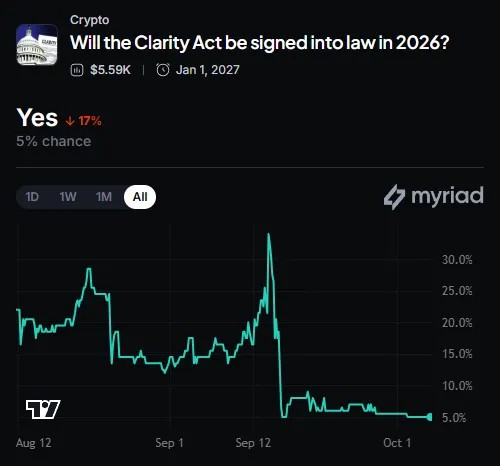
Myriad: Will Congress pass the Clarity Act? Click to make your prediction.
ICE and OKXformed the 50-50 venture in June, three months after ICE took a minority stake in OKX at a$25 billion valuation. The pair had alreadybrought crypto-native perpetual futures for oil to market for non-U.S. customers. Cuomo, who also served as New York's attorney general, has worked with OKX since 2023.
The SEC issued the exemption on September 17, months after Chair Paul Atkinswalked back a January target following pushback from Wall Street groups, and days after the Clarity Actfailed to advance in the Senate.
Atkinssaid the SEC was acting "within its statutory authority," and officials described the exemption as a temporary bridge toward permanent rulemaking.
The exemption "could put DeFi trading platforms and liquidity pools in much more direct competition with traditional exchanges," Chris Hayes, executive director of the Coalition for Tokenized Markets,toldCrypto in America at the time.

 decrypt.co