
 coindesk.com
A small number of repeating trade sizes accounted for more than half the value traded on Kalshi's bitcoin and ether perpetual-futures markets, according to a CoinDesk analysis of the exchange's public trade records.
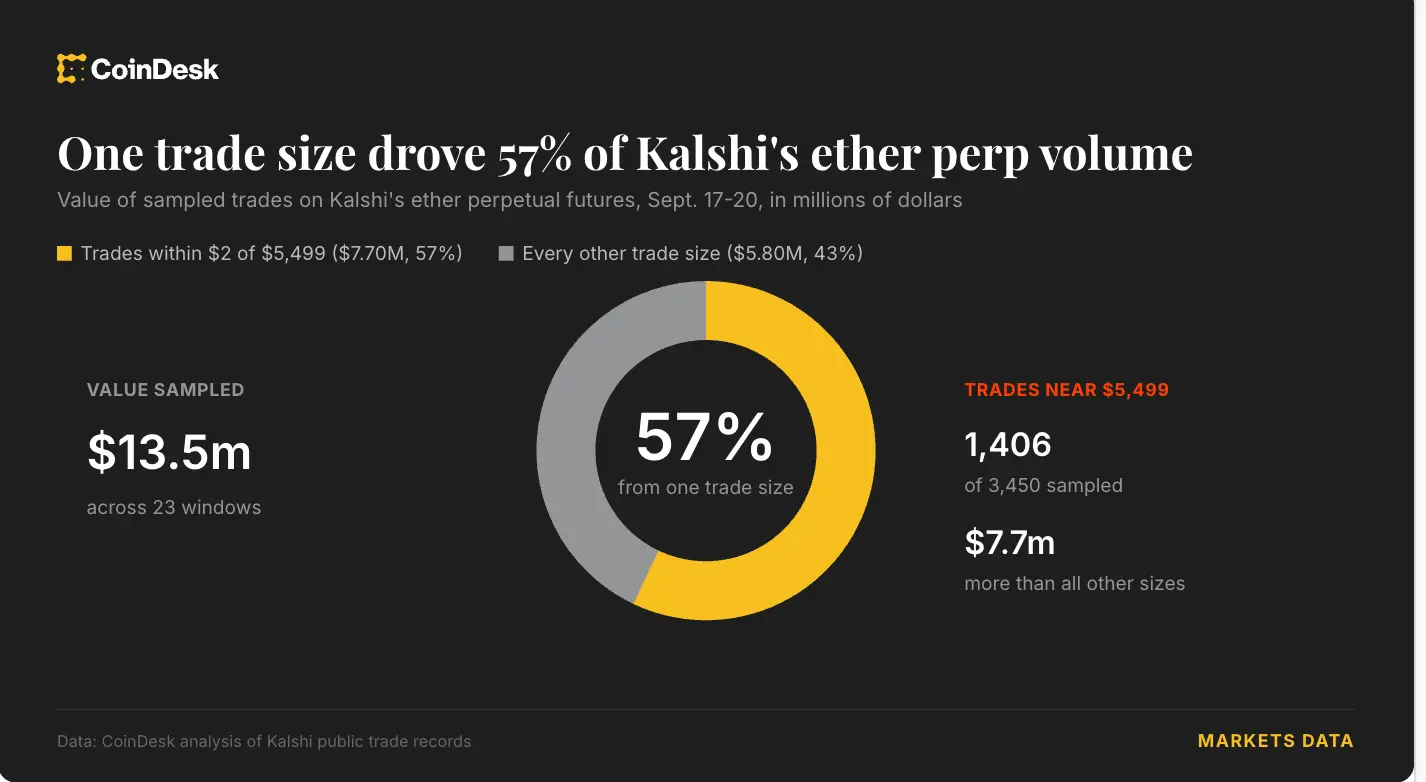
On the ether market, trades valued within $2 of $5,499 accounted for $7.7 million, or 57%, of the $13.5 million in transactions CoinDesk analyzed from Sept. 17 through Sept. 20. On bitcoin, two recurring trade sizes worth about $2,500 and $5,000 accounted for 54% of the $8.5 million data sampled over the same period.
Volume is one of the first metrics traders use to judge how active and liquid a market is — in other words, whether they can buy or sell without significantly moving the price.
High volume can also make a new market appear more widely used. So if a large share of that activity comes from the same recurring trade sizes, understanding who or what is generating those trades is important for assessing what the volume actually represents.
For example, if a publicly traded stock reports millions of dollars in trading volume each day, traders may assume there are plenty of buyers and sellers on both sides, making the stock worth trading.
However, those numbers alone don’t reveal how many different traders generated such activity. In this case, a large share of Kalshi’s volume came from the same set of recurring trade sizes, making it important to understand what was driving the pattern.
The pattern predates that four-day sample.
In 43 of 46 one-hour samples CoinDesk examined between June 19 and Sept. 20, ether trades repeatedly clustered around recurring specific dollar targets. The prevailing trade size accounted for about 45% of the value across those samples and more than half of the value on 15 dates.
The number of contracts involved changed as ether's price moved, while the dollar value of the trades remained nearly fixed. That pattern is consistent with one or more automated trading programs executing predetermined dollar amounts, known among traders as ‘clips.’
Kalshi is a U.S. derivatives exchange regulated by the Commodity Futures Trading Commission and best known for its prediction markets. It added bitcoin perpetual futures, or contracts that track the asset without expiring, in late May.
What the data shows
Kalshi divides the exposure into small contracts, which traded near $2.70 apiece on Monday. CoinDesk analyzed 3,450 ether-perpetual trades across 23 one-hour samples during the four-day period using the exchange’s public API datasets. Of those, 1,406 landed within $2 of $5,499.



