
 cryptopolitan.com

DefiLlama announced the launch of its new REAL Ranking tab on September 16, providing an alternative to the exchange leaderboard, which was mainly based on reported volume.
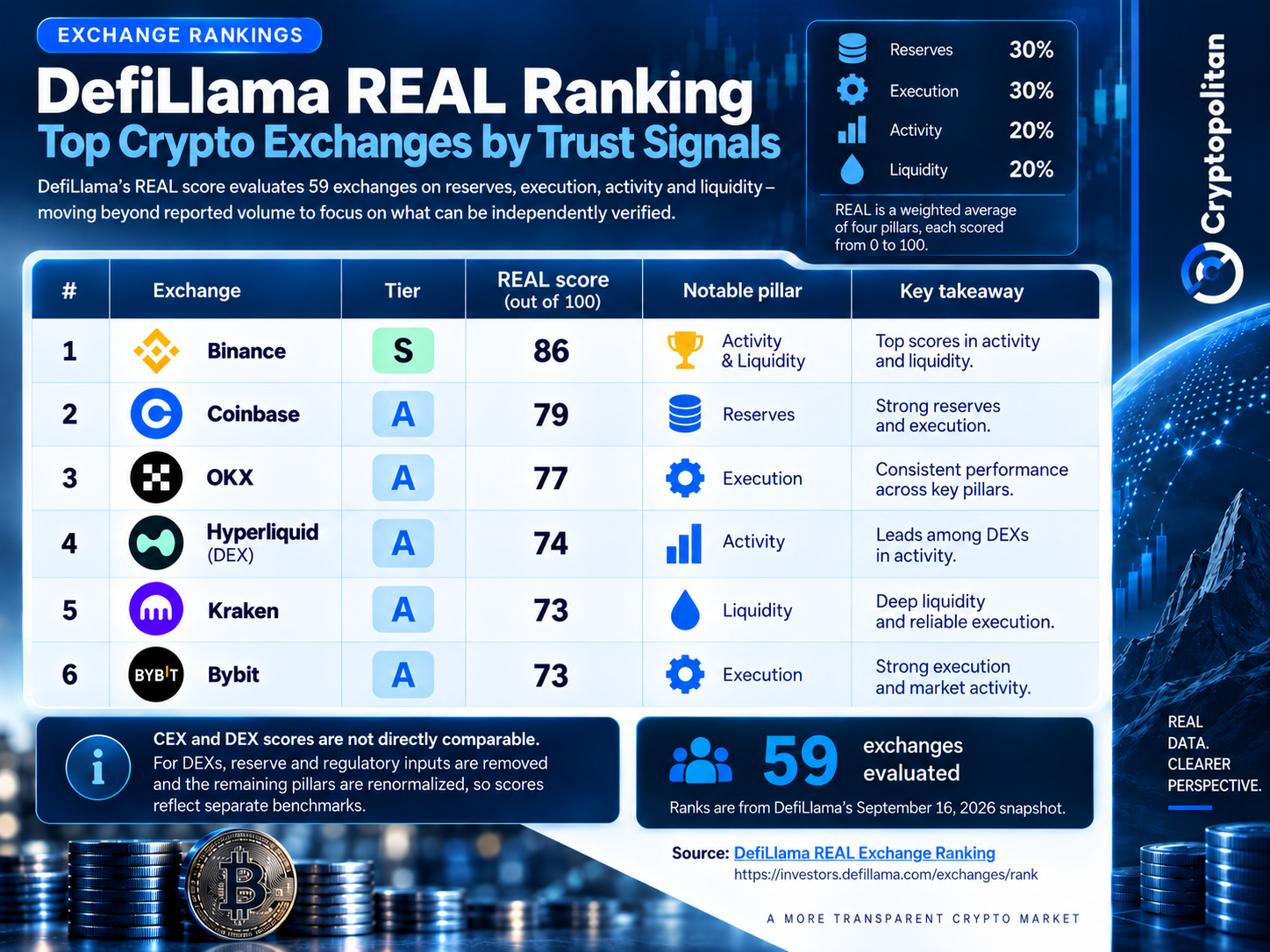
At the time of writing, the live ranking was showing 59 different exchanges, ranked based on their reserves, execution, activity, and liquidity. This provides traders and institutions with a way of estimating how much of the market activity of a given exchange could actually be verified.
This comes at a time when competition among trading venues has moved beyond just turnover rates. Decentralized exchanges are on the rise, regulated platforms implement 24/7 trading in crypto derivatives, and regulators are still working on resolving the issues arising from the discrepancy between jurisdictions. With the launch of its REAL Ranking tab, DefiLlama is raising a more pertinent question: beyond which venue ranks the highest, which indicators are trustworthy.
Why volume is the one figure a venue can print
REAL consists of a mix of four pillars scored between 0 to 100. The contribution of each pillar to the final REAL score is as follows: Reserves at 30%, Execution at 30%, Activity at 20% and Liquidity at 20%. According to DefiLlama, volume is very easy to inflate by an exchange venue, while reserves can be checked either on-chain or via filed numbers; execution is verified using its trade data, and the resting liquidity can be directly checked.
This concern is backed by academic research published in the International Review of Financial Analysis journal early this month. The researchers used BTC, ETH, LTC, and XRP trading data from 2020 to 2022 and found that wash trading can undermine integrity of exchanges and have a distorting effect on liquidity claims. They also observed that wash trading tends to rise in times of volatility.
Binance leads, but the tiers do not cross types
In a snapshot of the DeFiLlama REAL Ranking tab on September 16, Binance ranked the highest with an S-tier REAL score of 86. Coinbase followed at 79, OKX at 77, Hyperliquid at 74, while the score of Kraken and Bybit came at 73.
DefiLlama cautions that scores for centralized exchange (CEX) and decentralized exchange (DEX) scores cannot be directly compared. Although both appear in the overall ranking, the methodology adjusts how certain inputs are treated by exchange type. DefiLlama therefore says CEXs and DEXs should be compared within their own categories rather than treating their raw REAL scores as equivalent.
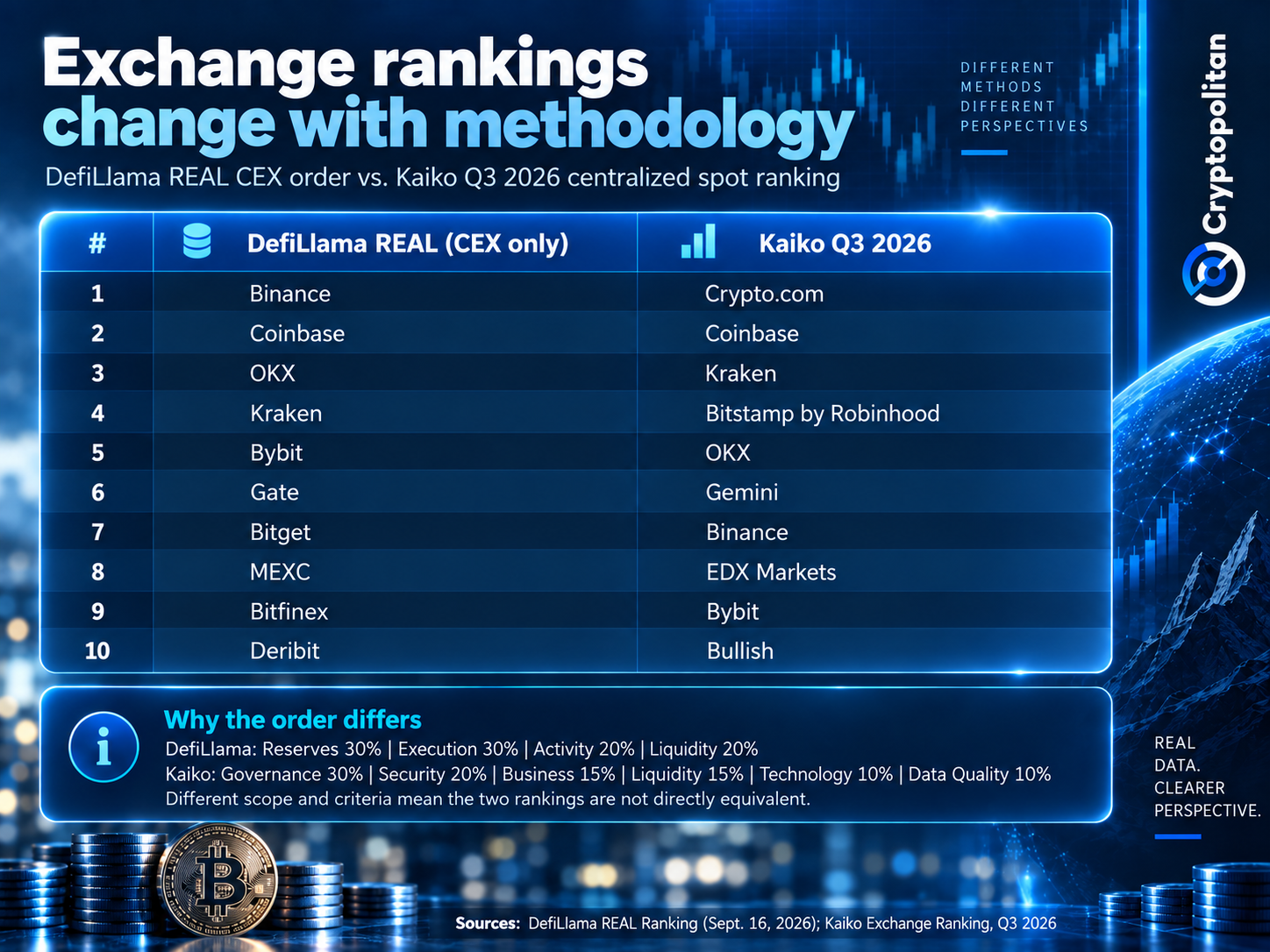
Kaiko’s Q3 2026 ranking reveals the extent of how much the methodology matters for the rankings. Its centralized spot ranking has Crypto.com in first place, followed by Coinbase, Kraken, Bitstamp, Robinhood, and OKX, with Binance coming in seventh. While Kaiko is looking at governance, security, business, liquidity, technology, and data quality, REAL is looking at the reserves, execution, activity, and liquidity. Both rankings are therefore addressing different questions.
DEX share is growing, especially in perps
At the time the DeFiLlama live exchange dashboard was accessed, it indicated that there was around $257 billion in 24-hour volume—$231.4 billion of which took place on CEXs and $25.5 billion on DEXs.
But the difference is much smaller when it comes to derivatives. The DEX dollar-denominated perpetual volume was approximately $25.2 billion compared to $187.8 billion for CEXs, while in the spot segment the volumes were only $343 million against $40.2 billion, respectively.
The 2026 trading report provided by CoinGecko shows the longer-term trend in trading. DEXs achieved a peak of 24.5% of spot volume in June 2025 and have remained above 10% since January 2025. The DEX-to-CEX ratio of perpetual volume has increased by five times to 10% by January 2026.
According to its perpetuals report, the top 12 perpetual DEXs have managed to increase their average monthly volume to $ 611.57 billion in the first four months of 2026 from $ 531.65 billion in 2025. In addition, their share of perpetual open interest hit 13.5% by April 30.
In addition, Cryptopolitan has reported a record high of 24.16% of the DEX-to-CEX spot volume in July, which is a directional ratio rather than a global market share measure.
The contest now includes regulated TradFi venues
CME Group launched 24/7 trading for cryptocurrency futures and options on May 29. More than 7,200 contracts, representing about $50 million in notional value, traded during the first weekend. The rollout brings regulated crypto derivatives into the same always-on trading cycle as crypto-native markets.
JB Mackenzie, VP and GM of Futures and International at Robinhood Markets, framed the significance in CME Group’s launch announcement:
“Crypto is a 24/7 asset class… This launch bridges the weekend gap between traditional derivatives and spot markets.”— JB Mackenzie, VP and GM of Futures and International, Robinhood Markets
The regulatory backdrop remains fragmented. An October 2025 FSB-IOSCO joint note pointed to uneven implementation, regulatory-arbitrage risks and enforcement gaps. The market’s plumbing also reaches beyond crypto: a March 2026 BIS working paper found that more than 70% of fiat-to-stablecoin conversions originated from non-US-dollar currencies, with measurable spillovers into conventional FX markets.