
 u.today
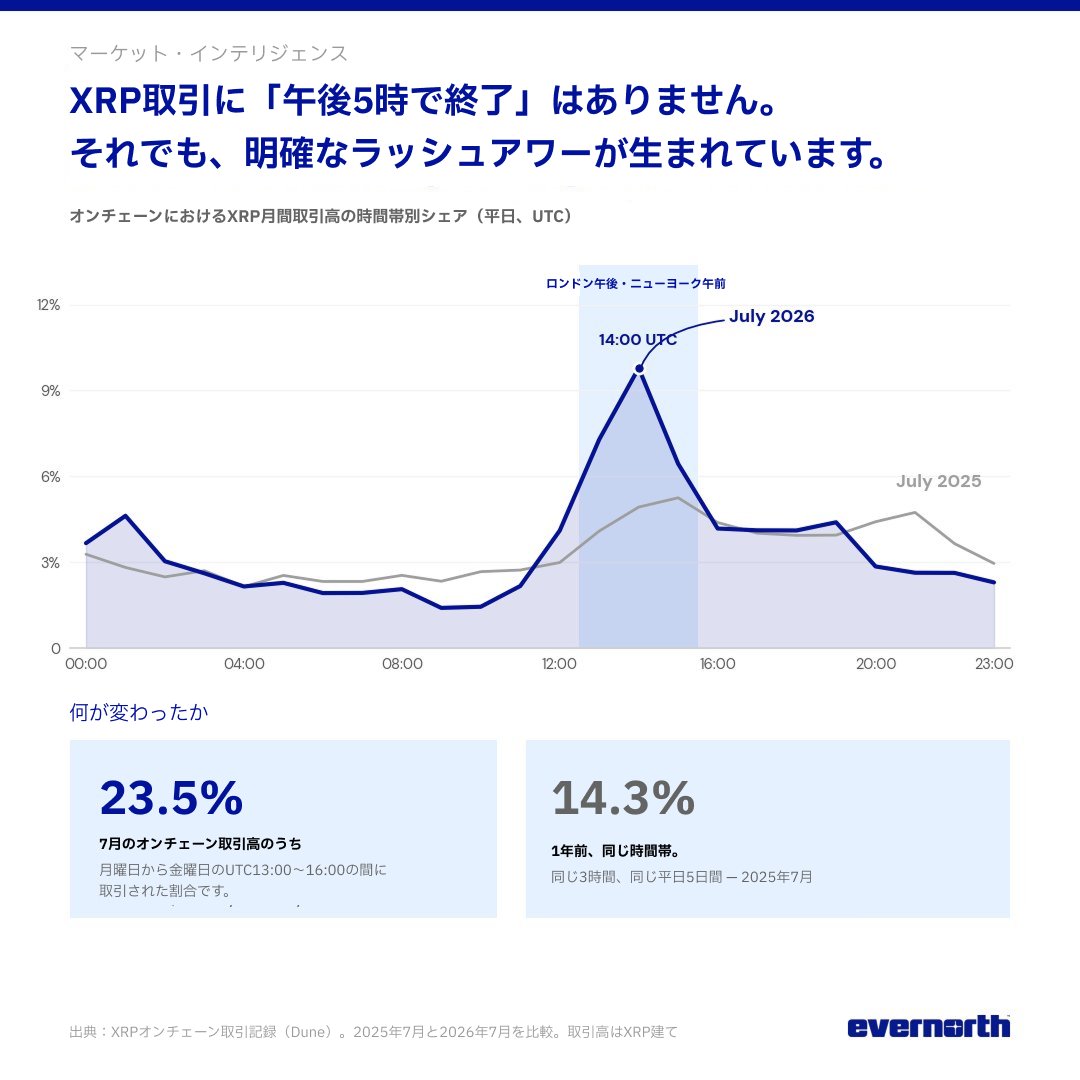
Cryptocurrency markets operate around the clock, but large volumes of capital are concentrated around the trading schedules of traditional exchanges. Analysts at the Japanese arm of financial company Evernorth, after studying on-chain data from the $XRP Ledger (XRPL) via Dune Analytics, identified a major shift in the market structure — $XRP has developed a clear "rush hour," while the share of trading during these key hours has nearly doubled over the past year.
This dynamic indicates that professional market participants are actively synchronizing their operations on the decentralized network with the rhythm of the traditional interbank market.
Big money likes a schedule. Why $XRP now has its own "rush hour"
According to Evernorth's July 2026 report, 23.5% of all weekday on-chain $XRP trading volume is now tightly concentrated within a narrow three-hour window — from 13:00 to 16:00 UTC. A year ago, the same period accounted for only 14.3% of total volume. The share of liquidity within this session has effectively doubled, creating an unusual isolated spike in activity exactly at 14:00 UTC that was not observed in 2025.
The phenomenon has a simple explanation: these three hours are when the working hours of the world's major financial capitals — London and New York — overlap (the London-New York overlap). This is the key period of the day for the global Forex market, when worldwide liquidity reaches its peak. $XRP has now begun operating according to the same schedule.
Evernorth, which is the largest company by the amount of $XRP held in treasury reserves, emphasizes that the emergence of a pronounced "rush hour" is direct evidence that major financial institutions have begun using the XRPL network on a large and systematic scale.
Moreover, the inflow of liquidity is distributed evenly across the blockchain's entire internal infrastructure. Growth in volume has been recorded simultaneously across three levels:
- Traditional limit order books;
- Automated market maker (AMM) pools;
- Cross-border payment gateways, where $XRP is used as a bridge asset for instant currency conversion.
The main feature of the new data is a qualitative change in the market structure. Digital asset trading has no concept of an exchange "closing at 5 p.m." However, real businesses prefer to operate during familiar commercial hours.
The fact that almost a quarter of all daily trading volume is now concentrated within a period that accounts for only 9% of the week's total duration points to the network's growing maturity. The $XRP Ledger is adapting to the rhythm of the global financial system, becoming a more predictable instrument for institutional participants.