Emerging Markets Account for Most of the Growth
StraitsX, which is a Singapore-based payments firm that sponsors Visa card programs for other crypto companies, recorded a 600% growth in gross transaction value across lower-GDP regions between early 2025 and 2026. At the same time, Binance has highlighted how the average users of its Brazil card rose 53% from the launch quarter to Q2 2026 while average volume grew 80%. The leading uses were ride-hailing, food delivery, groceries, restaurants and online subscriptions.
Similarly, Kraken also reported that weekly payments via its Krak Card more than doubled over the past year to 8.3 per user, with retail and store purchases making up 59.3% of spending.
The Issuing Rails Got Cheap Enough for Small Tickets
Mastercard turned on stablecoin settlement on June 3, covering USDC, Paxos-issued tokens, RLUSD and SoFiUSD across eight chains. Visa now counts more than 160 stablecoin card programs either live or in development. Providers like Rain, Reap and Stripe’s Bridge have stripped out much of the float and licensing overhead that made a $12 purchase pointless to settle onchain. Small tickets only work when the cost per transaction collapses, and that is what changed over the past year.
The Data Comes With Caveats
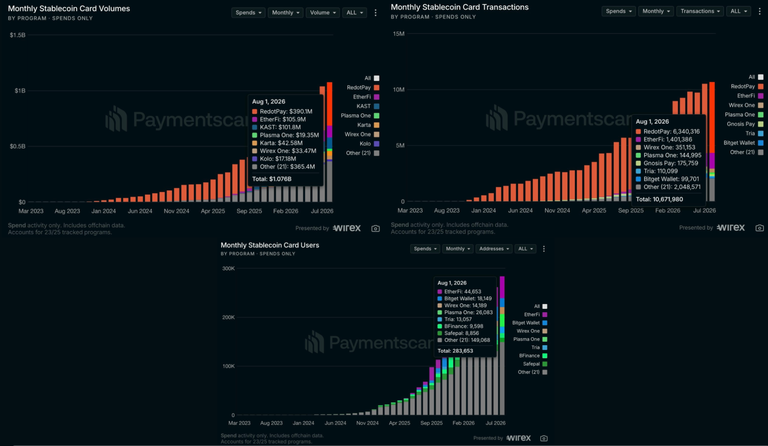
Three programs make up 55.6% of all volume, which makes the sector far more fragile than the headline number suggests. Paymentscan’s RedotPay figures are self-reported by the issuer rather than observed onchain, and RedotPay is both the biggest name in the dataset and its loudest promoter. The company is currently dealing with a roughly $472.8 million claim in Hong Kong brought by Binance affiliates over alleged user diversion, and its planned $1 billion US listing now looks unlikely before 2027.
Scale is worth keeping in perspective too. August’s $1.076 billion annualizes to roughly $12.9 billion, which is about 0.06% of the $20 trillion-plus traditional card market. This is still a rounding error in global payments.
Spending Went Up While the Float Went Down
Here is the part that stands out. Stablecoin supply has dropped 3.6% from its May peak and now sits around $304 billion, as per DefiLlama. Card spending set a record in the same window.
For most of the past three years, onchain payment activity moved with the size of the stablecoin pool. More supply meant more speculative capital sitting idle, and some of it eventually got spent. That link appears to be breaking. Volume, transactions and users all hit highs while the float contracted, which suggests the people using these cards are funding them to spend rather than parking capital and swiping the remainder.

 cryptopolitan.com