The Lines Between Crypto Exchanges and Financial Institutions Are Beginning to Blur
financemagnates.com
22 July 2026 21:47, UTC
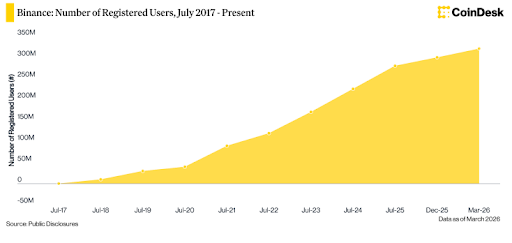
How should regulators and competitors as well as markets classify a platform that looks like several financial businesses at once? It processes $10 billion in daily spot trading volume, serves 316 million registered users across 180 jurisdictions, distributes $1.2 billion in yield rewards, handles $280 billion in cumulative payment volume, and offers access to more than 7,000 US equities.
A recent CoinDesk Research report revealed the answer. It’s that the platform is no longer best understood simply as a venue for buying and selling digital assets. As the digital asset market matures, this category-defying evolution forces a reexamination of what these ecosystems mean for global competition and regulatory oversight as well as the fundamental structure of financial services.
Mapping the Category Overlaps
One of the clearest examples of this convergence is the rapid expansion of traditional investment products on crypto-native infrastructure. Binance's direct stock trading and bStocks offerings surpassed $1 billion in assets under management within their first month, suggesting demand extends well beyond digital assets alone.
Know when your coins move
Alerts, real-time prices, and market news — all in one app
Point your phone camera to install
4.8 based on 40K reviews in the App Store and Google Play
"A billion dollars in 30 days is a sign of the demand that's been waiting decades for a door to walk through," says Shunyet Jan, Head of Spot & Derivatives Business at Binance. "The walls that kept most of the world out of U.S. stocks were never as solid as they looked. We built this for the hundreds of millions of people who never had a way in."
That early adoption helps explain why Binance increasingly overlaps with multiple categories of financial institutions rather than functioning solely as a cryptocurrency exchange.
When measuring Binance's capabilities against traditional financial categories, the structural overlap becomes apparent. Retail brokerages Robinhood, eToro, Webull, and Revolut collectively serve fewer users than Binance's 316 million registered users. At that scale, the introduction of new products can rapidly reshape participation in markets where traditional financial infrastructure has historically remained limited.
Binance Research found that approximately 93% of early direct stock trading users originated from emerging markets, highlighting a vast demographic where 82% of the global population lacks meaningful access to the world's largest equity market.
During the platform's first week of direct stock trading, more than 80% of trading volume came from emerging-market users, while nearly 40% of all trades were under US$100, which is a distribution that would be structurally difficult to achieve through many traditional brokerage models given account minimums, cross-border fees, and funding friction.
The Competitive Frontier Has Expanded
CoinDesk Research indicates that the platform now competes directly with fintech applications, neobanks, and traditional financial institutions rather than just other cryptocurrency exchanges. A larger transformation is unfolding within the traditional banking system, where tokenized deposits already facilitate trillions of dollars in annual transfers, far more than stablecoin payments. McKinsey notes that JPMorgan's Kinexys alone is estimated to facilitate more than $1 trillion in tokenized deposit transfers annually.
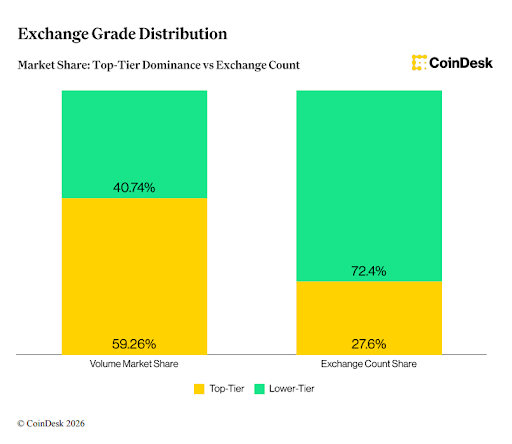
As traditional institutions adopt blockchain architecture, centralized digital asset exchanges continue to consolidate market share. The CoinDesk Exchange Benchmark found that top-tier exchanges account for 59.26% of first-quarter spot volumes despite representing only 27.6% of rated venues.
The competitive frame extends beyond exchange versus exchange. Markets are witnessing an environment where exchanges compete with banks, brokerages, and fintechs for the same global capital flows, blurring the lines between institutional finance and retail crypto ecosystems.
The Vertical Integration Advantage
Many modern fintech applications rely on external trading venues, liquidity providers, and financial infrastructure to route orders and settle transactions. Centralized exchanges, conversely, operate for profit while providing services that people demand through deeply vertically integrated models. Binance operates its own exchange and also a derivatives platform, liquidity network, and an expanding tokenized-asset ecosystem. This bundle of services aims to reduce dependencies on third-party intermediaries.
This integration removes friction points that standalone applications struggle to bridge. As detailed in the platform's recent data, stock trades settle in stablecoins (USDC, USDT, USD1, $U) or BNB, reducing friction in both user experience and market access. Controlling the underlying infrastructure creates closer links between trading, payments, savings, and asset management than disparate fintech bundles can typically achieve, allowing users to move capital efficiently across entirely different asset classes without waiting for banking settlement delays.
The Regulatory Challenge: Which Regulator Oversees a Platform That Doesn't Fit One Category?
Oversight requires new frameworks when a platform operates across spot trading and derivatives and also payments and equities simultaneously. But which regulator oversees a platform if it doesn't fit into a single regulatory category?
The Abu Dhabi Global Market addressed this structural complexity by granting Binance full authorization in December 2025 through a three-entity model. Here, Nest Exchange acts as the exchange operator while Nest Clearing and Custody serves as the clearing house and custodian. Finally, Nest Trading functions as the broker-dealer.
Broader regulatory infrastructure remains fragmented. The CoinDesk Exchange Benchmark reports that only 16 of 75 exchanges hold a full MiCA licence, and 53% of benchmarked exchanges have no regulatory footprint beyond basic registration. While 2025 saw several advancements in digital asset regulation globally, including frameworks in Hong Kong, Singapore, the US GENIUS Act, and MiCA, the regulatory gap remains a significant near-term challenge. Most jurisdictions simply haven't developed frameworks for platforms spanning multiple financial services categories simultaneously.
A New Classification for the Next Decade
What launched in July 2017 as a centralized venue for trading digital assets has grown into an infrastructure model that lacks a definitive industry label. Binance's evolution from a niche trading platform to a multi-asset ecosystem mirrors the broader maturation of the digital economy as the company is approaching its nine-year anniversary.
Whether categorized as a financial super app, a crypto-native financial institution, or a completely new construct, the convergence of these distinct services represents a different category of market participant. The data through H1 2026 suggests that crypto-native infrastructure is increasingly capable of supporting this convergence. What will likely define the structure of financial services over the next decade is how regulators and competing financial institutions as well as global markets respond.

 financemagnates.com