
 coindesk.com
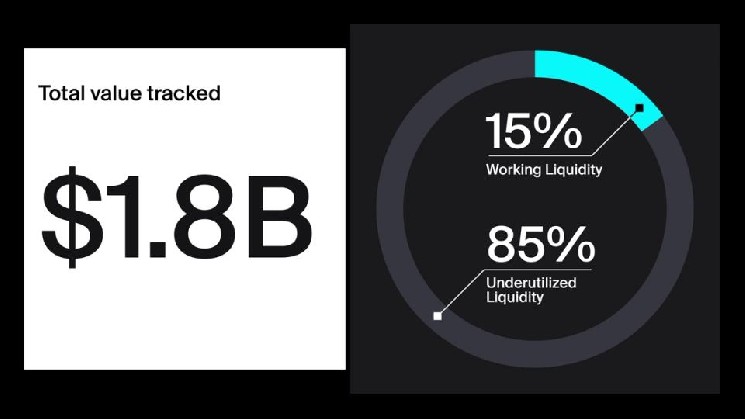
About $1.6 billion in liquidity deposited across major decentralized exchanges was not being used to its full potential during the first half of 2026, a new research finds.
The figure represents 85% of the $1.84 billion tracked across concentrated liquidity pools on Uniswap, PancakeSwap and Aerodrome, according to research by analytics firm Dune commissioned by decentralized exchange aggregator 1inch.
Roughly $542 million, or 29.5%, sat fully out of range in an average week. The money had not left the decentralized finance ecosystem. It was priced so high that traders could not use it.
The findings come as retail platforms bring more users and traditional assets onchain and financial firms expand their work on tokenized funds and blockchain-based settlement. 1inch argues that idle liquidity will become more costly as markets grow, more capital will be stranded, and more trading fees will go unearned as liquidity becomes thinner.
“Decentralized exchanges have grown into one of the deepest, most liquid markets in crypto,” said Filippo Armani, research lead at Dune. “What our research shows is that it has reached this scale even though much of its liquidity is not yet fully at work.”
Concentrated liquidity pools let providers place assets within a chosen price range. The capital supports more trading and collects more fees while the market stays within that range; once the price moves beyond it, the position stops working until the provider adjusts the range or the market returns to its original setting.
For example, a position in an $ETH/USDC pool set between $2,000 and $2,500 stops earning fees if the price of $ETH moves outside that band. The provider must set a new range or wait for the market to return to it.
Dune tracked Uniswap v3 and v4, PancakeSwap v3 and Aerodrome Slipstream across 7 chains using weekly snapshots from Jan. 6 to June 30. The out-of-range share stayed mostly between 25% and 35%, rising to nearly 41% in early February.
The study linked idle liquidity more closely to price movements than to volatility. A steady price move in one direction is more likely to strand capital than a volatile week that ended near where it began. Incidentally, the bitcoin price was hovering near $90,000 during January before crashing to around $60,000.
Additionally, larger positions are usually less likely to sit idle, but the research found that those pools of money still held most of the inactive capital.