
 cointelegraph.com

Canadian fintech Wealthsimple is launching a prediction markets app powered by Kalshi, giving that country's retail investors access to thousands of event-based contracts following regulatory approval earlier this year.
The standalone app, called Wealthsimple Predict, is scheduled to launch this summer and will offer Canadian users access to about 4,000 event contracts listed on Kalshi across categories including financial markets, economic indicators and climate.

Source: Kalshi
The Canadian Investment Regulatory Organization (CIRO) in March authorized the firm to offer prediction market contracts tied to those categories. It is the second investment dealer authorized by CIRO to offer prediction market trading in Canada. The contracts will be regulated as derivatives and must have settlement periods of at least 30 days.
The Canadian rollout comes as Kalshi expands beyond prediction markets. On Thursday, the company said that its perpetual futures products were now live for trading, following a May 31 announcement that marked the company's entry into the crypto perpetual futures market.

Source: Kalshi
CME pushes back against CFTC's crypto derivatives stance
Kalshi's expansion beyond prediction markets is already facing pushback from established derivatives exchanges.
On Thursday, CME Group sued the US Commodity Futures Trading Commission (CFTC) over its approval of cryptocurrency perpetual futures contracts offered by Kalshi and similar products by Coinbase, arguing the regulator misclassified the products under federal law. The filing followed comments from CME CEO Terrence Duffy a day earlier that the exchange planned to challenge the approvals in court.

CME CEO Terry Duffy. Source: CNBC Fast Money
The lawsuit comes amid a broader push to bring crypto perpetual futures onshore. In May, the CFTC approved Bitcoin perpetual futures contracts for Kalshi and issued a no-action position allowing Coinbase to offer similar products.
Since then, Coinbase expanded US institutional access to global crypto derivatives markets, while Kraken launched perpetual futures trading this week through its CFTC-regulated Bitnomial exchange.
Countries push back against prediction markets
Despite gaining traction in Canada, prediction markets continue to face regulatory resistance in several jurisdictions. In May, Spanish regulators ordered internet providers to block access to Kalshi and Polymarket while investigating whether the platforms were operating in violation of national gambling regulations.
Asian regulators have also moved against prediction markets. Indonesia recently banned Polymarket after users traded contracts tied to whether President Prabowo Subianto would leave office early, while Japanese crypto exchange Bitbank warned users over Polymarket-linked transfers and South Korean police reportedly investigated local users over alleged gambling violations.
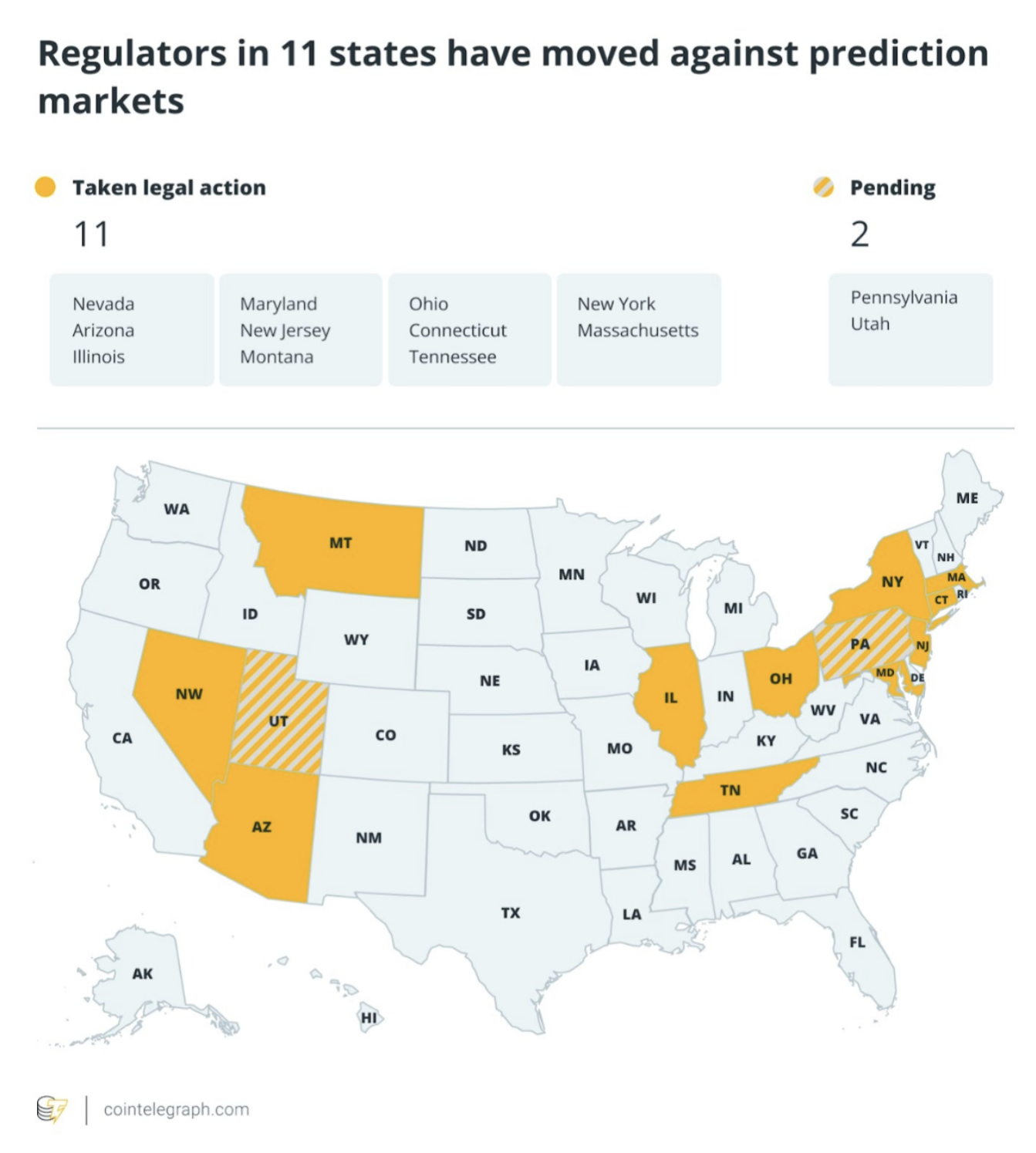
In the United States, at least 11 states have challenged prediction markets in recent months. At the center of the dispute is whether event contracts should be regulated under state gambling laws or as federally regulated derivatives overseen by the CFTC.
Speaking at Bitso's Stablecoin Conference in Mexico City on June 16, Digital Chamber CEO Cody Carbone said the growing conflict between the CFTC and state gambling regulators is likely headed for the US Supreme Court.
Source: Cointelegraph