Estonian regulator partially suspends Zondacrypto operator license
cointelegraph.com
19 May 2026 15:56, UTC
A European regulator has partially suspended the operating license of the company behind troubled crypto exchange Zondacrypto.
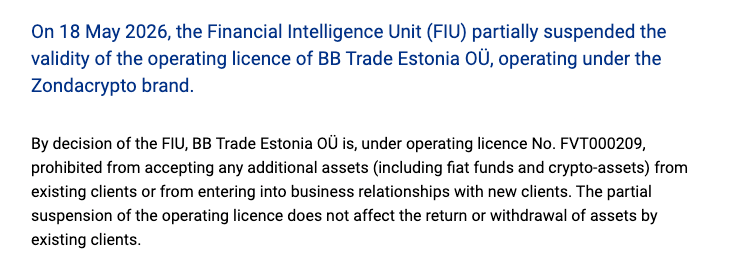
The Financial Intelligence Unit (FIU) of Estonia partially suspended the license of BB Trade Estonia OÜ, operating under the Zondacrypto brand, according to a statement on Monday.
According to the FIU, the company is now barred from accepting deposits and onboarding new clients, while existing users are still allowed to withdraw their funds.
Know when your coins move
Alerts, real-time prices, and market news — all in one app
Point your phone camera to install
4.8 based on 40K reviews in the App Store and Google Play
The suspension puts BB Trade Estonia OÜ at risk of losing its operating license if it does not meet compliance requirements set by Estonian authorities.
Source: FIU
Zondacrypto faces broader regulatory scrutiny in Europe following withdrawal issues and its CEO saying that an exchange cold wallet holding about 4,500 Bitcoin ($345.9 million) was inaccessible.
A 30-day compliance window and potential license revocation
The FIU said that BB Trade Estonia OÜ has 30 days to bring its operations into compliance with legal requirements following the partial suspension of its license.
“If it fails to do so, the law obliges the FIU to revoke the operating license,” the regulator said.
The FIU did not specify what compliance breaches led to the suspension. Cointelegraph contacted the authority for comment but did not receive a response at the time of publication.
Estonia’s Financial Supervision and Resolution Authority (FSA) previously issued a warning against BB Trade on May 8, saying its “TeamPL” crypto token violated the European Union’s Markets in Crypto-Assets Regulation (MiCA) because it was listed without a white paper.
Zondacrypto at center of regulatory debate in Poland
The suspension comes amid broader concerns around Zondacrypto, including reported withdrawal issues and past comments by Polish Prime Minister Donald Tusk referencing around 30,000 potential victims linked to crypto-related losses.
Market data from CoinGecko shows little to no recent trading activity on the exchange at publishing time.
Founded in Poland in 2014 as BitBay, Zondacrypto has grown into a major European crypto exchange, particularly among Polish-speaking users.
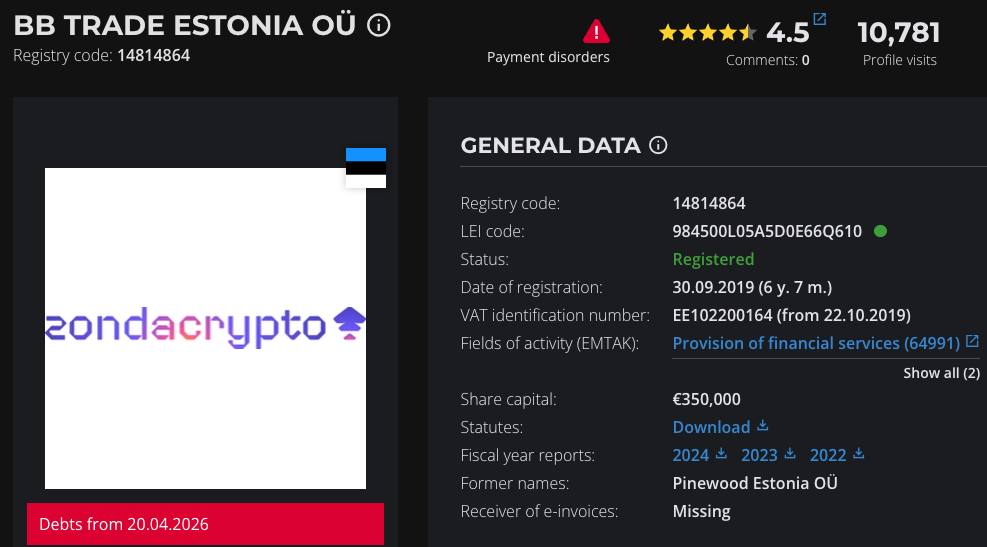
Despite its Polish origins, the company has been registered in Estonia since September 2019, according to InfoRegister data, well before the EU’s MiCA regulation fully took effect in late 2024.
Source: InfoRegister
Zondacrypto has since become part of a broader regulatory debate in Poland, where officials have raised concerns about its potential links to Russian capital and political influence.
Some Polish policymakers have also criticized delays and inconsistencies in the country’s implementation of MiCA rules, even as the exchange operated under its Estonian registration.
On Tuesday, the FSA issued a MiCA license to LHV Pank, one of the country’s largest banks, making it the second financial institution in Estonia to receive approval under the EU’s crypto regulatory framework.

 cointelegraph.com