
 thecryptobasic.com
A study reveals that 13 billion $XRP sits in exchange accounts using destination tags, with Robinhood holding the largest share.
The study by $XRP community researcher ChaCha shows that the tagged balances represent individual user holdings within shared exchange wallets, which reveals how much $XRP actually sits in custodial systems.
Key Points
- Data identifies 13.26 billion $XRP in tagged exchange accounts across 41 platforms and over 260 wallets.
- Robinhood accounts for over 10 billion $XRP, dominating tagged balances among exchanges.
- Tagged $XRP represents about 21% of the 61.6 billion $XRP circulating supply.
- Combined holdings in exchange environments exceed 47% of supply when adding 16 billion $XRP in primary wallets.
- Destination tags on the $XRP Ledger help exchanges assign funds to individual user accounts.
Over 29B $XRP in Exchange Environments
ChaCha shared these findings on X, presenting a summary of exchange and wallet destination data. The report identified 13.26 billion $XRP in tagged accounts, in addition to about 16 billion $XRP stored in main exchange wallets. Together, this brings the total tracked amount to over 29 billion $XRP within exchange environments.
Data shows that the research covers 41 exchanges and tracks more than 260 wallets along with their destination tags. The system also follows over 12,000 rows of point-in-time data every day, which confirms a detailed tracking process.
Robinhood Dominates Tagged $XRP Balances
Among all the platforms studied, Robinhood holds the largest share of tagged $XRP. The data indicates that destination tags linked to Robinhood accounts make up more than 10 billion $XRP, ahead of any other exchange. Interestingly, one of the tagged Robinhood wallets contain 3.65 billion $XRP.
This large share shows activity on the platform, either from retail users or institutions. While ChaCha highlighted Robinhood’s lead, the exact purpose of these holdings is still unclear. Some market watchers believe the $XRP could serve internal uses such as liquidity, tokenized assets, or future payment systems, instead of being ready for sale.
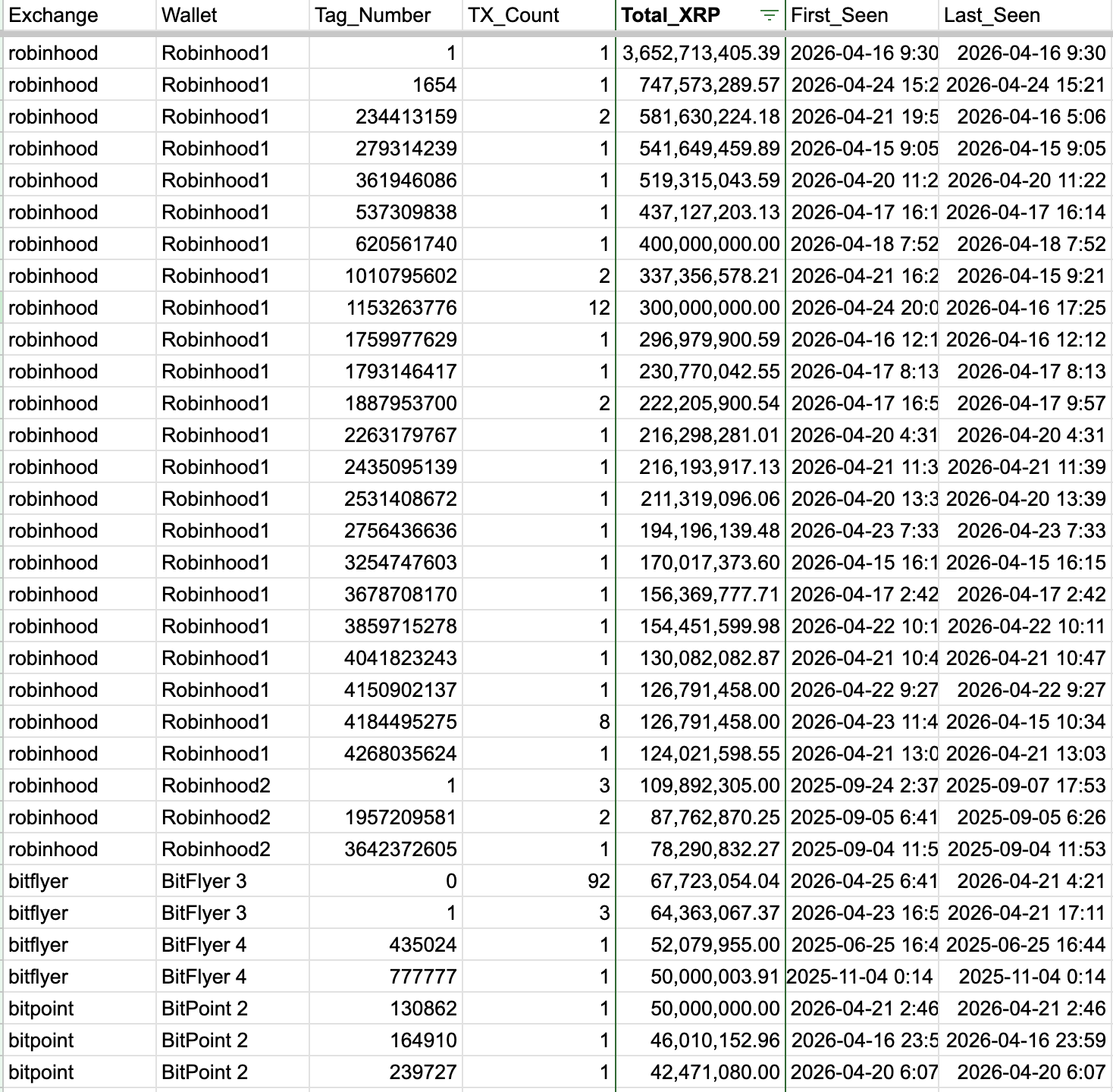
Meanwhile, other exchanges like BitFlyer and BitPoint also appear in the data, but their totals are much smaller compared to Robinhood. For instance, the top four tagged accounts from Bitflyer hold a combined 234 million $XRP. Overall, the findings suggest that a large amount of $XRP is held within centralized platforms instead of private wallets.
Destination Tags on the $XRP Ledger
For the uninitiated, destination tags are an important feature of the $XRP Ledger. They act as extra identifiers in transactions sent to shared wallet addresses, and help exchanges know which user should receive the funds.
Instead of creating a separate wallet for every user, exchanges use one or a few main addresses and rely on tags to separate balances. This reduces costs, since each wallet requires a minimum $XRP reserve. Simply speaking, destination tags work like account numbers in a banking system.
If a transaction is sent without the correct tag, it may be delayed, misdirected, or even lost within the exchange’s system. However, not all $XRP accounts need tags. Personal wallets usually do not use them, and some large institutional wallets also hold funds without splitting them into tagged accounts.
Possible Market Implication
The 13.26 billion $XRP in tagged accounts equals about 21% of the circulating supply, which stands near 61.6 billion $XRP as of April 2026. When combined with the 16 billion $XRP in main exchange wallets, more than 47% of the supply appears tied to exchanges or custodial services.
Notably, this shows that a large share of $XRP sits under the control of exchanges, which could lead to selling pressure if many users decide to trade or withdraw at once. At the same time, exchanges can handle trades internally, which may limit immediate selling on the public ledger.