“Tether’s mission has always been to provide simple, reliable access to stable value for people who need it most,” said Tether CEO Paolo Ardoino.
MiniPay claims to be operational in 60 countries, with 12.6 million activated wallets and 350 million transactions processed. It saw 50% user growth in Q4, predominantly in emerging markets.
Demand for stablecoins, tokenized gold in emerging markets
The MiniPay app, which is available on Android and iOS, only requires a mobile phone number for activation.
Across all integrations, more than $153 million was sent or received through MiniPay in December, “underscoring growing demand for stable, dollar-based payments in mobile-first regions.”
In addition to the world’s leading stablecoin, MiniPay also supports Tether tokenized gold XAUT for “inflation-resistant savings.” The asset surged to an all-time high of $5,600 in late January in tandem with spot gold markets.
The tokenized real-world asset has a circulating supply of 712,747 XAUT and a market capitalization of $3.4 billion, according to CoinGecko.
Stablecoin exchange flows are falling
Despite strong demand in emerging markets, stablecoin market capitalization and exchange flows have been falling amid the broader crypto market decline.
Following expansion over the past two years, the total stablecoin market capitalization began declining in December, ending a sustained growth trend, CryptoQuant reported on Monday.
Net stablecoin-to-exchange inflows “have been largely wiped out,” said analyst Darkfost.
“After an initial sharp decline of $9.6 billion, followed by a brief period of stabilization, stablecoin flows have once again turned negative, with more than $4 billion in outflows,” they added.
“Recent months clearly reflect a rise in risk aversion, or even capitulation among later entrants, who have chosen to withdraw their stablecoins from exchanges.”
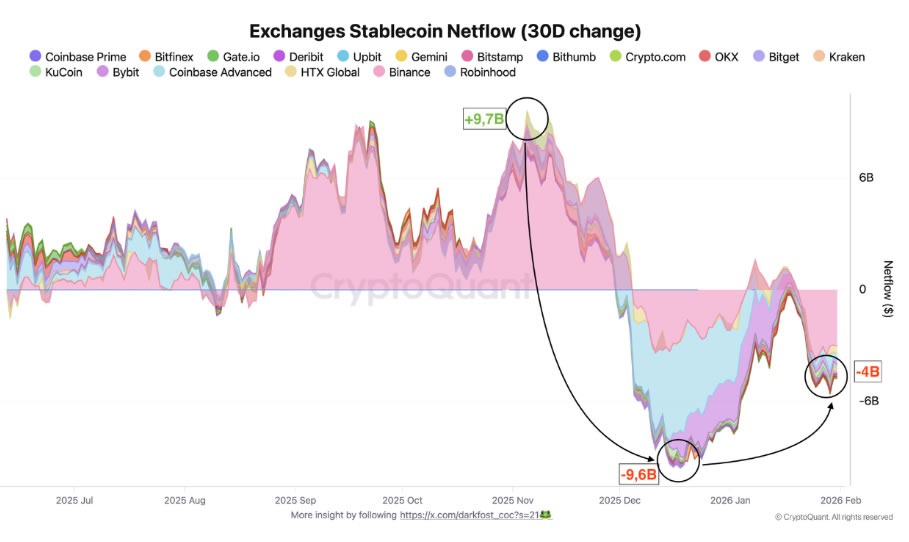
Exchange stablecoin net flow change. Source: CryptoQuant
Meanwhile, crypto markets have declined 38% since their total market cap peak of $4.4 trillion in October.

 cointelegraph.com