
 news.bitcoin.com

In the final week of 2025, weekly prediction market notional volume cleared $5.3 billion, and the opening week of 2026 pulled the same trick—once again topping $5 billion and etching fresh records into the sector’s ledger.
Prediction Markets Gain Serious Attention
Prediction markets have been stealing the spotlight lately, and data compiled by Dune Analytics makes it clear that three platforms are running most of the table. Figures from the first week of 2026 show the year kicked off with $5.26 billion in volume—just a whisker shy of the Dec. 29 high-water mark of $5.38 billion.
Dune.com data compiled by @datadashboards shows Kalshi ruled the first week of 2026, claiming 38.2% of total market notional volume across seven distinct prediction markets. Trailing Kalshi is Opinion, the BNB-based prediction market that has been flexing serious volume muscle since late October. Much of that activity appears tied to Opinion’s points-based rewards system (PTS), with quick uptake fueled by the PTS program and the ever-tempting prospect of airdrops.
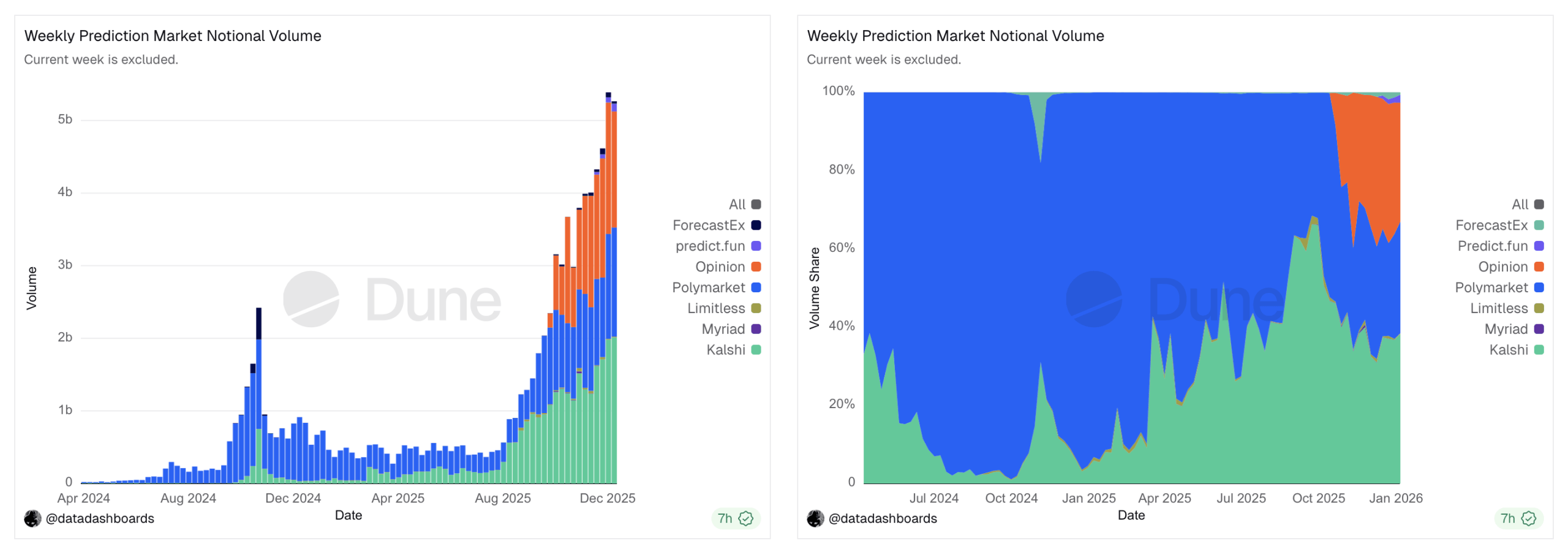
Opinion now holds 30.3% of weekly notional volume, while the long-standing Polymarket lags with 28.6% of the pie. Predict.fun clocks in at roughly 2.1%, Forecastex, Limitless, and Myriad barely register at under 1% each, and on the transaction front Polymarket tops the chart with 11.4 million during the year’s first week, Kalshi follows with just over 11 million, and Opinion checks in with more than 683,000.
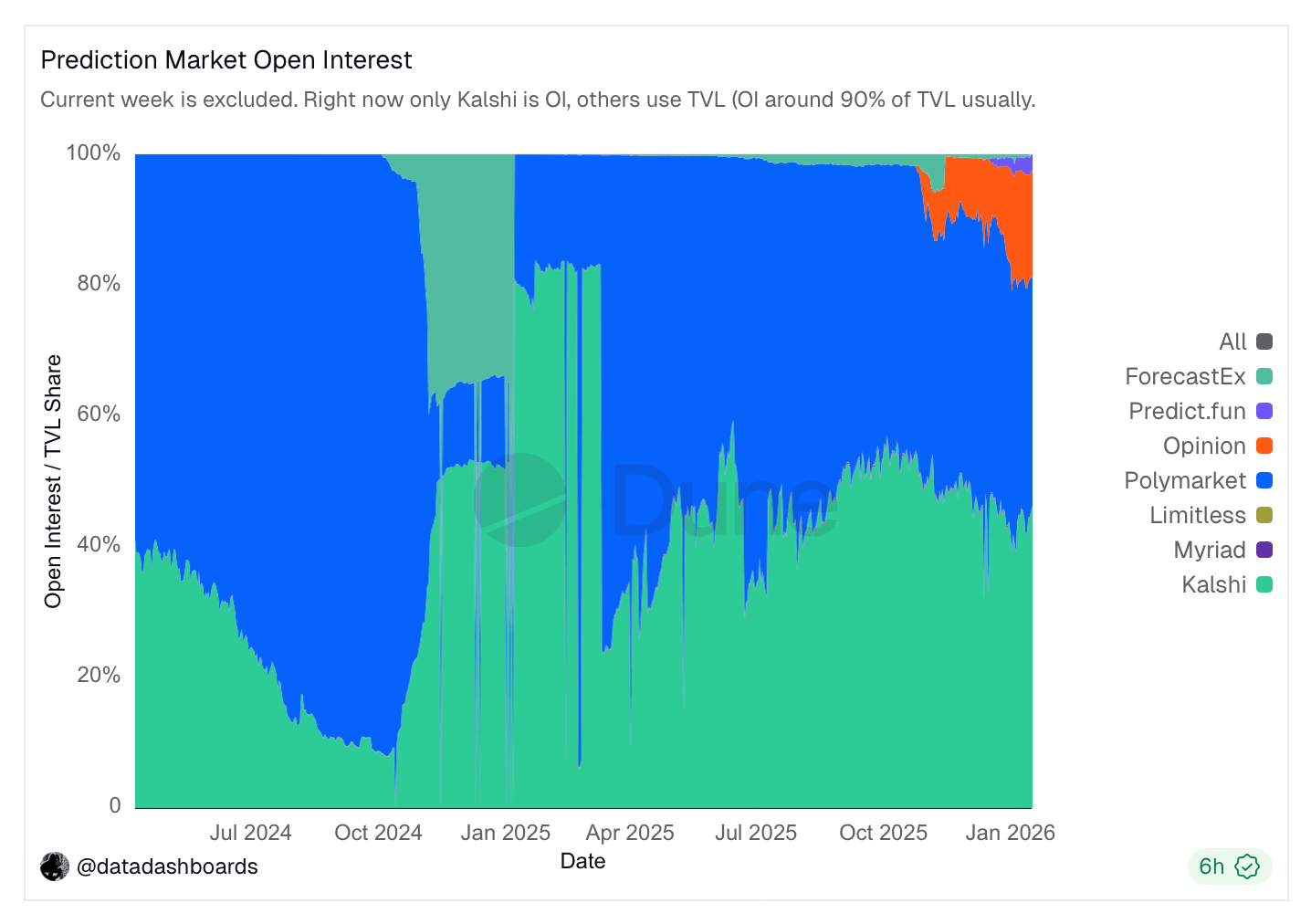
Open interest across all markets sat at $892 million as of Jan. 16, 2025, the most recent day recorded on the Dune.com dashboard. That mix of interest, demand, and volume has turned plenty of heads, with many betting the space gets much bigger—stoking an increasingly competitive race.
On top of that, Kalshi and Polymarket have pulled in hefty capital infusions and carved out real mainstream traction, with Kalshi landing partnerships with CNBC, CNN, and MSNBC. Beyond cable news, Kalshi has also teamed up with the NHL and tapped golfer Bryson DeChambeau as its first athlete endorser, rolling him out for promotions and new market launches.
Also read: Is Bitcoin About to Go Parabolic? Bitwise Sees ETF Demand Draining Supply
Polymarket has inked partnerships with the Golden Globes, Dow Jones—the publisher of The Wall Street Journal—the New York Rangers, and Yahoo Finance, and Parcl, among others. Moreover, Polymarket pulled in a $2 billion capital injection from Intercontinental Exchange (ICE), giving the platform a deep-pocketed ally and plenty of financial muscle.
The YZi Labs-backed Opinion wasted no time snagging a meaningful slice of weekly sector volume after launch, and it didn’t exactly slip in quietly—others sniffing around the predictions marketplace include Crypto.com, Draftkings, Robinhood, Fanduel, and Coinbase.
The sector expansion, volume, competitiveness, and growth make one thing clear: prediction markets aren’t fading into the background, and the category has grown well beyond a passing novelty. This day in age, it’s quickly turning into gold-rush territory, with platforms big and small rushing in to stake a claim as prediction market growth draws an ever-crowded field.
FAQ 🔮
-
What is driving the rise in weekly prediction market volume?
Increased trading activity and intensifying competition among major platforms are pushing weekly prediction market volume higher across global markets. -
Which platforms are competing for prediction market volume?
Several leading prediction market platforms are vying for liquidity and market share as the sector attracts more users and capital. -
Why does trading volume matter in prediction markets?
Higher volume improves liquidity, pricing accuracy, and user confidence, making platforms more competitive at scale. -
How does Polymarket’s funding affect the sector?
Polymarket’s $2 billion capital infusion from Intercontinental Exchange strengthens its position as competition intensifies in the global prediction markets arena.