
 thedefiant.io

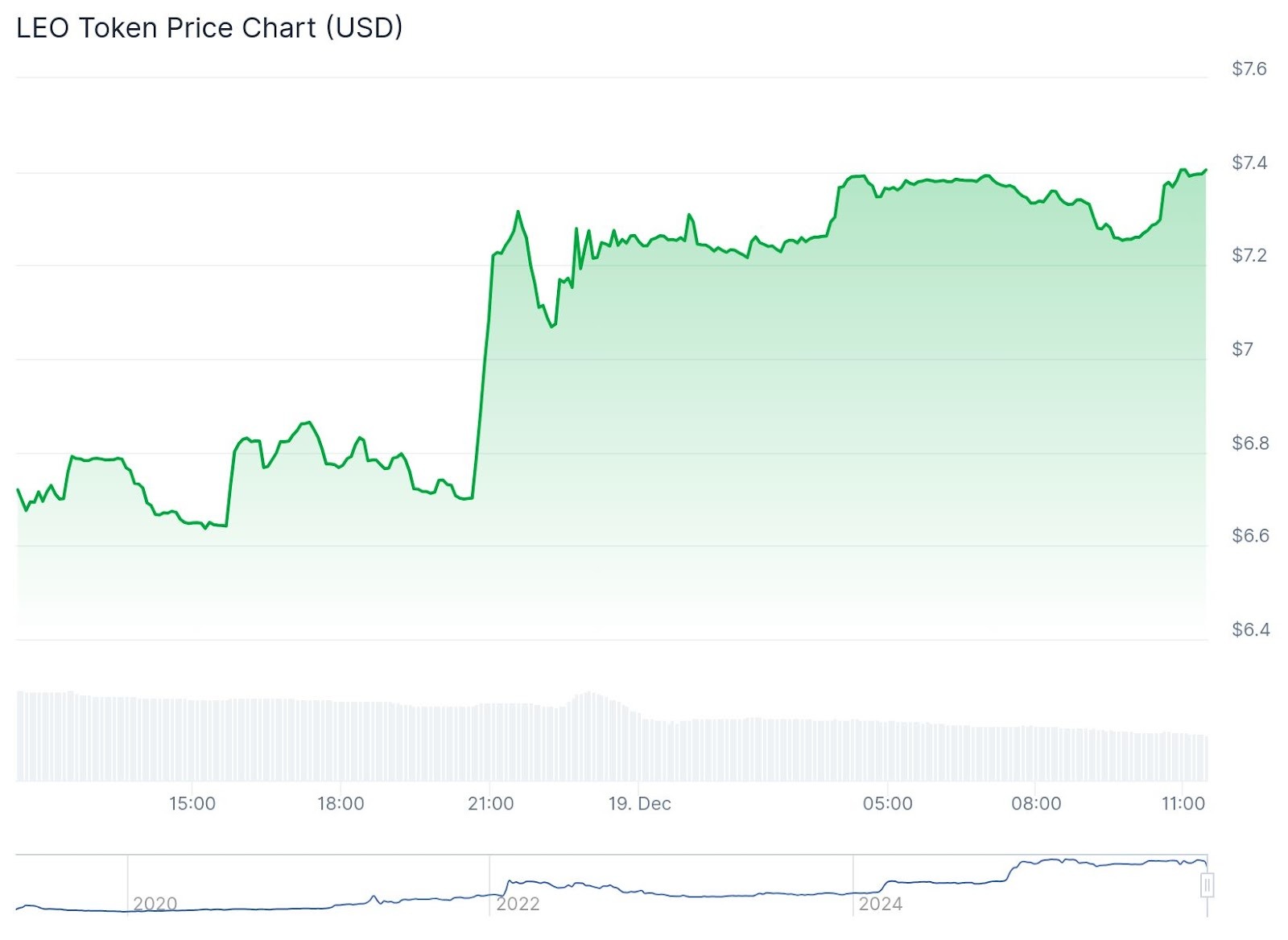
$LEO, the native token of the iFinex — the parent company of Bitfinex and Tether — outperformed the broader cryptocurrency market on Friday, Dec. 19 following Bitfinex’s decision earlier this week to scrap all trading fees.
The token is currently changing hands at $7.40, up 11% on the day, according to data from CoinGecko, pushing it into the top gainers today. The surge follows a few days of losses for the token, which was trading as high as $9.51 just a week ago.
The centralized exchange (CEX) decided to eliminate maker and taker trading fees across its platform, including all trading pairs for spot, margin, derivatives, OTC trades and tokenized securities, according to an official blog post.
The CEX Challenge
The move has reignited debate over how smaller crypto exchanges can attract and retain users in a space dominated by a handful of large players like Binance and Bybit. Bitfinex, which launched in 2012 and once held over 15% of monthly global crypto spot volume, now ranks 33rd among CEXs by 24-hour trading volume, according to CoinGecko.
The decision to cut fees also comes as activity rises on decentralized exchanges (DEXs) like Hyperliquid, Uniswap and PancakeSwap. In October, DEX activity reached record highs with total DEX spot volume reaching $613.3 billion, up from around $500 billion in September.
That growth was mainly led by Uniswap’s massive month, which recorded $170.8 billion, while PancakeSwap posted $101.9 billion in trading volume, The Defiant previously reported. Moreover, compared to last October, DEX volume was up about 200% year over year, though weekly volumes have tapered off since the Oct. 10 liquidations.
Just earlier today, Hyperliquid’s HIP-3 upgrade, which launched in October and enables permissionless perpetual markets, surpassed $10 billion in total trading volume.
“The gap is clear: DEXs operate with near-wholesale margins, while CEXs rely on broker-style fees,” a Hyperliquid community account under the handle @Hyperliquid_Hub said on X after Bitfinex’s news went live.
“This structural difference makes fee competition an uphill battle for centralized platforms.”
Earlier today, Bitfinex also had its operating limit for its tokenized securities platform raised to $310 million from $210 million, following an expansion approved by regulators in Kazakhstan. This increase allows Bitfinex Securities to list and trade a larger volume of tokenized securities. Currently, the tokenized real-world asset (RWA) sector is valued at over $37 billion, per RWAxyz.