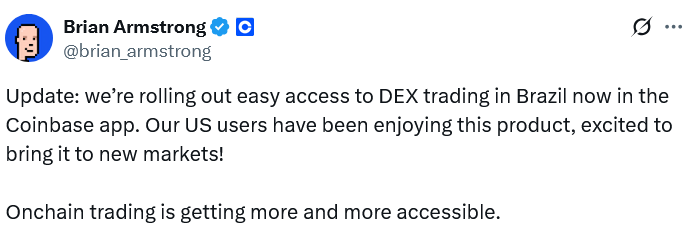
Source: Brian Armstrong
Users can trade without incurring network fees by using a self-custody wallet, thereby maintaining full control over their tokens. Coinbase didn’t state when the DeFi feature would officially roll out in Brazil.
The move comes amid new crypto regulations in Brazil that bring crypto companies under banking-style oversight, classifying stablecoin transactions and some self-custody wallet transfers as foreign-exchange operations.
Brazil has a population of 215 million and has reportedly been weighing a tax on crypto for international payments as it moves to adopt the Crypto-Asset Reporting Framework, which more than 70 countries have committed to.
DeFi Mullet is part of Coinbase’s “everything app” vision
DeFi Mullet is part of Coinbase’s vision to become an “everything app,” enabling its more than 100 million users to trade “anything from anywhere in the world with 24/7 access.”
Part of that vision includes advancing stablecoin adoption via Circle’s $USDC ($USDC) stablecoin, tokenized stocks, prediction markets, and early-stage token sales.
Coinbase said Base saw a rise in adoption across trading, payments, lending and social apps in Q3, while it also launched Flashblocks — a transaction preconfirmation feature that enables 200-millisecond block times.
Coinbase is also committed to building a Bitcoin ($BTC) treasury, having added 2,772 $BTC in Q3 to bring its total to 14,548 $BTC, currently worth $1.3 billion.
It comes as Coinbase increased its net income over fivefold to $432.6 million year-over-year in the third quarter, with total revenue rising to $1.9 billion, up 55% from the same period a year ago.
Coinbase shares have held steady in 2025
However, Coinbase (COIN) shares continue to fall amid a broader market correction, down 25.2% to $257.29 over the last month.
COIN is now trading almost exactly where it started in 2025, while other crypto stocks such as MARA Holdings and Strategy are down 33.8% and 35.6% over the same time frame.

 cointelegraph.com