
 coinpedia.org

Justin Sun’s lawsuit against World Liberty Financial has cleared a major procedural hurdle, and the case is staying in open court. A federal judge rejected World Liberty’s attempt to push all of Sun’s claims into private arbitration and seal the proceedings, allowing his individual claims to continue publicly.
Justin Sun Lawsuit Moves Into Public View
The dispute stems from Sun’s reported $45 million investment in $WLFI, involving 4 billion tokens. Sun is seeking hundreds of million of dollars in damages, alleging that World Liberty Financial secretly retained contractual powers to freeze, transfer and burn holders tokens and then exercised those powers against him.
That makes the court fight considerably more interesting than a routine investor dispute. The arbitration request could have kept much of the battle away from public scrutiny. Instead, the federal court ruling leaves Sun’s individual claims exposed to public examination.
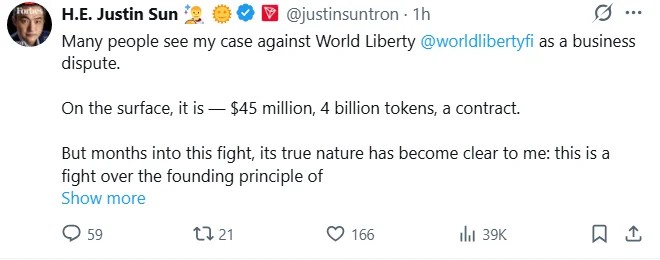
Sun Turns Token DIspute Into Ownership Fight
Sun has now framed the Justin Sun lawsuit as something much bigger than the money involved. In a statement, he argued that the dispute concerns one of blockchain’s foundational ideas: whether holding an asset actually means having control over it.
His argument centers on the alleged ability of an issuer to freeze a holder’s assets without disclosure, governance or a formal process. Sun claims that his tokens were subjected to those controls within days of becoming unlocked.
The rhetoric is deliberately sharp. The phrase “freedom in the name, control in the code” captures the argument he is taking to court, while also putting the spotlight directly on the contract design behind $WLFI and USD1.
Code Versus Control Now Faces Court Scrutiny
Sun says the case could establish a legal precedent around what asset ownership means in blockchain markets. His position is straightforward: if an issue can arbitrarily seize or freeze tokens, then digital ownership starts looking rather different from the permissionless ownership that helped define the industry.
The argument remains Sun’ allegation, not a final judicial finding on the underlying dispute. The latest ruling concerns whether his claims can proceed publicly rather than deciding the ultimate merits of those claims.
For now, the Justin Sun lawsuit has moved another step into the spotlight, with the federal court keeping Sun’s individual claims in open proceedings. WHat happens next could determine whether the dispute remains a fight over $45 million and 4 billion tokens or becomes a much broader test of control and ownership in token contracts.