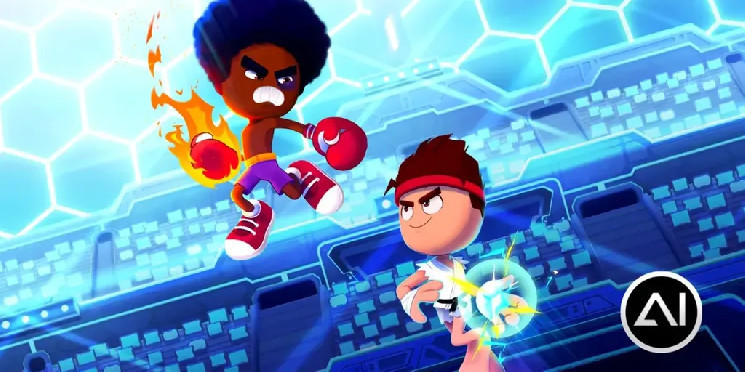
This is very similar to the Arbitrum-based version of AI Arena, where players fight in the Smash Bros-esque game to train an AI to later fight on their behalf. However, the major difference is the type of learning that the AI agents handle.
In the traditional version of the game, agents learn via imitation which, put simply, is when a bot attempts to mimic the exact behavior of the human training it. With reinforcement learning, the agent learns based on reward or punishment instead.
This means that if a human trained the two models to intentionally kill themselves in game, the imitation agent would copy that behavior while the reinforcement learning agent would not, as it would regard that behavior as an undesired outcome.
“This proof of concept is all about gathering the data needed to research and develop the next generation of [reinforcement learning] agents for complex games,” Wei Xie, Chief Operating Officer at Arena X Labs, told Decrypt.
Following this initial step, NRN Agents is aiming to roll out more proofs of concept for Ronin games. In just a few months, the team plans to distribute the NRN gaming SDK to game studios on the network. How games then choose to integrate NRN Agents will be up to the developers.
“In some games, AI may replace traditional [non-playable characters] with more intelligent and dynamic behavior. In others, AI might focus on solving specific challenges, like enhancing player liquidity or powering AI v AI agent competitions,” Xie explained. “NRN Agents bring entirely new levels of immersion to their favorite games.”
This echoes moves made by Ethereum game franchise Illuvium. Earlier this month it announced plans to integrate AI agents into its games via the Virtuals Protocol. In this instance, the agents aim to enhance non-playable characters (NPCs), enabling more dynamic questing and deeper $NPC relationships.

 decrypt.co