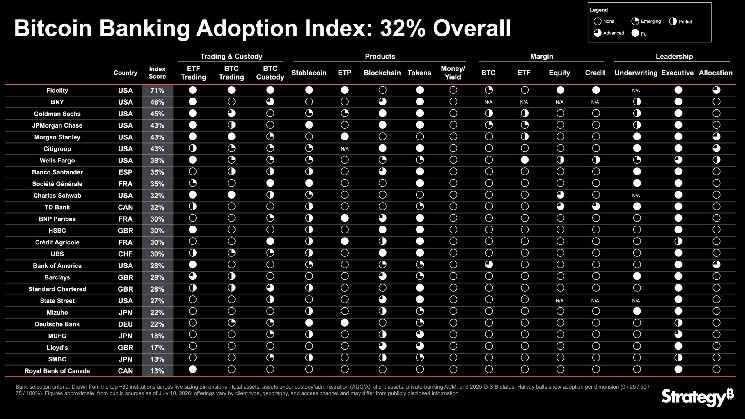
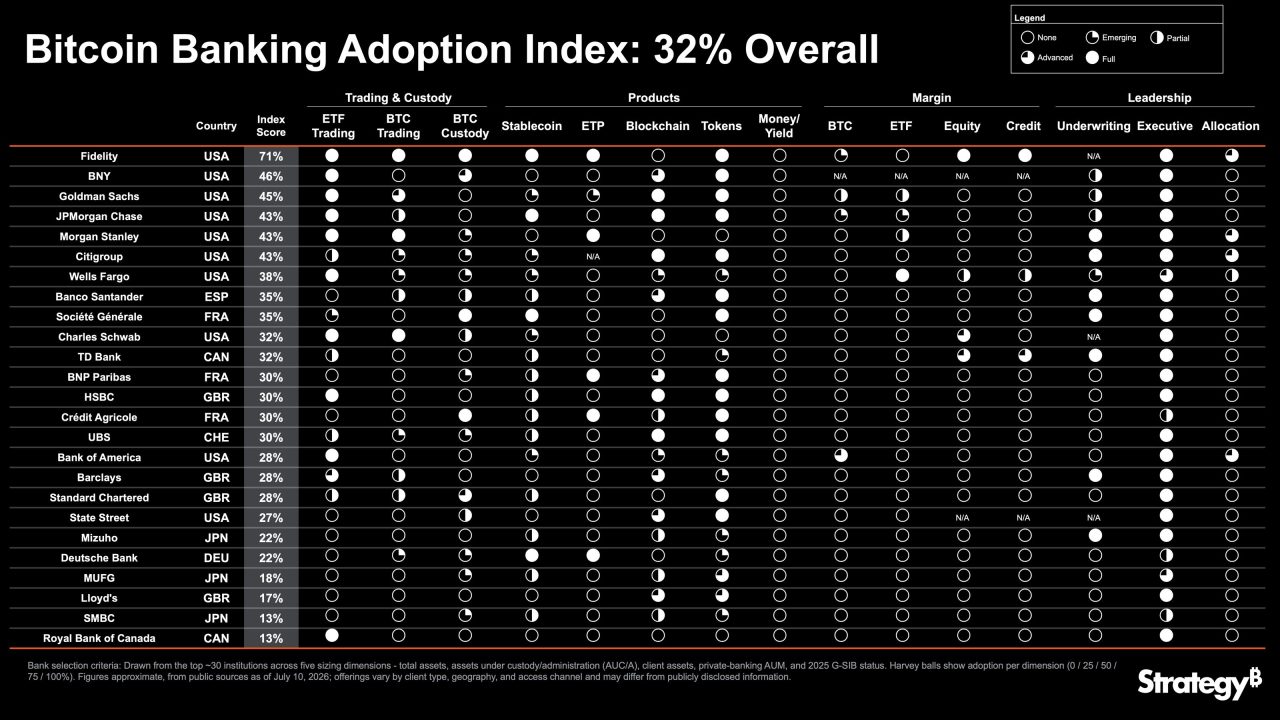
Strategy selected roughly 30 institutions using measures including total assets, assets under custody or administration, client assets, private-banking assets, and 2025 global systemically important bank status. The chart says figures are approximate and based on public information available as of July 10, 2026. Offerings may also vary by geography, client type, and access channel.
Fidelity’s Lead Highlights an Uneven Market
Fidelity ranks first with a 71% score, significantly ahead of BNY at 46% and Goldman Sachs at 45%. Its position reflects broad involvement in digital-asset trading, custody, and investment products through Fidelity Digital Assets, the company’s institutional cryptocurrency platform, and the Fidelity Wise Origin Bitcoin Fund (NYSE Arca: FBTC), its spot bitcoin ETF.
BNY’s second-place ranking reflects an established institutional custody and servicing operation. The company has offered bitcoin and ether custody services to select clients, provided servicing for exchange-traded products (ETPs), and expanded its digital-asset work into tokenized funds and stablecoin infrastructure.
The Methodology Will Decide How Much the Rankings Mean
The index currently offers a high-level snapshot rather than a fully reproducible benchmark. Le said Strategy plans to release methodology and updates, while inviting institutions to submit corrections or additional public information. Category weights and evidence standards will determine whether the 32% figure can be independently tested.
Future disclosures could also clarify whether adoption means technical capability, a limited institutional service, or broad customer availability. That distinction matters when comparing global banks operating under different regulations and product structures. Regular revisions, documented scoring rules, and bank responses could show whether the index becomes a durable measure of institutional bitcoin adoption.

 news.bitcoin.com