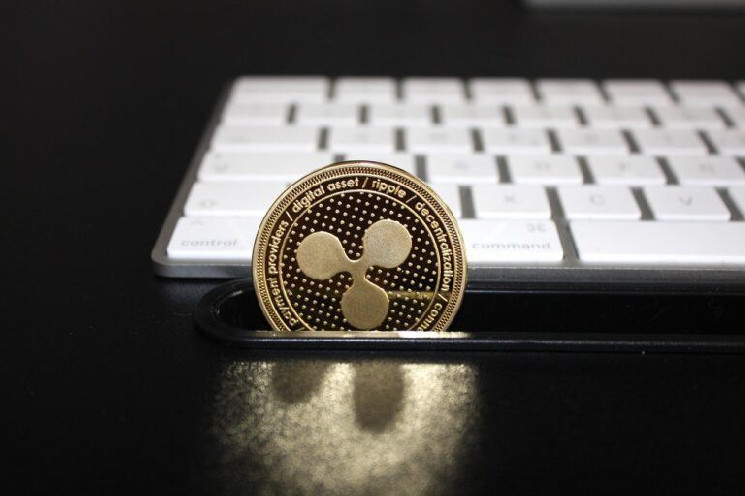
Meanwhile, products offering exposure to other altcoins largely saw inflows, with $XRP leading the pack after seeing $800,000 of inflows. Polygon ($MATIC) investment products came next with $300,000 of inflows and were followed by Solana ($SOL) investment products, which saw $200,000 of inflows.
Products offering exposure to $TRX and $LTC both saw $100,000 of inflows. Month-to-date, over $200 million were withdrawn from cryptocurrency investment products, although year-to-date outflows total $17 million.
Investors were worried about the Shanghai upgrade that will allow un-staking (yield distribution), as shown by the $2.8 million outflows from Ethereum and the $500,000 inflows into short-Ethereum, according to the report.
As CryptoGlobe reported, the price of $XRP, the native token of the $XRP Ledger, surged earlier this month after the cryptocurrency community pointed out that in the lawsuit the Commodity Futures and Trading Commission (SEC) filed against Binance, it named several digital assets as commodities.
The rise also came after the $XRP Ledger introduced a number of significant upgrades, including a proposal that could ‘significantly expand’ its use cases.
The CFTC filing was seen as a bullish catalyst for $XRP as Ripple, the largest player in the cryptocurrency’s ecosystem, has an ongoing legal battle with the U.S. Securities and Exchange Commission (SEC), after the regulator alleged the fintech firm “raised over $1.3 billion through an unregistered, ongoing digital asset securities offering.”
Ripple has numerous times separated itself from $XRP, with the cryptocurrency providing the underlying value for certain Ripple offerings. Developments in the legal case nevertheless impact $XRP over Ripple’s size and influence in the cryptocurrency’s ecosystem.
If $XRP were to be seen as a commodity, Ripple would win the legal case, which when it was filed saw numerous cryptocurrency trading platforms delist $XRP, leading to a sell-off as it lost significant liquidity.
Image Credit
Featured Image via Pixabay

 cryptoglobe.com