“Despite the price decline, institutional positioning appears resilient.”
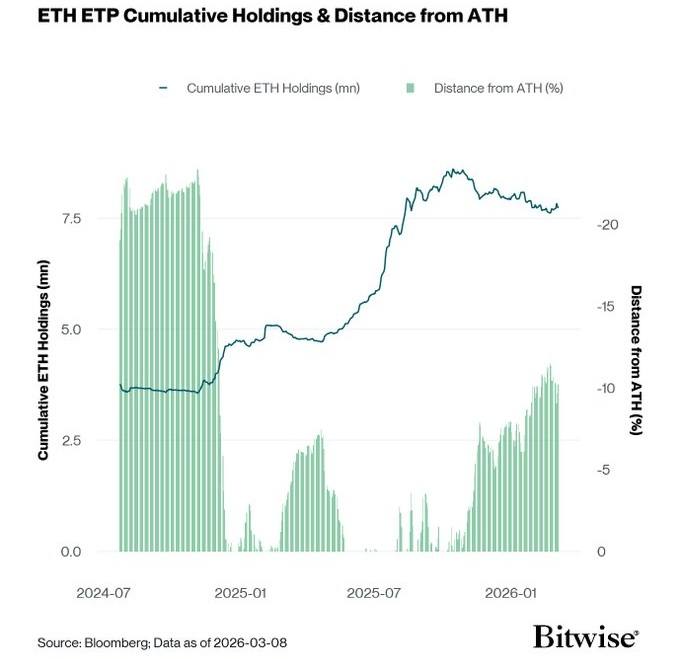
“Cumulative $ETH ETP holdings remain only about 10% below peak levels, which may suggest that institutional capital is potentially sticky with a positive long-term outlook on $ETH, despite being underwater on the average ETP cost basis,” the asset manager stated.
Institutional exposure to ethereum has increasingly been expressed through exchange-traded products (ETPs), which allow investors to gain price exposure without directly holding the asset. Bitwise also pointed to continued accumulation by Digital Asset Treasury Companies, noting that monthly purchases have exceeded monthly net new ether supply since the second half of 2025. The firm wrote:
“We assess that a significant portion of institutional accumulation reflects positioning ahead of potential regulatory clarity, particularly the anticipated passage of the Clarity Act that could possibly support $ETH price recovery.”
The proposed Clarity Act aims to establish clearer regulatory boundaries for digital assets in the United States, including defining oversight responsibilities among financial regulators and providing greater legal certainty for market participants. However, the bill remains under debate in Congress.
Ethereum’s broader ecosystem metrics also remain strong despite the price decline. “In addition, tokenisation and stablecoin liquidity, of which it currently commands ~58% and 52% of asset value respectively, may serve as long-term catalysts following regulatory clarity,” the firm outlined. Bitwise also highlighted growing network participation, adding:
“Despite harsh price conditions, the percentage of $ETH staked reached an ATH of 30.76%, as the validator entry queue continues to exceed the exit queue, indicating sustained value in $ETH’s yield and participation in securing the network.”
FAQ 🧭
-
Why are institutional investors still holding $ETH despite the price drop?
Large investors appear to maintain exposure because they expect long-term growth from the Ethereum network utility, staking yield, and potential regulatory clarity.
-
How are institutions gaining exposure to $ETH without directly buying it?
Many institutions use exchange-traded products that track $ETH’s price, allowing regulated market exposure without holding the asset itself.
-
What potential catalyst could help $ETH recover in the long term?
Investors are watching for possible regulatory clarity in the United States, which could strengthen institutional confidence and support broader adoption.
-
Why does the Ethereum network activity matter for investors?
Strong staking participation, tokenization growth, and stablecoin liquidity suggest continued ecosystem demand that may support long-term value.

 news.bitcoin.com