The incident led to a hard fork of the Ethereum blockchain to recover the funds, which split the community and ultimately created two separate chains, Ethereum and Ethereum Classic.
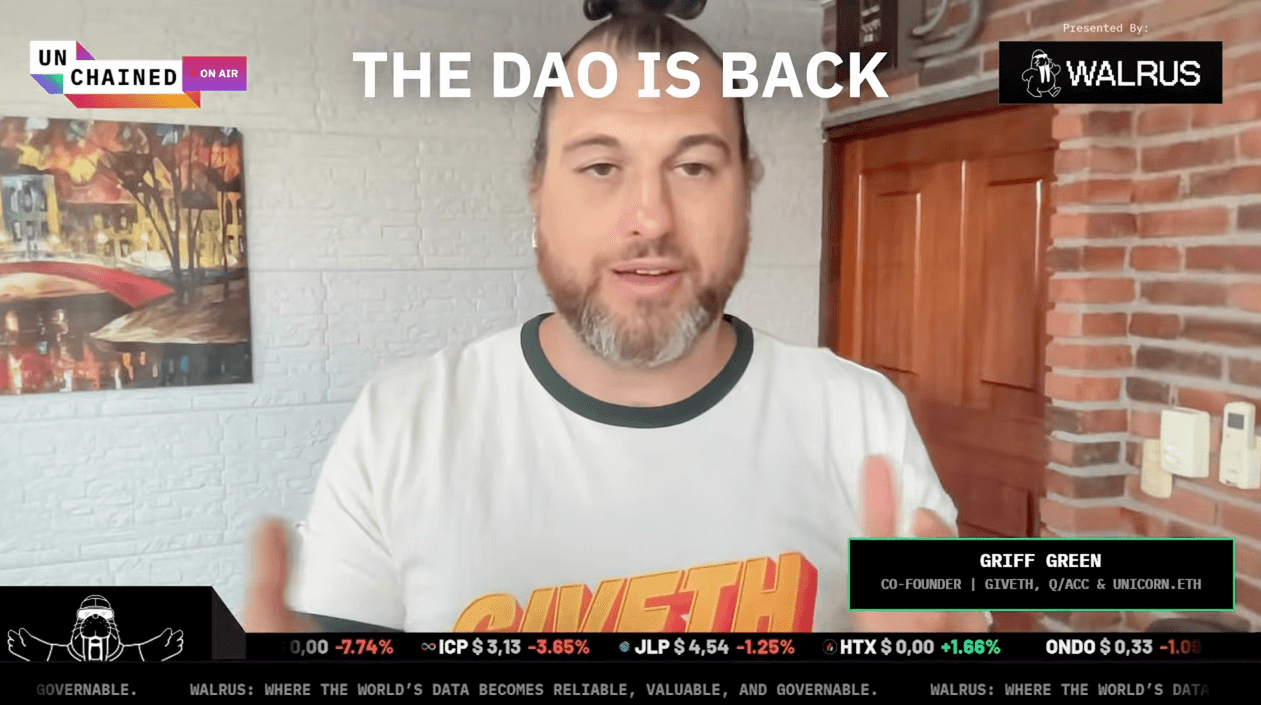
Griff Green spoke to Laura Shin on the Unchained podcast on Thursday. Source: Unchained
Green explained that the hard fork returned a lot of the Ether (ETH) held in The DAO to token holders, but the claims process was not straightforward. Green said that certain “edge cases” were handled through a multisignature wallet he joined, involving around $6 million.
While more than 80% of those funds have since been claimed, the remaining balance is now worth around $200 million. “We’re going to stake them and use the revenue to actually support Ethereum security,” he said.
Making Ethereum safer than a bank is the goal
“It makes sense that The DAO is now going to be focused on security,” Green said.
“We really want to stick to our guns with The DAO and live up to the name of The DAO, so we’re going to focus on DAO style distributions,” he said.
Green said that while The DAO has an “incredible” pool of developers capable of identifying security projects to support, the priority will be on security distribution methods, including retroactive funding, quadratic funding, conviction voting, and ranked-choice voting, with the aim of strengthening the broader ecosystem.
“I really want to see The DAO security fund come to a place where people feel that it’s safer to store assets on Ethereum than in a bank,” Green said.
“The DAO really kickstarted the security industry in Ethereum,” Green added, noting that before the hack, there was effectively no audit market, but afterward, smart contract audits became widespread.

 cointelegraph.com