
 cryptoslate.com

Ethereum is undergoing its most prolonged inflationary period, with over 350,000 $ETH (worth around $1.1 billion) added to its supply since the March Dencun upgrade, according to Ultrasound.money data. Ethereum’s current inflation rate is 0.35%.
The increase has brought the total supply to 120.4 million $ETH, leaving just under 95,000 $ETH to match the levels seen at the Ethereum Merge in Sept. 2022.
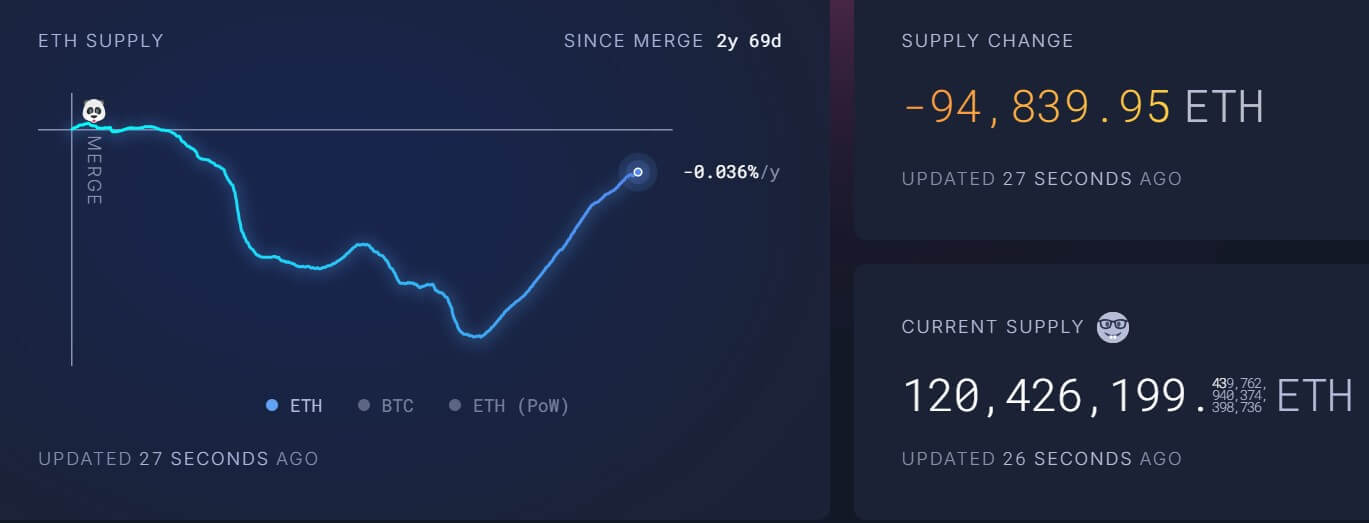
$ETH’s nearly two years of supply reduction have been wiped out in just seven months since EIP-4844, also known as Dencun or Proto-Danksharding.
How Dencun altered Ethereum’s supply dynamics
The Dencun update introduced significant changes that reduced Ethereum’s base fee burn rate.
By allocating specific block space for layer-2 networks to process bundled transactions, known as blobs, competition for mainnet block space was reduced. Additionally, the proto-danksharding mechanism made data availability more efficient, causing base fees to drop sharply.
These events have severely impacted the blockchain network transaction fees, resulting in Ethereum issuing more $ETH than it burns in most blocks.
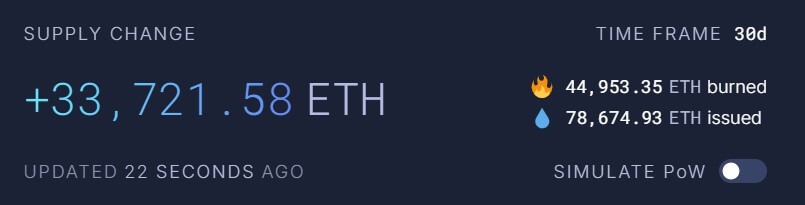
For context, Ethereum burned 45,022 $ETH while issuing 78,676 $ETH over the last 30 days. This resulted in a net supply increase of over 30,000 $ETH, underlining the inflationary impact of the reduced base fee environment.
Staking impact
The increase in Ethereum’s inflationary pressure is also linked to the rising $ETH staking ratio. Coinbase analyst David Han noted that while the Dencun upgrade has significantly impacted Ethereum’s ecosystem, the inflation rate changes appear linked to broader factors, including the rising $ETH staking ratio, which is accelerating all token issuance.
Ethereum’s move to Proof of Stake (PoS) has strengthened network security and boosted participation, but it has also resulted in more $ETH being issued. Validators who lock up their $ETH to secure the network earn rewards in newly minted tokens.
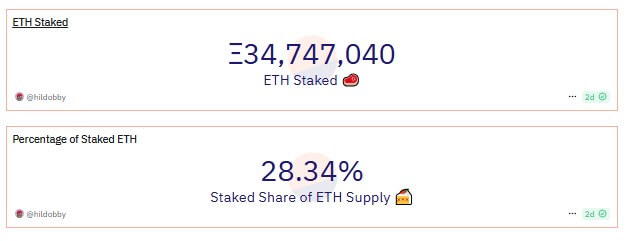
According to Dune Analytics data, approximately 34.7 million $ETH—about 28% of the total supply—is currently staked. This staked $ETH helps secure the network and generates rewards, further increasing Ethereum’s supply.
Additionally, the growing trend of restaking, especially with protocols like EigenLayer, amplifies this effect. Users reinvesting their staking rewards generate even more $ETH, compounding the inflationary impact.