Sky Seeks Emergency Intervention as Lending Pool Runs Dry
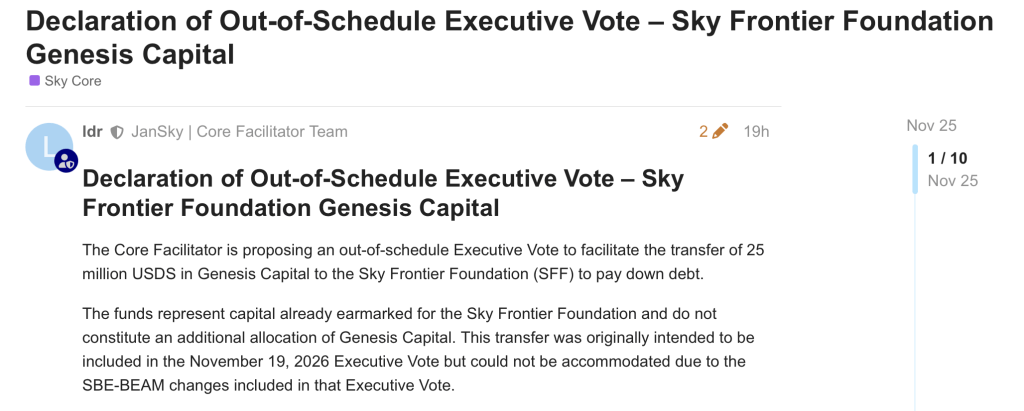
Sky’s governance apparatus is pursuing an unscheduled executive vote to transfer 25 million of the stablecoin USDS to the Sky Frontier Foundation, accelerating a previously planned capital allocation intended to facilitate debt repayment and release liquidity for depositors.
The funds were originally earmarked for the foundation but omitted from the Nov. 19 executive vote. Approximately 6 million USDS would come from Amatsu, 4 million from Ozone and 15 million from the Core Council Executive Agent 1 (CCEA1).
Sky’s core facilitators determined that waiting until the next scheduled executive vote on Dec. 3 would prolong the liquidity crunch unnecessarily.
Know when your coins move
Alerts, real-time prices, and market news — all in one app
Point your phone camera to install
4.8 based on 40K reviews in the App Store and Google Play
Sky’s governance proposal screenshot.
The stUSDS product allows depositors to earn variable yields by supplying capital for loans collateralized by staked $SKY tokens. However, when borrowers consume virtually all available capital, depositors must rely on fresh deposits or debt repayments to withdraw their funds.
According to an analysis by blockchain analytics firm Bitquery, daily withdrawals approached $14 million two weeks ago, draining available liquidity. Subsequent Spark data showed utilization hovering near 100%, effectively leaving depositors stranded despite the pool holding substantial assets.
Sky Co-Founder Admits Borrowing Was a ‘Big Mistake’
On Nov. 23, Christensen disclosed that he had repaid 3 million USDS but still owed approximately 77 million USDS against his staked $SKY holdings. Bitquery’s analysis attributed roughly 48% of the pool’s outstanding debt to a wallet associated with the co-founder.
Christensen characterized his borrowing strategy as “a big mistake,” acknowledging that he had underestimated the potential for borrowing rates to climb. He apologized and indicated that he was exploring direct $SKY sales to institutional investors.
“To repay the rest, I’m exploring options to sell part of my $SKY directly to institutional investors who share Sky’s vision of becoming infrastructure that institutions can rely on,” Christensen added.
Complicating matters, existing governance parameters had disabled liquidations on the $SKY-backed positions, limiting the protocol’s ability to forcibly unwind loans.
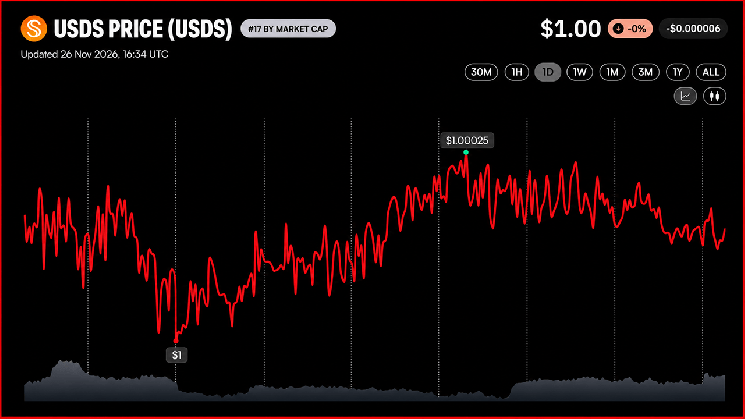
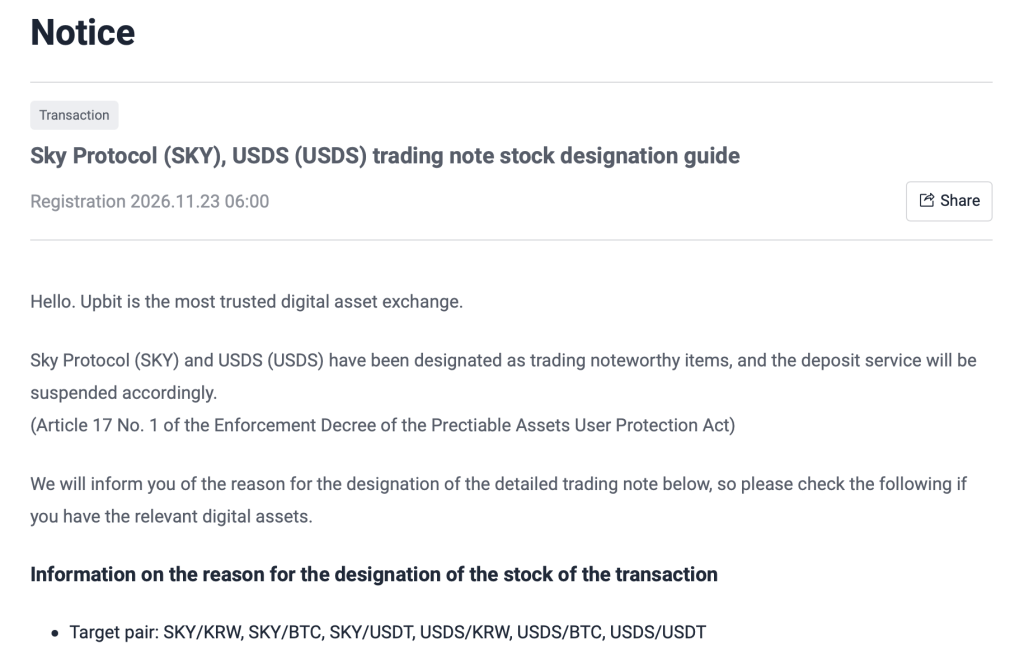
Meanwhile, South Korean cryptocurrency exchanges Upbit, Bithumb and Coinone placed $SKY and USDS on trading warning lists and suspended deposits. USDS nevertheless maintained its dollar peg, distinguishing the lending pool’s liquidity constraints from the stablecoin’s broader stability.
Translated Upbit notice concerning $SKY and USDS.
Alternative community proposals include deploying $40 million to $50 million in reserves to purchase $SKY directly from borrowers, with the proceeds simultaneously directed toward debt repayments. Other suggestions involve reducing borrowing rates and suspending new loans.
As of Nov. 26, the emergency transfer remains a proposal rather than a completed intervention. Even if approved, the allocation does not guarantee unrestricted withdrawals. The DeFi platform Sky‘s predicament illustrates a fundamental vulnerability in collateralized defi lending: A pool can hold considerable assets on paper while offering depositors virtually no immediate access to their capital.

 news.bitcoin.com