Sky, formerly MakerDAO, has implemented a proposal that will disable new borrows on legacy vaults, representing the end of an era for this decentralized finance (DeFi) stablecoin.
Specifically, a recent executive proposal, approved the ending of new borrows for multiple legacy vaults — which previously issued Dai — and the finalization of the offboarding of the legacy $USDC Peg Stability Module (PSM).
BA Labs pointed out that for these vaults “repayments are outpacing new borrowing across these vault types as a whole.”
Know when your coins move
Alerts, real-time prices, and market news — all in one app
Point your phone camera to install
4.8 based on 40K reviews in the App Store and Google Play
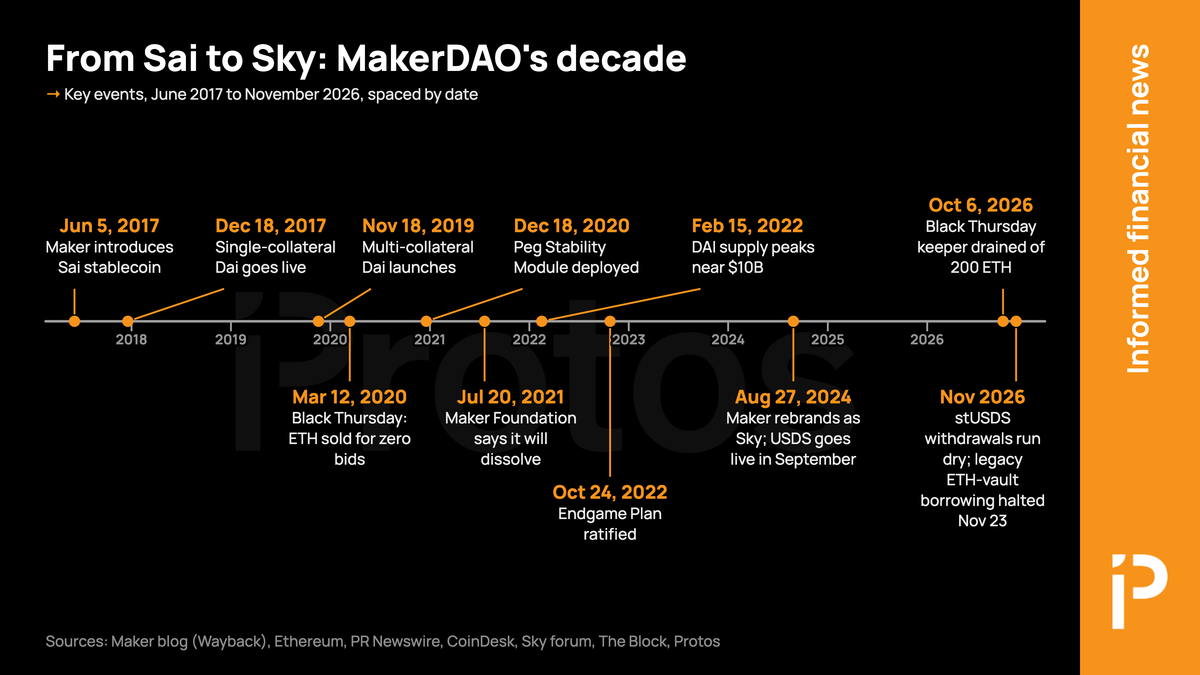
This represents a major event in the history of this stablecoin so Protos decided to take a look back at many of the other historical events that it’s been involved in.
In 2017 MakerDAO launched what was then called “Sai,” an abbreviation of “Simple Dai.”
MakerDAO, backed by Polychain Capital and Andreessen Horowitz, would then launch Single-collateral Dai itself a few months later in 2017, with $ETH as the only collateral form allowed.
This was followed just under two years later with the launch of multi-collateral Dai, which brought it much closer to its current design by allowing for vaults with a variety of different collaterals decided on by the DAO.
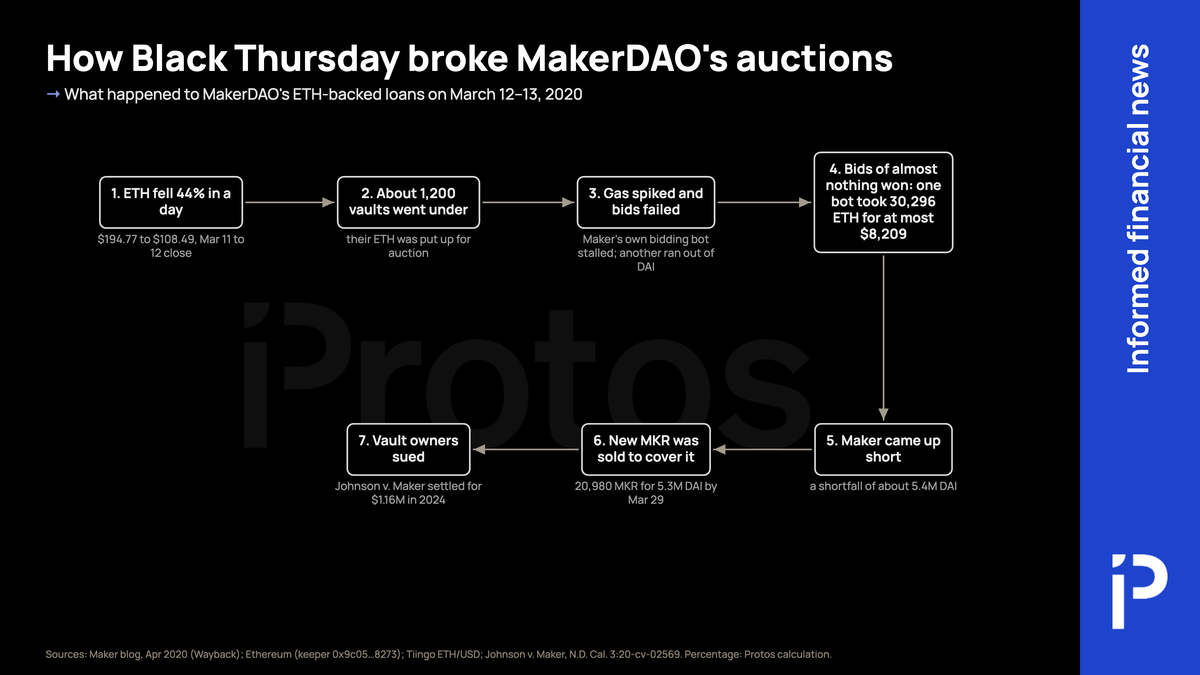
Black Thursday
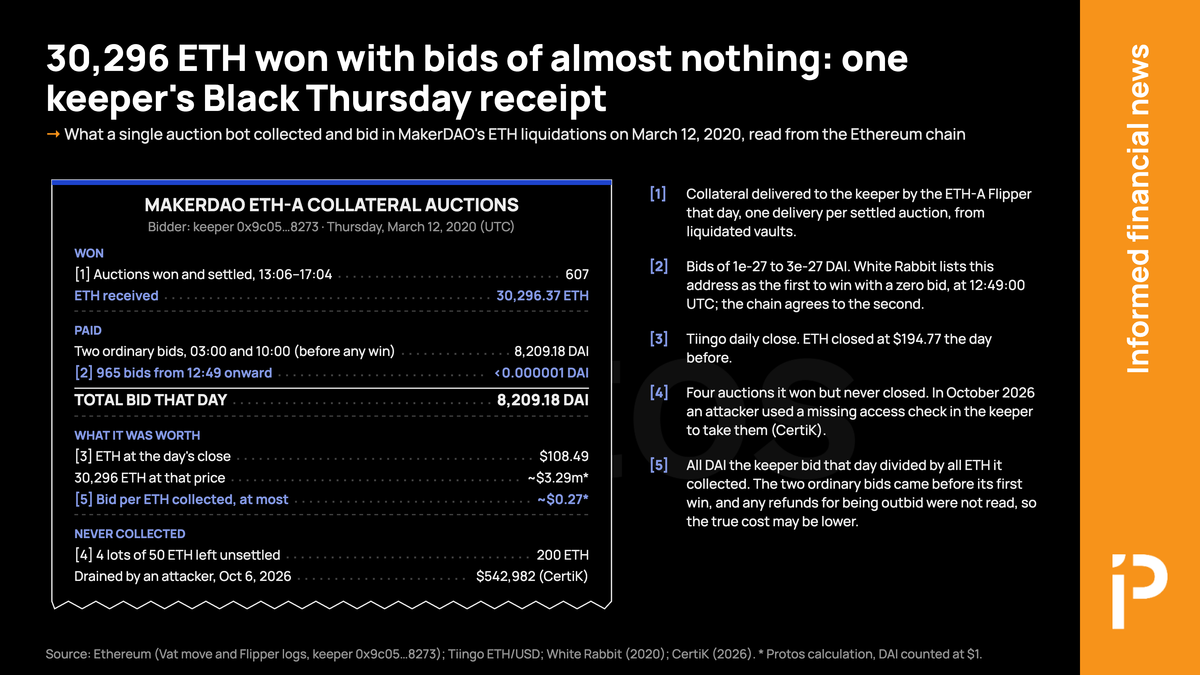
Based on the activity of 0x9c05a05893ada984fc20d0da0c046de5cc0e8273.
This brings us to one of the most destructive days in MakerDAO history, “Black Thursday.”
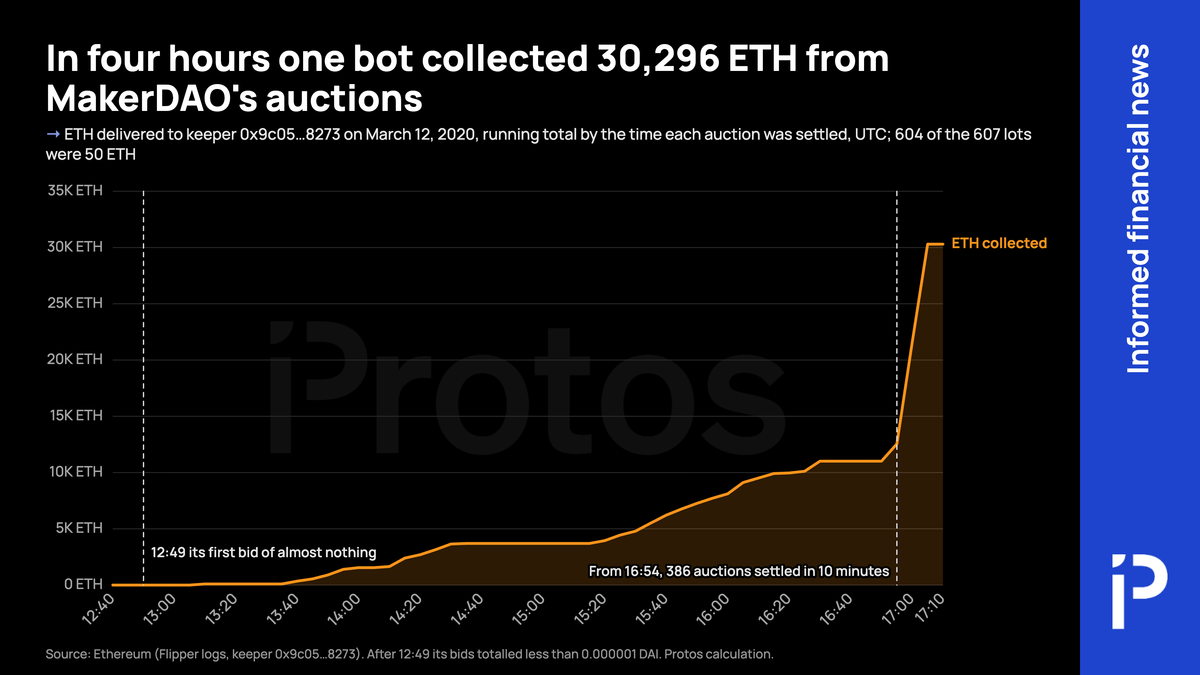
On Black Thursday, $ETH volatility and chain congestion created conditions that enabled some keepers to buy $ETH for prices far below the market.
Far below the market, paying fractions of a cent for the $ETH, over 60,000 $ETH was acquired in this fire sale.
Based on the activity of 0x9c05a05893ada984fc20d0da0c046de5cc0e8273.
This event represented a meaningful challenge to the Dai stablecoin.
It required Maker to sell new MKR tokens to deal with the protocol shortfall.
Incredibly, Black Thursday has remained relevant, with one of these keepers who benefitted from it, 0x68399ed8aa33C5b43F863EE6782de492006A5546, recently was exploited.
This attacker was able to steal 200 $ETH from the old contract.
PSM brought more stability
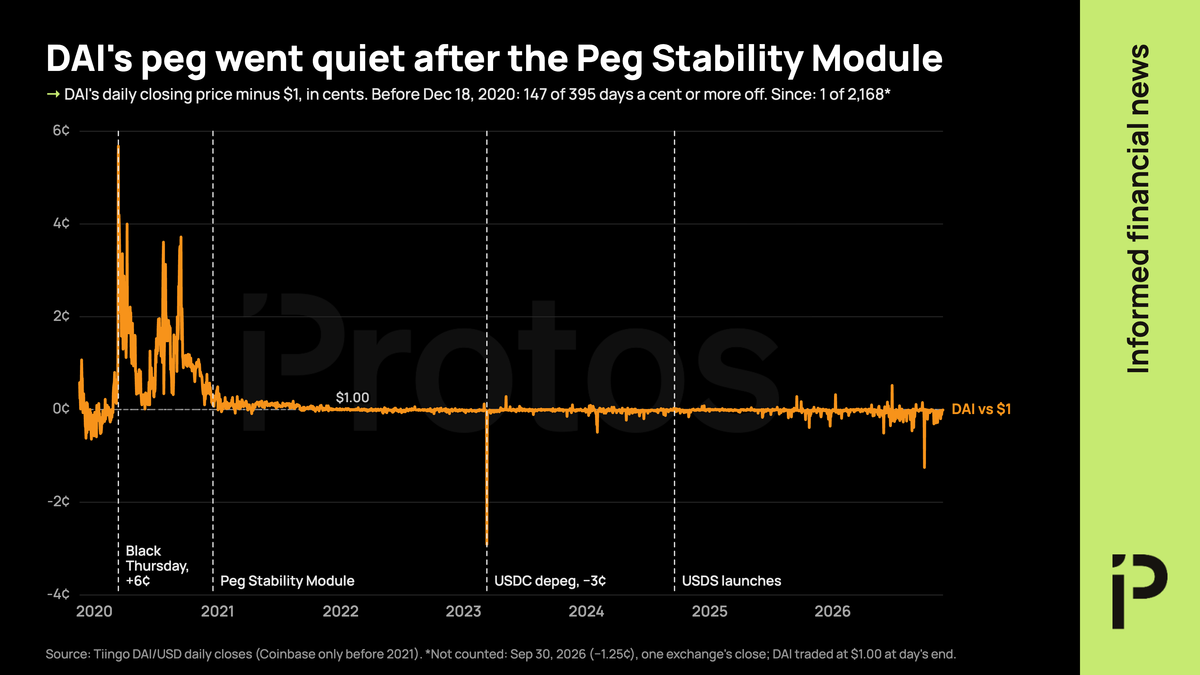
The early days of Dai involved a stablecoin that, while stable by cryptocurrency standards, still often deviated several cents off the dollar.
That persisted until the introduction of the PSM, a special kind of vault that enabled Dai to be exchanged ~1:1 with another stablecoin, initially $USDC.
The legacy PSM is also being discontinued under this same governance discussion.
However, there has still been one notable depeg since the introduction of the PSM.
This was the depeg in 2023, driven by $USDC, the stablecoin issued by Circle, breaking its own peg.
Circle at the time was holding a substantial portion of its reserves at Silicon Valley Bank, and when Silicon Valley Bank closed, $USDC experienced a substantial depeg, more than 10 cents.
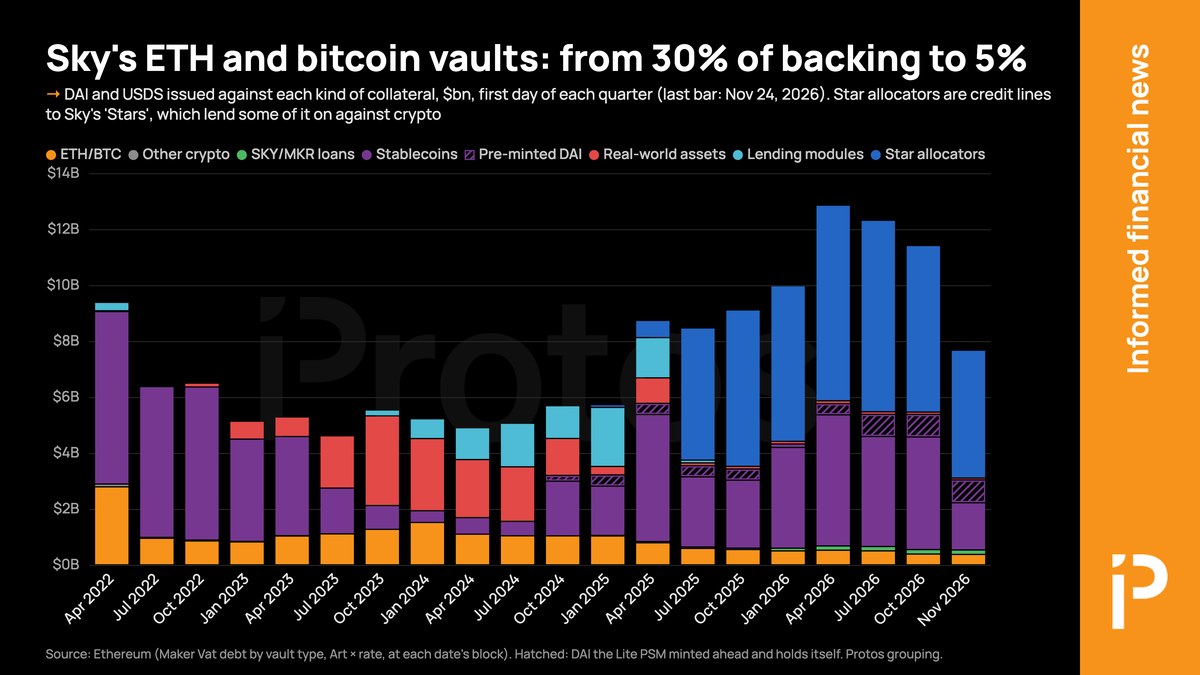
At the time $USDC was over half the collateral for DAI, and so the centralized stablecoin threatened the “decentralized” stablecoin.
Maker Foundation’s Endgame
In 2021, MakerDAO founder Rune Christensen announced, “MakerDAO is now completely decentralized” and noted that “The Foundation will formally dissolve within the next few months.”
The next year, Christensen announced “The Endgame Plan,” where he proposed substantial changes to MakerDAO, including MetaDAOs, deeper integration of real-world assets, and a new governance token.
This was eventually revised and then approved and then made into a constitution and revised and tweaked and extended.
Then in 2024 MakerDAO rebranded to Sky, and the stablecoin for the Sky ecosystem became USDS.
This was also part of the mercurial Endgame.
Justin Sun and the current crisis
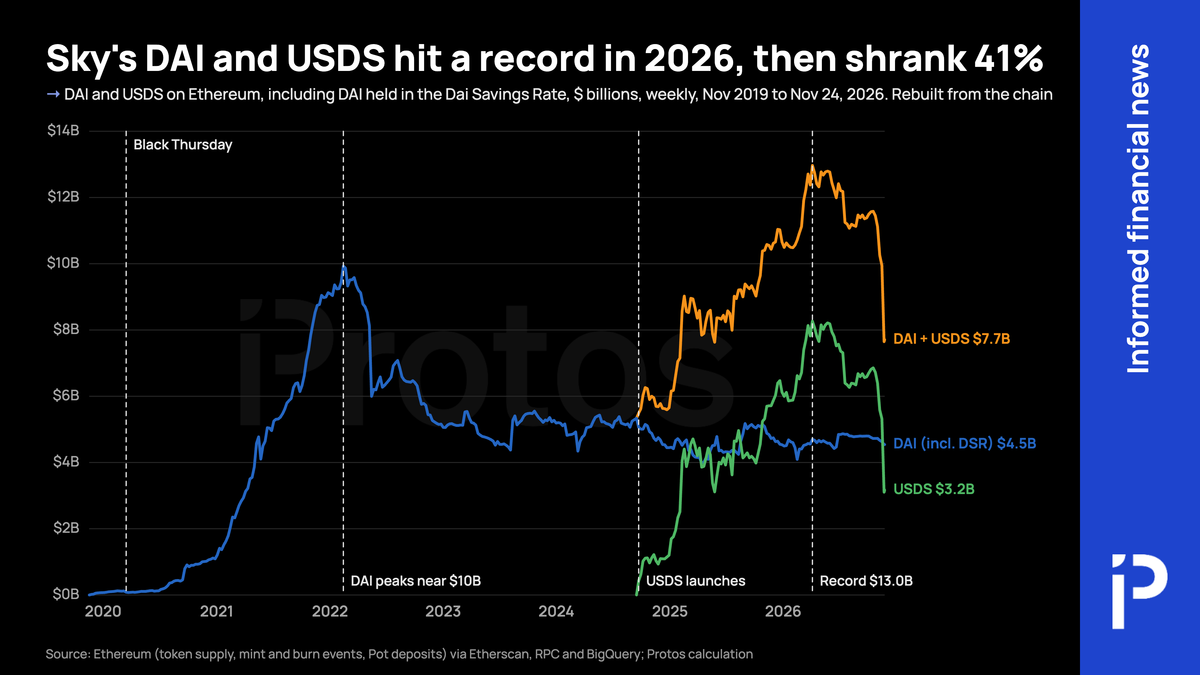
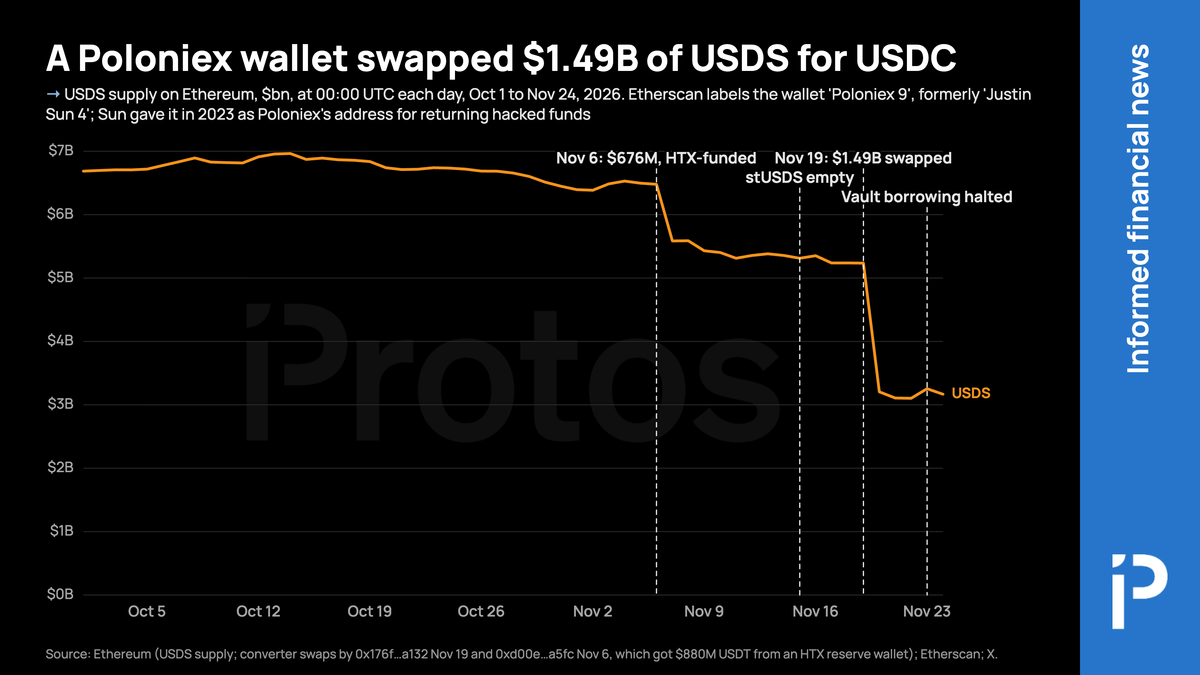
The supply of USDS has been declining rapidly over the last month, driven in large part by a Poloniex-labeled address, 0x176F3DAb24a159341c0509bB36B833E7fdd0a132, which was previously labeled “Justin Sun 4.”
Poloniex is Justin Sun-owned.
Sun is the founder of the Tron-based JustLend platform, which inherited a substantial portion of its design from MakerDAO, as well as the founder of the USDD stablecoin, which in its current iteration also owes much of its design inspiration to MakerDAO.
Its exit on November 19 substantially reduced the amount outstanding.
Interestingly, almost two weeks before that Poloniex exit, an address that has received hundreds of millions worth of USDT from Sun-owned HTX, 0xd00e0079b8cab524f3fa20ea879a7736e512a5fc, performed a very similar exit.
Both Poloniex and this other address swapped their USDS for $USDC and then placed the $USDC into Aave.
These issues are exacerbated by the recent problems with the stUSDS market, from which Christensen is the most substantial borrower.
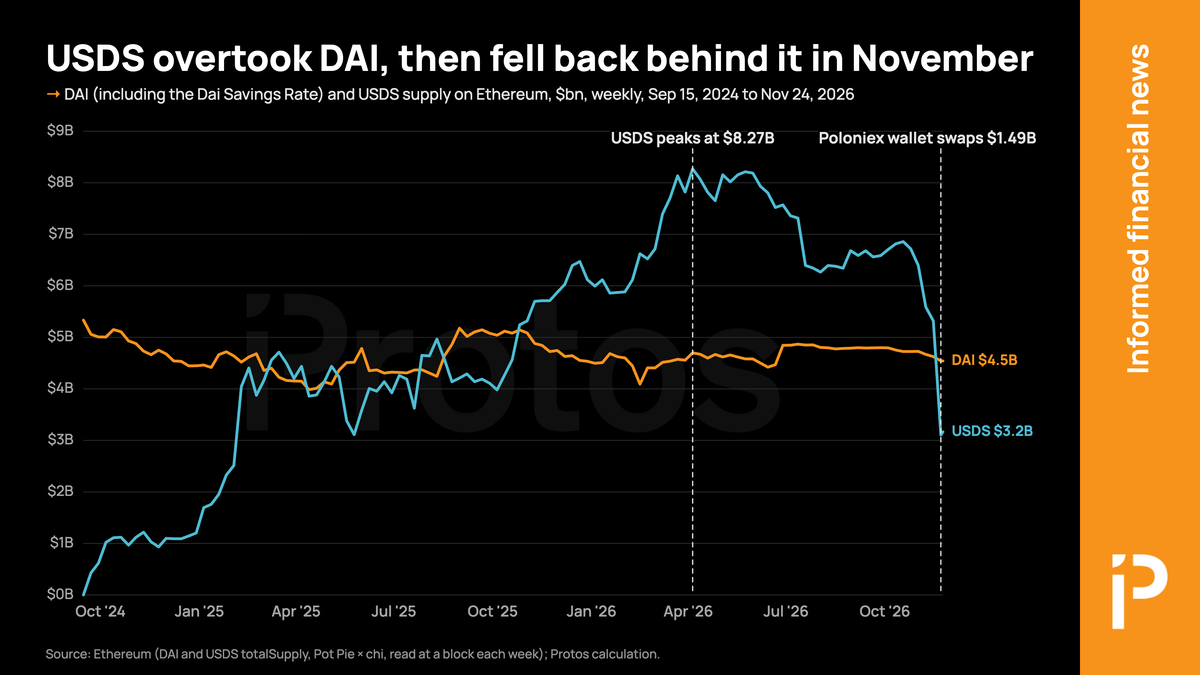
These problems do in some sense accentuate how slow the transition away from Dai has been, with USDS’ supply once again falling below that of Dai’s.
While Dai’s supply may never again meaningfully increase, it’s not clear that USDS has truly replaced it.

 protos.com