Coinbase says bitcoin pledged for its crypto-backed loans is converted into cbBTC, its tokenized version of bitcoin, and transferred to Morpho on Base to borrow $USDC. The Defiant covered the product's January 2025 launch. Coinbase's current documentation says variable rates depend on supply and demand and may include a platform fee on top of the market rate; it also offers fixed-rate loans whose rates are locked for a set term. Sealaunch's identification connects the particular pool examined here to Onchain Loans.
Capital Shifts Between Markets
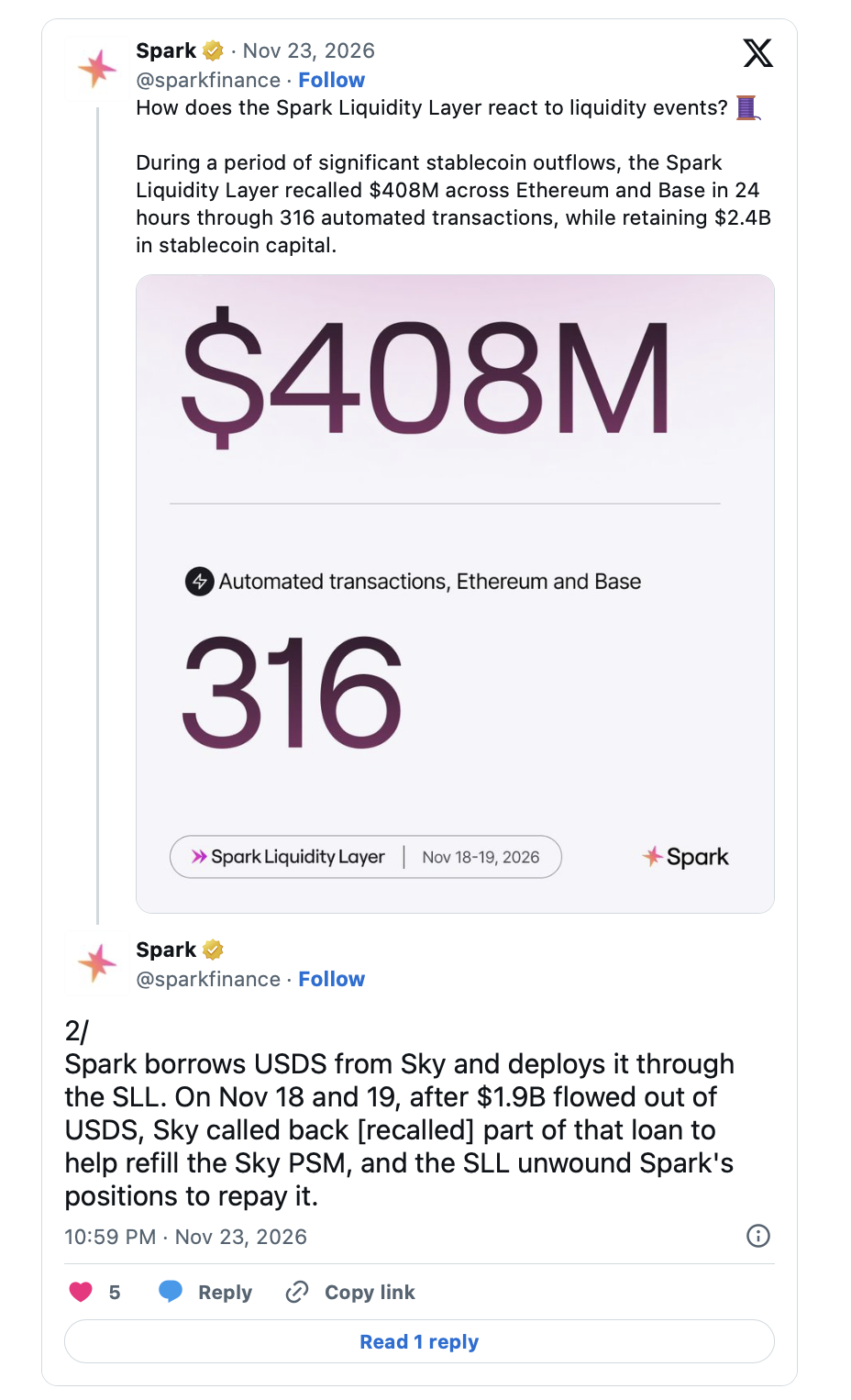
Spark said that on Nov. 18 and 19, Sky recalled part of its loan to Spark after $1.9 billion flowed out of USDS, and Spark unwound investments to repay it.
View post on X
In a separate statement, Spark said its Liquidity Layer recalled $408 million across Ethereum and Base in 24 hours while retaining $2.4 billion in stablecoin capital. That shorter, cross-chain recall measure is distinct from the six-and-a-half-day change in its position in the single Morpho market.
Morpho's balances show how tight that market became. At the start of the measured window, it had about 1.765 billion $USDC supplied against 1.528 billion $USDC borrowed, leaving about 237 million $USDC unborrowed. At 1 p.m. ET on Nov. 19, supply was about 1.540 billion $USDC against 1.529 billion $USDC borrowed, leaving roughly 11 million $USDC unborrowed. By Nov. 24 at 5:40 p.m. ET, supply was about 1.678 billion $USDC and debt was 1.409 billion $USDC, leaving about 269 million $USDC available.
Sealaunch attributed part of the replenishment to vault managers shifting capital. It reported that Grove x Steakhouse $USDC removed another roughly $125 million from cbBTC/$USDC, while Steakhouse High Yield $USDC Edition moved about $300 million from the $USDe/$USDC market into cbBTC/$USDC. Those individual movements remain the analyst's estimates.
The same analysis put the $USDe market's remaining supply at $58 million against $51 million borrowed—just $7 million left to withdraw or lend. Its central point: “isolated markets don't isolate liquidity risk.” For Sealaunch, the movements illustrate how capital used to relieve one market's shortage can leave another with less room to meet demand.

 thedefiant.io