Morpho halves Aave's lending lead as outstanding loans hit $5B record
cryptopolitan.com
01 September 2026 21:17, UTC
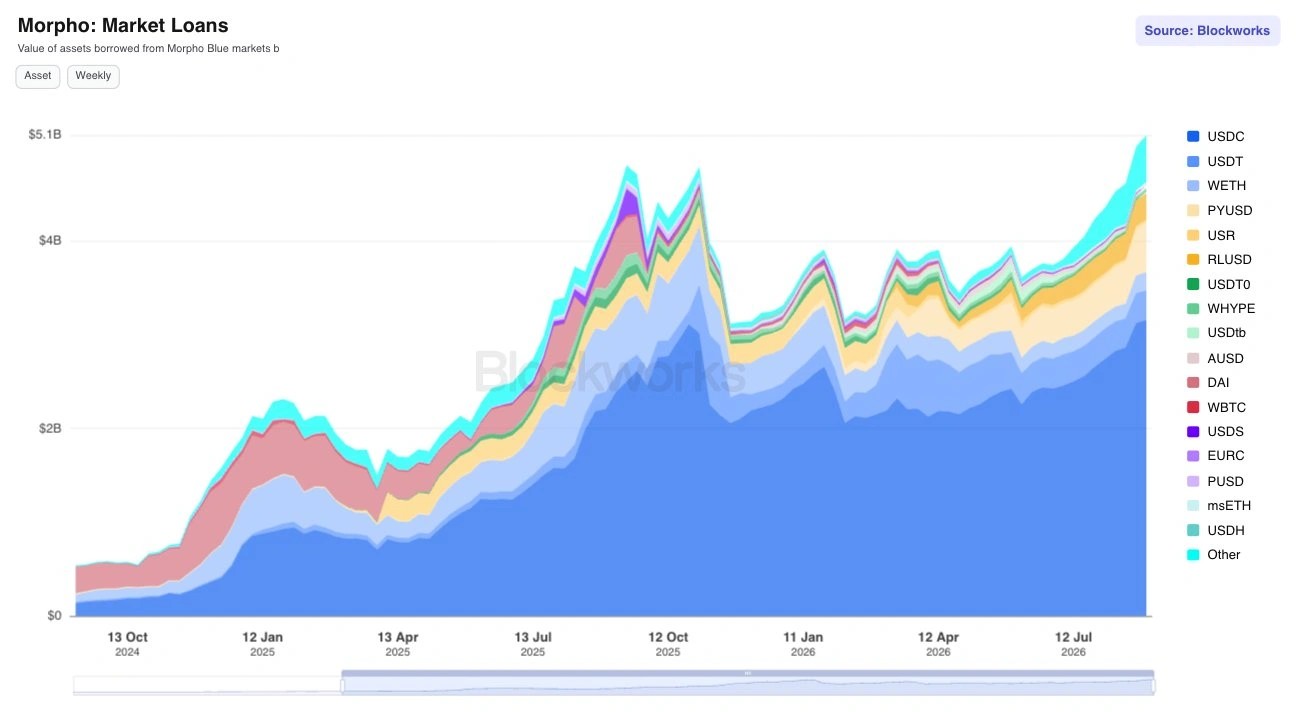
Morpho’s outstanding loans have reached an all-time high of $5 billion. Crypto analytics firm Messari reported the metric on Tuesday, September 1.
This brings the decentralized lending protocol closer to Aave, which is the longtime leader in that space, and it also raises its profile among the fintechs and stablecoin issuers routing credit through it.
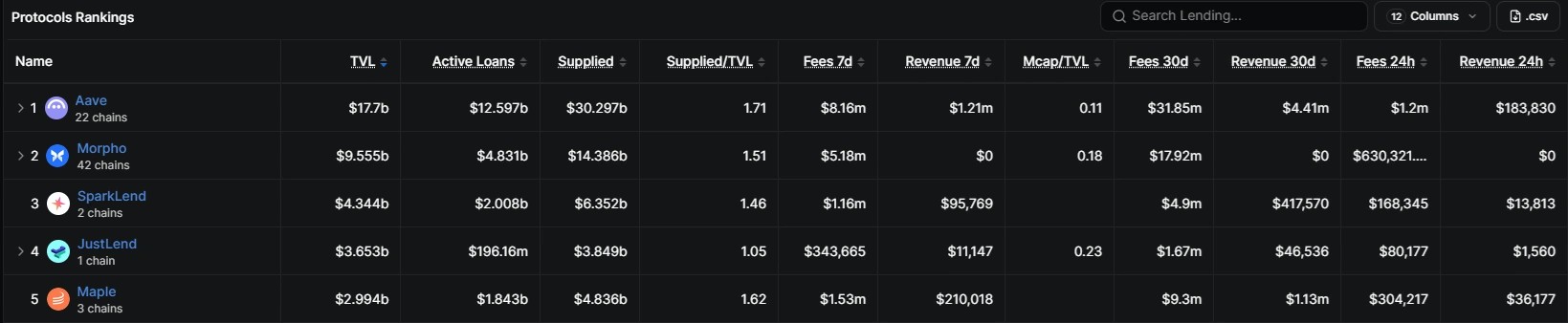
Lending protocol ranked by TVL. Source: Defillama
Know when your coins move
Alerts, real-time prices, and market news — all in one app
Point your phone camera to install
4.8 based on 40K reviews in the App Store and Google Play
Stablecoins carry almost all of the borrowing
The composition of that $5 billion is lopsided, as Messari reported that 95% of the borrowing is denominated in stablecoins, with $USDC accounting for 62% of it. It shows that most users are using it for dollar credit against crypto collateral and not leveraged speculation on volatile tokens
Morpho loan compositions. Source: Messari
On August 18, Messari flagged that Morpho Blue loans had reached their highest level since October 2025 and were approaching new highs, with Robinhood and Base together responsible for more than $650 million in fresh loans.
A week before that, Morpho’s markets generated over $4 million in interest in one week. It is the most since November 2025, and for one of the few times, its Base markets out-earned its Ethereum markets.
Base did the heavy lifting
Base has become Morpho’s engine. In an August 6 post, Morpho said its deposits on the Coinbase-built layer-2 had passed $5 billion, more than 70% of everything deposited on the network.
The protocol credits its “DeFi Mullet” model, the crypto-backed loan product Coinbase launched on Morpho rails in January 2025. According to Morpho, it has since driven around $1.3 billion in outstanding $USDC borrowing backed by about $2.5 billion of cbBTC collateral.
Aave still leads, but the cushion is thinner
While Morpho is recording an increase, it is still not enough to unseat Aave, which leads the industry.
DefiLlama data shows that Aave has over $12.7 billion in active loans against Morpho’s $4.83 billion and $17.7 billion in total value locked, to Morpho’s $9.55 billion.
Aave also suffered losses after the $292 million KelpDAO exploit in April, losing more than $10 billion in total value locked. Aave’s backers rallied, and stakeholders publicly bet on a recovery.
Morpho, which had only minor exposure to the same April hack, has been growing into the space that opened up.
Named in DeFi’s strangest blowups
That growth has a shadow side. Morpho’s scale keeps surfacing in incidents that are not failures of its core code but of the markets and curators built on top of it. DeFi researcher DeFi Warhol pointed on August 26 to a Paxos $PAXG oracle misconfiguration, where a decimal error overvalued collateral so badly that one borrower drew roughly $230,000 in $USDC against about $350 of $PAXG.
Marc Zeller, who used to be a prominent Aave contributor, needled the protocol on August 25, writing that user losses on Morpho were “an inch from a total of $150m” and jabbing, “They run our marketing dept.” Not everyone reads the losses as failure.
Euler cofounder Michael Bentley argued on August 27 that lenders can lose money and that the interest they earn is “compensation for taking” risk, pushing back on the idea that a protocol or curator must always be made whole.
A $175 million war chest
Morpho is not short on capital or credibility. The protocol reportedly raised $175 million in June, in a round led by a16z crypto, Paradigm, and Ribbit Capital, with Circle’s venture arm and VanEck also participating, valuing it at up to $2 billion.
Cofounder Paul Frambot, 25, started the project at 20 and initially built on top of Aave before pivoting to let anyone “build their own Aave” with custom risk parameters. Coinbase, Kraken, Anchorage Digital, and Galaxy Digital are among its users.

 cryptopolitan.com