A 2025 AMBCrypto news report expanded upon what it means. It said,
Think of it as a marketplace, like an app store, but for perps, and it’s more decentralized. Users can then choose what and where to trade, but under the hood, they’ll be using Hyperliquid.
“Community-first” promises vs. in-house realities
Hyperliquid, Aave, and Polygon initially sold a vision of community-first tokenomics.
Hyperliquid promised an “open, permissionless L1 order book,” while Aave brought about “true” peer-to-peer money legos. One of the first movers in the sector, Polygon once marketed MATIC as a “community-owned gas token” meant to keep Web3 accessible to all.
However, instead of sharing protocol fees with the public, these projects have now started to hoard yield.
Take Hyperliquid, for example. The protocol funnels 99% of its trading fees straight into an internal Assistance Fund. This has created a “self-sustaining buyback engine” that keeps capital encased.
Armand Didier, Head of Product at Aurora Labs, broke this down in a conversation with AMBCrypto.
With its HLP vault, Hyperliquid pools that capital in one place. LPs can then share in the returns through a single position, and the protocol can smooth those returns.
Aave, on the other hand, has started the fee switch and will funnel 100% of product revenue directly into the DAO treasury.
Generating $907 million in annualized revenue in 2025, the Aave Protocol functions less like a peer-to-peer utility and more like a “Wall Street cash-flow engine” today.
However, Didier told AMBCrypto,
Holders have always used Voting power in DAOs as they please, so I don’t think fee switches really change that.
He added,
Once a protocol is bringing in real revenue, it can choose to use that money to support the token through buybacks.
When Polygon officially migrated from MATIC to POL in 2025, it turned a fixed-cap gas asset into an inflationary security engine. This allowed retail token holders to absorb emissions while the core team built an enterprise fintech stack.
Walled gardens offer “user experience” at the cost of…
Smart contracts were initially written for precision. They would cut out the middleman and ensure that all parties adhered to preset rules.
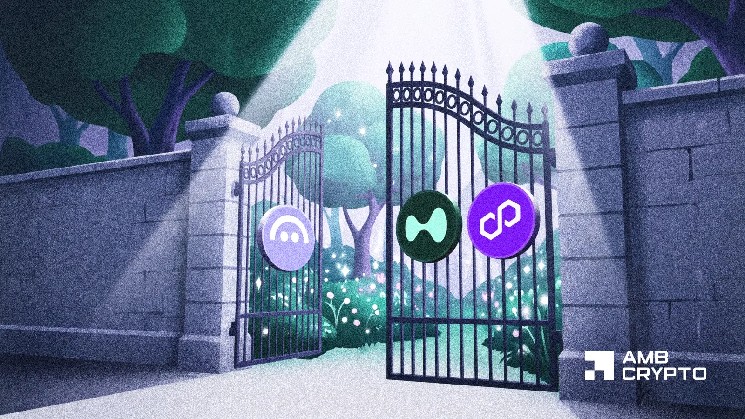
However, once adoption peaked and these contracts became more elaborate, the once open protocols shut themselves off to external access. They built their own “structural walled gardens” with rigid ecosystems.
According to Paul G, Business Development Manager at Metallicus,
A walled garden is a network environment that introduces built-in protections, consistent user experience, and flexible access controls.
He added,
It meets institutions where they are while still offering the openness, efficiency, and programmability of blockchain.
Through a walled garden, core teams capture priority fees and liquidations before capital ever touches an open market. Even though fee switches were originally advertised as power-to-the-people governance wins, they actually function as corporate revenue collectors.
Retail gets price support through buybacks, but the core team retains ultimate authority over treasury reserves.
Maksym Sakharov, CEO & Co-Founder of WeFi, acknowledged this in an email to AMBCrypto,
In many DAOs, the core team, early investors, delegates, and large holders still shape the outcome long before an ordinary token holder votes. The vote exists, but the real power may sit in proposal design, treasury control, delegation networks, and informal coordination.
Are protocols harming open DEXs?
This dynamic has a significant impact on the broader ecosystem. With liquidity trapped inside native vaults, the open DEX ecosystem gets starved of organic volume. Protocols reward users who keep assets inside their own vaults.
Moving assets across ecosystems is tricky for users because it often involves greater costs and delays. That is the reason why users prefer staying inside the “home” ecosystem.
Without free-flowing liquidity, cross-chain DEXs such as PancakeSwap can’t consistently maintain their orderbooks.
According to Didier though,
Hyperliquid is a good example of why this kind of model doesn’t necessarily hurt the participants around it, because LPs can still share in the value this activity creates.
He emphasized,
There’s still a real role for wallets and other partners that bring that infrastructure to users.
What does the future of LPs hold?
However, it’s not all bad news. These shifts may be necessary in reality. Centralizing liquidity creates bulletproof balance sheets that can withstand market declines, gets rid of speculative capital, and lessens end-user instability.
In that sense, their logic isn’t incorrect. The crypto ecosystem has evolved, and in doing so, it has built hyper-efficient models that keep the token where it is supposed to be.
For the average investor, one just stepping into the chaos that is crypto, these walled gardens provide a sense of security. They can hold a speculative claim while they figure out the markets while doing their own research (DYOR).
Sakharov summed up the debate best when he said,
Traditional LPing is not disappearing, but the economics are being challenged. External LPs will still matter where markets need deeper liquidity, broader risk distribution, and independent capital.
He concluded,
Some systems may move toward more vertically integrated models. Others will keep external liquidity because openness, depth, and neutrality are part of their value.
Final Summary
- Core teams now hoard yield, lock liquidity behind closed doors, and have nearly abandoned the “community-first” ideal they once sold.
- For the average investor, these closed-loop systems offer stability but at the cost of the DeFi that was promised.

 ambcrypto.com