Flare CEO Says Network Mints XRP Directly From Exchanges, Removing KYC Friction Other Wrapped Models Can’t Solve
thecryptobasic.com
05 May 2026 12:22, UTC
Flare CEO Hugo Philion has outlined how the network can mint $XRP directly from exchanges, removing the KYC and centralization barriers that have limited other wrapped-$XRP models.
In a recent interview with Paul Barron, Philion explained that this approach could unlock a more scalable and accessible DeFi ecosystem for $XRP holders.
Key Points
Flare enables $XRP minting directly from exchanges, removing KYC friction seen in other wrapped $XRP models.
FXRP lets users access DeFi without intermediaries, improving onboarding and expanding access for $XRP holders.
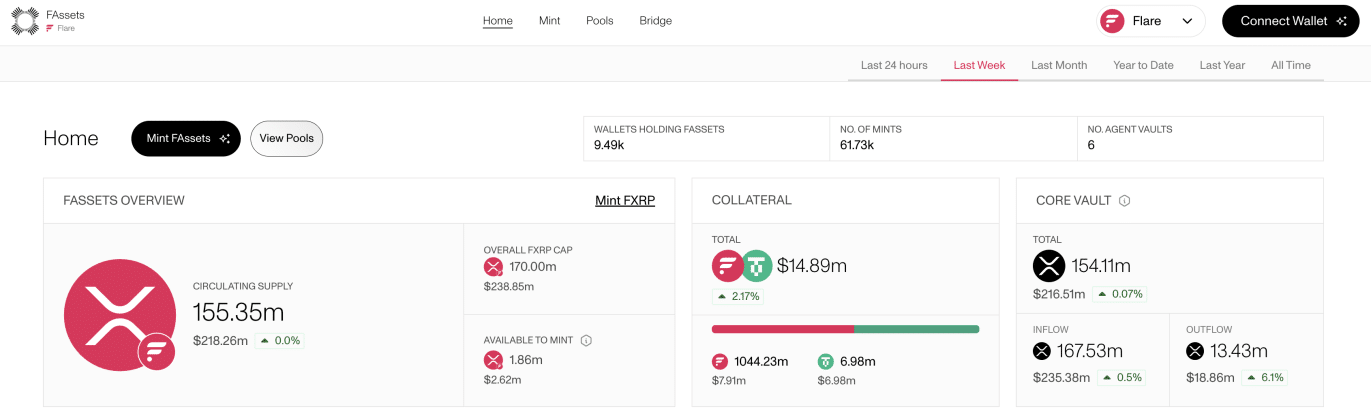
Flare now hosts ~155M $XRP and a $450M DeFi market, adding lending, insurance, and yield tools.
With Flare 2.0, the network aims to boost privacy, scale, and institutional adoption through secure computing.
Know when your coins move
Alerts, real-time prices, and market news — all in one app
4.8 based on 40K reviews in the App Store and Google Play
Direct Minting from Exchanges Changes the Game
At the core of Flare’s approach is FXRP. It launched in September 2025 to allow users to bring $XRP into DeFi without relying on centralized intermediaries.
Unlike other wrapped $XRP solutions, which require identity verification at the minting stage, Flare enables users to mint directly from exchanges without KYC.
According to Philion, this is possible because competing systems rely on centralized entities that must verify users before issuing wrapped tokens. Flare removes that layer entirely, allowing $XRP holders to move funds into DeFi more seamlessly.
The result is a smoother onboarding process that reduces friction and broadens access for users who prioritize privacy or face restrictions from centralized platforms.
Building a DeFi Ecosystem Around $XRP
Flare’s mission is to turn $XRP into a productive asset within decentralized finance. The network brings smart contract functionality to assets like $XRP that do not natively support it.
Since launching FXRP, Flare has grown into the largest $XRP DeFi ecosystem. The network now hosts around 155 million $XRP and supports a DeFi market worth roughly $450 million.
FXRP
Partnerships have played a key role in that expansion. Flare has backed projects like Firelight, an emerging DeFi insurance protocol that uses $XRP as collateral. It has also integrated institutional-focused platforms such as Morpho.
These additions aim to create a more mature financial environment in which lending, insurance, and yield generation can operate at scale.
Yield Demand Driving $XRP Adoption
Philion pointed to a shift in user behavior following the resolution of the Ripple legal case. With regulatory uncertainty easing, $XRP holders are increasingly looking for ways to earn yield while keeping their assets secure.
Flare is positioning itself as the solution to that demand. It offers infrastructure that supports lending, collateralization, and other DeFi strategies built around $XRP.
However, the company is taking a measured approach to growth. Philion emphasized that scaling too quickly could create systemic risks, referencing past issues in DeFi where rapid expansion led to capital shortfalls and bailouts.
Instead, Flare is focusing on gradual, security-first development, bringing in stablecoins, institutional liquidity, and robust risk management tools before accelerating adoption.
Flare 2.0
Looking ahead, Flare is preparing to launch Flare 2.0, a major upgrade centered on confidential computing.
This new layer will improve scalability while introducing privacy features that keep sensitive data secure during computations. The upgrade could also make the network more attractive to institutional players, who require both efficiency and confidentiality.
Philion suggested that this evolution could open the door to a broader range of financial products.
Ultimately, Flare is attempting to reshape how $XRP works in decentralized finance by enabling direct minting from exchanges and removing traditional onboarding barriers.

 thecryptobasic.com