Euler’s Institutional Pivot
In his post yesterday, Bentley acknowledged limits to Euler’s earlier approach, writing that the “fully permissionless vision” he and co-founder Doug Hoyte pursued in 2020 didn’t find “strong product market fit.” He added, “That does not diminish the work or the ambition behind it, but it does point clearly to the need for a change in direction and a fresh vision.”
Now, as Bentley explained, Euler Finance is “exceptionally well suited to building bespoke credit markets for novel use cases,” elaborating that Euler’s next phase will involve pivoting toward meeting the demands of institutional players:
“Leveraging the protocol to support tailored markets that meet the needs of fintech and institutional participants is a natural next chapter, and one for which many aspects of Euler’s design are uniquely well suited.”
Jonathan Han, who previously served as senior vice president of business development and partnerships at crypto market intelligence firm The Tie, will take over as Euler’s CEO. In a separate X post, Han said he wants to focus on building the “best vault infrastructure for our existing community and for the next wave of institutional, fintech, and retail users coming on-chain.” He added “DeFi is no longer an experimental frontier; it is rapidly emerging as core financial infrastructure.”
After the leadership change was announced, EUL, Euler Finance’s native token, fell more than 7% to $2.64, and is down 2% on the day at press time.
The Big Comeback
Euler’s growth since the hack is broadly considered one of DeFi’s greatest comeback stories. After the March 2023 exploit, the protocol’s total value locked (TVL) plunged to the low-millions from its previous high of around $333 million. It took Euler Finance a few years to recover, but by October of last year, Euler Finance’s TVL topped $2 billion, marking a massive resurgence above its previous highs.
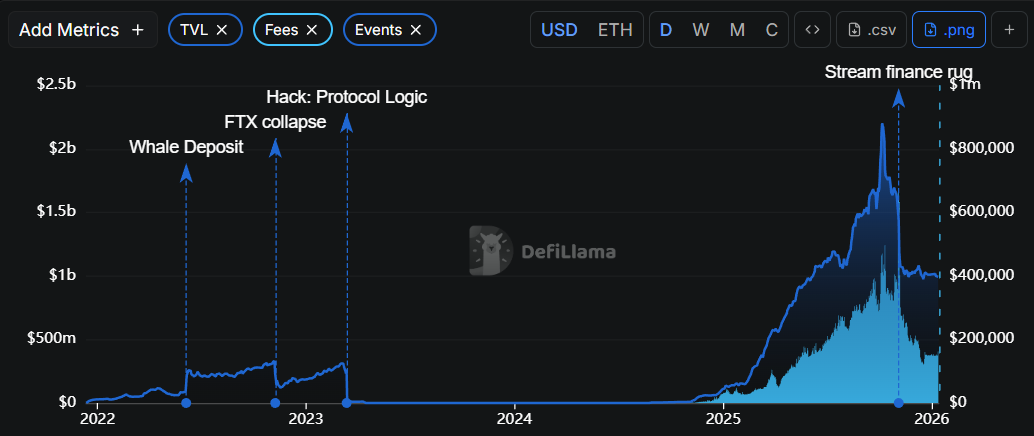
Euler Finance TVL, 2022-present. Source: DefiLlama
However, market contagion after Stream Finance’s collapse in early November 2025 contributed to volatility across lending markets, and Euler’s TVL has fallen to around $1 billion by press time.

 thedefiant.io